






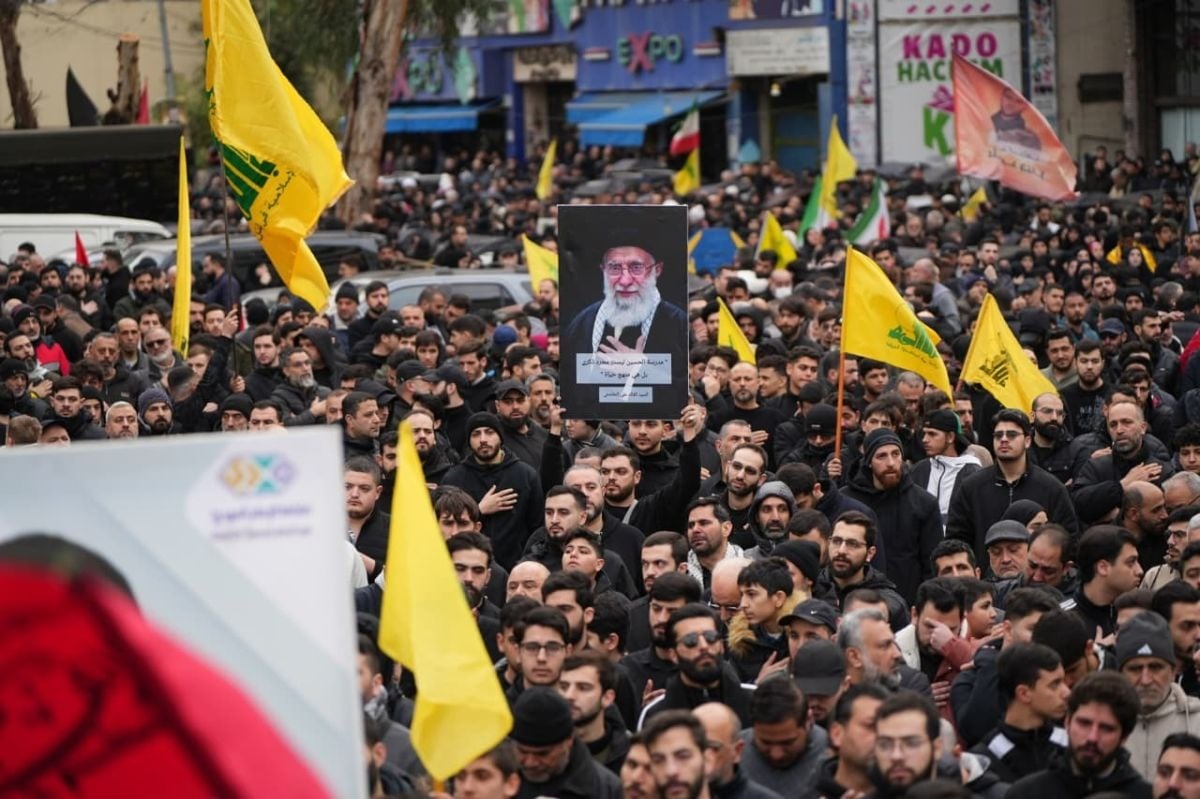
A crowd waves Hezbollah flags and portraits of Ayatollah Ali Khamenei during a rally in his honor after his assassination, in the southern suburbs of Beirut, on March 1, 2026. (Credit: Mohammad Yassine/L’Orient-Le Jour)






The U.S. Treasury Department’s Office of Foreign Assets Control (OFAC), responsible for sanctions, announced Thursday the redesignation of Hezbollah for its ties to the Quds Force, the Iranian Revolutionary Guard Corps’ foreign operations unit.
OFAC also sanctioned 10 individuals who, according to Washington, belong to a network of couriers responsible for transferring cash to Hezbollah and who facilitated the movement of up to several hundred million dollars between various countries.
“Hezbollah is being redesignated … on the grounds that it is owned, controlled, or directed by, or has acted or purported to act on behalf of, or for the benefit of, the Quds Force of the Iranian Revolutionary Guard Corps [IRGC-QF],” the U.S. Treasury Department wrote in a statement, amid the ongoing conflict with Iran and the war between Hezbollah and Israel.
Hezbollah was first designated a “Specially Designated Global Terrorist” (SDGT) in 2001 and has also been on the U.S. list of “Foreign Terrorist Organizations” (FTOs) since 1997. Through its latest decision, Washington is more explicitly citing Hezbollah’s ties to the Iranian regime, and in particular to the Quds Force of the Islamic Revolutionary Guard Corps, as grounds for this designation.
However, this is not a designation under a new legal authority: Hezbollah is being redesignated under the same presidential Executive Order 13224, as amended, that established its SDGT designation. This time, the Treasury Department explicitly cites its role “serving the Iranian regime under the command” of the Quds Force. The Treasury Department justifies this decision, in particular, by citing "the Quds Force's coordination of Hezbollah attacks" and its "deep involvement in directing the movement's political decisions." It asserts, on this basis, that Hezbollah is "owned, controlled, or directed" by the Quds Force, or that it has acted or purported to act on its behalf or in its name.
Network linked to a deceased member of the Quds Force
The measure, therefore, does not legally transform Hezbollah into an "Iranian organization" rather than a Lebanese one, but adds to its American designation a basis explicitly linked to its relationship with the Quds Force, Reuters explains.
Washington simultaneously sanctioned 10 people Thursday accused of participating in this network. “Hezbollah and its allies exploit financing mechanisms that include oil smuggling, illicit shipping, the sale of goods, and the smuggling of large amounts of cash to generate and move funds throughout the region,” the Treasury Department stated.
“The network targeted today, which was once associated with the late Behnam Shahriyari, the financial head of the Quds Force, exemplifies the methods used to channel support to proxy terrorist groups throughout the region,” it added.
The sanctions target Turkish businessman Yunus Alper Yilmaz, whom the Treasury Department identifies as the head of the courier network responsible for transporting cash between various countries in the region and Hezbollah’s base in Lebanon; Halil Ibrahim Kacmaz; and Onder Dede, couriers who, according to Washington, collect the cash from exchange bureaus. Vasfi Akyuz, who allegedly coordinated their logistics while also acting as a courier himself, as well as Mehmet Akyuz, Mehmet Acur, Feyyad Karasalih, Masoud Mousafar, Gulay Kaya Savci and Emrah Ayaz, are accused of smuggling cash destined for Hezbollah on commercial flights to Lebanon.
These couriers travel on commercial flights between Lebanon, Turkey, the United Arab Emirates and Iran to transport cash, according to OFAC.
Specifically, the sanctions freeze all assets and interests of the targeted individuals that are located in the United States or are owned or controlled by U.S. persons. Unless authorized or exempted, transactions involving these assets are prohibited for U.S. persons or when they occur in or transit through the United States. Certain transactions with the designated individuals may also expose foreign financial institutions to secondary sanctions, according to the statement.

 7 p.m. recap: Iran warns Egypt, Israeli soldiers vote in south Lebanon, Haret Hreik responds to Kataeb