






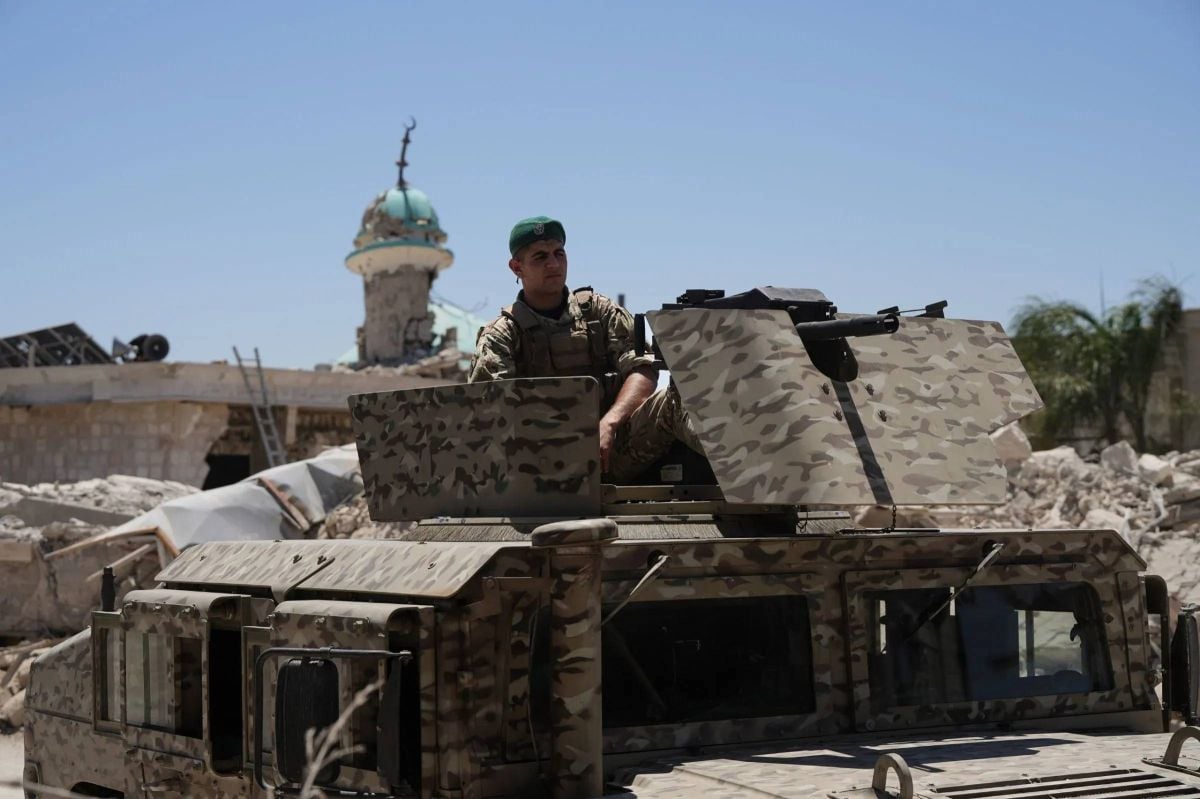
A Lebanese soldier on board an armored vehicle in Zawtar Gharbieh, south Lebanon, on July 28, 2026. (Credit: Mohammad Yassine/L'Orient-Le Jour)






BEIRUT — On the eve of the resumption of Lebanon-Israel negotiations, scheduled for Aug. 4-6 in Rome under U.S. mediation, Washington is urging both sides to prioritize a durable agreement over a rushed deal.
U.S. ambassador to Lebanon, Michel Issa, said Monday that "taking the necessary time to do things right from the outset" is essential, as the discussions are expected to focus in particular on the future of the "pilot zones" in the South.
"There is a significant difference between drafting an agreement on paper and implementing it responsibly," Issa said in a statement. He warned that "moving too quickly risks endangering the very civilians this process is meant to protect." He added that "important technical work remains to be done to ensure the safety of civilians on the ground" and that the time devoted to finalizing the agreement would allow the "next pilot zones to be implemented more effectively." In these zones, the Lebanese Army has been deployed to disarm Hezbollah, without intervention by the Israeli army.
Issa also stressed that "both parties must agree on a clear and actionable process before proceeding." However, he said that he was "encouraged" by the continuation of talks in Rome, and hopes "both governments will achieve a positive outcome."
The Lebanese delegation, led by Ambassador Simon Karam, arrived in Rome with several items on the agenda, including land border demarcation and the expansion of the “pilot zones.” For the first time, the delegation includes military officials as well as legal experts.
'The bet on the framework agreement has failed'
The seventh round of talks aims to continue implementing the framework agreement reached in June, as tensions remain high on the ground. Since the cease-fire took effect in June, Israeli forces have continued carrying out demolitions and strikes in southern Lebanon.
Criticized by the Shiite political alliance of Amal and Hezbollah, the framework agreement calls for the “gradual” withdrawal of Israeli forces from southern Lebanon in exchange for Hezbollah’s disarmament. The plan includes the creation of “pilot zones,” with the first phase launched around 10 days ago involving three villages. However, two of those villages were not initially occupied by Israel, while Israeli forces remain positioned on the outskirts of the third.
Israel, meanwhile, continues to insist that it will not withdraw from southern Lebanon until Hezbollah is disarmed.
MP Ali Hassan Khalil, a close ally of Parliament Speaker Nabih Berri and head of Amal movement, said that “Israel’s open aggression shows that the bet on the framework agreement has failed.”
He called for “reviewing the approach that allows the Israeli enemy to justify, conceal and legitimize its aggressions in the name of this agreement.”
Rejecting "a process that weakens the Lebanese position and does not take national interests into account," he said that the negotiations "must not lead to abandoning Lebanon's rights, but rather to protecting them." According to him, "the state must rise to the challenge, the sacrifices, and the expectations of the population." Khalil also accused Israel of maintaining its occupation of several localities and continuing military operations despite the agreement, saying that “this process cannot continue as if nothing had happened.”
A similar position was expressed by Hezbollah MP Hussein Hajj Hassan, who rejected any prospect of the party disarming. “Neither you nor the armies with which you threaten us are able to disarm the resistance. And we will not hand over our weapons to you,” he said.
He argued that any army entering Lebanon with the mission of disarming Hezbollah “would be an occupying army,” and questioned Washington’s ability to pressure Israel. He said that “destruction has not stopped since the framework agreement,” citing attacks on the Lebanese Army, kidnappings and assassinations of Lebanese citizens.
Hajj Hassan also said that "the main achievement of the authorities has been the withdrawal from Zawtar Gharbieh, which was not under occupation." According to him, "the framework agreement, which sets no timetable, makes the withdrawal of Israel from the occupied zones, the return of the displaced, and reconstruction dependent on two requirements: the disarmament of the resistance and Israeli verification of the results."
Meanwhile, the "Assembly of Inhabitants of the Southern Border Localities," founded by activist and engineer Tarek Mazraani, called on Lebanese authorities to "halt all talks with the Israeli enemy as long as it razes, demolishes and destroys border villages, day and night, despite the cease-fire."
In a statement, the movement denounced "the incomprehensible and reprehensible silence in the face of these destructions at the local, Arab and international levels," calling on Lebanese "to show solidarity against this campaign of destruction" and to demand "an end to the occupation."

 8 p.m. recap: Israel again threatens Beirut’s south suburbs; 2 ships hit near Hormuz; Riyadh football matches canceled