






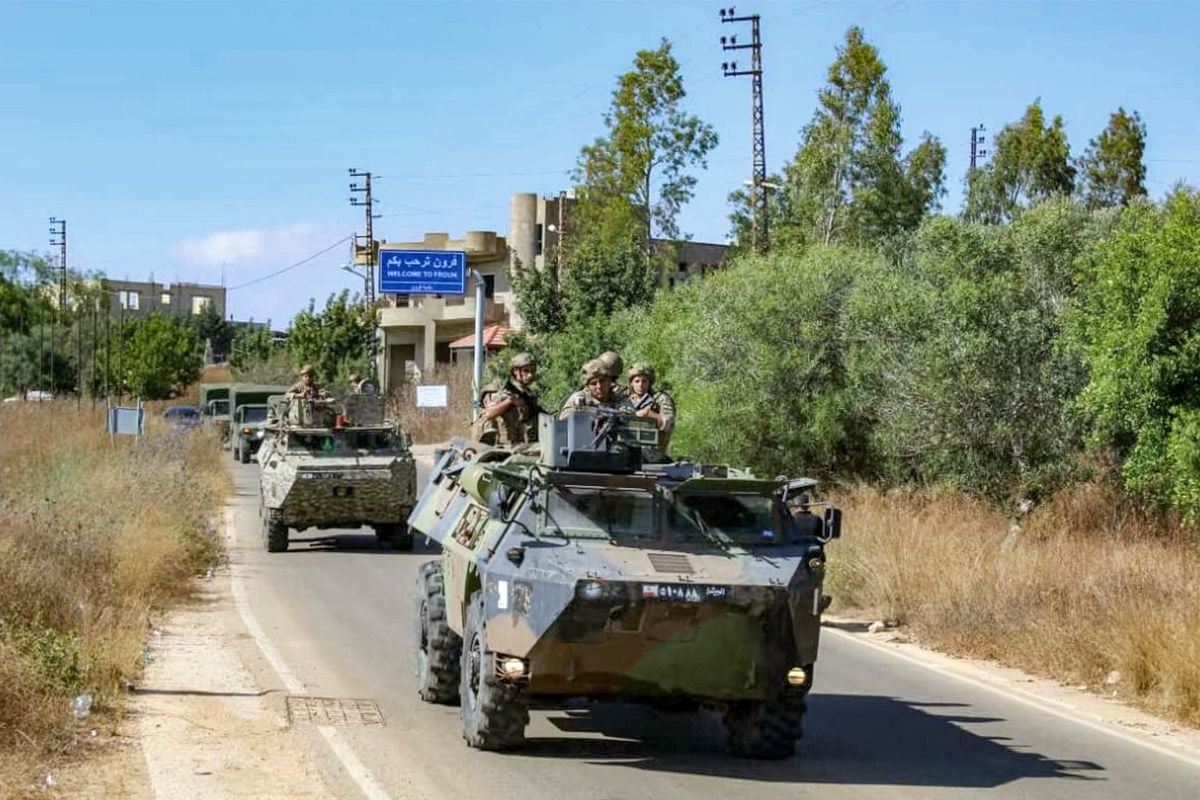
Lebanese Army vehicles patrolling in Froun, in the Bint Jbeil district of southern Lebanon, in July 2026. Photo by the Lebanese Army press service / AFP.






’’The Lebanese Army is not an institution like any other. It is the sole guarantor of Lebanon, its unity, sovereignty and independence.’’
President Joseph Aoun delivered that message Saturday on the occasion of Army Day, observed annually on Aug. 1, which this year comes as the war between Hezbollah and Israel continues.
‘’The Lebanese Army’s unique institutional role and this national constant should lead everyone to accept that weapons outside state authority are illegitimate, and that the country’s defense rests solely with its national army, which must be regarded as its only legitimate defense institution,’’ Aoun said. ‘’This is what we are working toward with consistency and determination.’’
Since taking office in January 2025, Aoun has consistently argued that the Lebanese state must hold a monopoly on arms, which would require the disarmament of armed groups, chiefly Hezbollah.
Prime Minister Nawaf Salam has echoed that position. His government adopted decisions in August 2025 aimed at disarming militias and deploying the Lebanese Army across southern Lebanon. The latest war with Israel, launched by Hezbollah on March 2 in support of Iran, has reinforced the government’s determination to establish the state’s monopoly on arms and pursue direct talks with Israel on an Israeli withdrawal from southern Lebanon and the deployment of the Lebanese Army. Hezbollah continues to reject both disarmament and direct negotiations with Israel.
Aoun also praised the Lebanese Army’s role in southern Lebanon.
’’Its responsibilities increase with every Israeli withdrawal from Lebanese territory,’’ he said.
’’The next phase will require the full deployment of military units along the entire southern border and the extension of the state’s sole authority across the country. This will demonstrate to the international community that Lebanon, through its army alone, is capable of protecting its sovereignty and securing this sensitive region, paving the way for residents to return safely.’’
Under the framework agreement signed by Lebanon and Israel in June, Israeli forces are expected to withdraw gradually from occupied areas of southern Lebanon through previously agreed pilot zones. The first such withdrawal took place in Zawtar al-Gharbieh, in the Nabatieh district. Uncertainty remains over subsequent withdrawals, however, following statements by Israeli officials insisting on maintaining operational freedom in southern Lebanon.
Aoun also reaffirmed his ‘’full confidence’’ in Lebanese Army Commander Gen. Rodolphe Haykal, saying he had demonstrated ‘’a sense of responsibility, professionalism and selflessness, even under the most delicate circumstances.’’ Haykal has faced criticism, particularly from pro-sovereignty figures who accuse him of not taking a firm enough stance toward Hezbollah.
Salam: ‘One army, one people, one nation’
In a post on X, Salam said restoring full sovereignty, strengthening stability and protecting the population depend on deploying the Lebanese Army across all Lebanese territory and extending state authority ‘from Naqoura to Arida.’
’’One army, one people, one nation,’’ he wrote.
Salam added that the government would continue supporting the military by increasing troop numbers, improving equipment and enhancing conditions for military personnel.
Several political and religious figures also marked Army Day by emphasizing the ongoing conflict and the devastation in southern Lebanon.
The Progressive Socialist Party said the army is waging a difficult battle to restore sovereignty as Israeli attacks continue and stressed the need to strengthen its capabilities. It also warned against ‘’defamation campaigns targeting the army,’’ saying they serve ‘’projects aimed at partitioning the country.’’
Druze Sheikh Akl Sami Abi el-Mona spoke by phone with Lebanese Army Commander Haykal and condemned ‘’the attacks targeting the army, as well as the expansionist mentality and the machinery of destruction and crime that can only be confronted through national unity,’’ referring to the Israeli military campaign.
Shiite cleric Ali Fadlallah congratulated the army on its anniversary, calling it ‘’the country’s main pillar, one of the symbols of its unity and a source of its strength and resilience.’’
Jean Arnault, the acting U.N. special coordinator for Lebanon, said the army has earned the trust of Lebanese from all backgrounds. He said Lebanon relies heavily on the army to fulfill its national and international obligations, particularly by strengthening security and stability throughout the country, preserving territorial integrity and implementing U.N. Security Council Resolution 1701.
Former Prime Minister Saad Hariri wrote on X that ‘’the army remains the only institution that protects the country’s borders, guarantees stability and confronts all forms of discord.’’
Kataeb leader MP Samy Gemayel said the Lebanese Army ‘’is the cornerstone of the state, the guarantor of sovereignty and the defender of the Constitution and the law.’’
Technology and Artificial Intelligence Minister Kamal Chehadé and Energy Minister Joe Saddi both said on X that only the Lebanese Army and law enforcement agencies have the legitimate right to bear arms.
Former Minister Michel Pharaon called on all Lebanese groups to unite behind the Lebanese Army ‘’so it can fulfill its sacred mission of protecting the country.’’
American message
On the occasion of Army Day, the U.S. Embassy in Beirut posted a message on its X account, praising “the army’s commitment to Lebanon’s sovereignty and security.” It continued: “As U.S. Secretary of State Marco Rubio stated, our hope is that the Lebanese Armed Forces and the legitimate and sovereign Lebanese government will continue to be able to control and secure an increasing portion of their own territory.”
In this regard, the French Embassy posted a message on X: “On the occasion of the 81st anniversary of the Lebanese Army, building a strong and sovereign army that holds a monopoly on arms throughout Lebanon is more necessary than ever. France will continue to stand by its side and work to strengthen it.”
Haykal in Sour
Later on Saturday, the commander of the Lebanese Army, Rodolph Haykal, rejected the continued Israeli occupation of any part of Lebanese territory. "We believe that every inch of our land rightfully belongs to us, and we reject the continued Israeli occupation of any part of our territory," he said in an address to officers during an inspection of units in southern Lebanon.
"The sacrifices of our martyrs and wounded will not be in vain. We will continue to stand by our people and support their return, no matter how great the challenges," he added.
Haykal inspected the South Litani Sector Command at the Benoit Barakat Barracks in Sour, the 5th Infantry Brigade in Al-Shawakir (Sour), and the 5th Intervention Regiment in Kfar Dounin (Bint Jbeil), where he was briefed on the operational situation and the missions being carried out within the sector of responsibility.
While meeting with officers, he highlighted the "importance of steadfast determination among military personnel," noting that "Lebanon draws its strength from the army, and that the success of the military institution depends on the combined efforts of all its units and personnel."
"We believe in one united and indivisible homeland, defended by one army that protects its borders and safeguards its stability," he said.

 8 p.m. recap: Israel again threatens Beirut’s south suburbs; 2 ships hit near Hormuz; Riyadh football matches canceled