







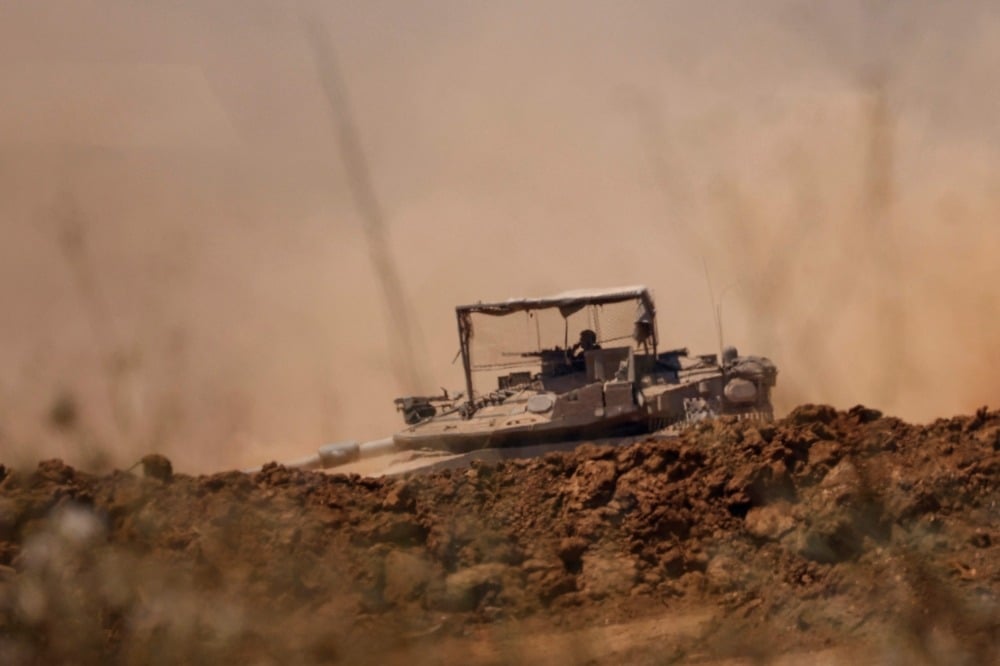
This photo, taken in Upper Galilee, in northern Israel, shows an Israeli tank taking position along the border with southern Lebanon on July 22, 2026. (Credit: Jalaa Marey/AFP)






SOUTH LEBANON — The Israeli army has taken control of the medieval citadel of Doubeih, in the village of Shaqra (Nabatieh), and recently planted its flag there, our correspondent reported Thursday.
This latest came the day after Prime Minister Nawaf Salam visited Zawtar Gharbieh (Nabatieh), one of the "pilot zones" where the Lebanese Army is deployed, to raise a Lebanese flag. Army commander-in-chief General Rodolph Haykal is also making a tour of the same area Thursday.

According to our correspondent, the Shaqra municipality "condemned this aggression against Lebanese sovereignty and the infringement on a historical and archaeological site that forms an integral part of human heritage and should be protected as such."
"Any attack on historical heritage is an attack on national memory and a violation of international laws that guarantee the protection of cultural property during conflicts," the municipality’s statement emphasized.
The municipality called on the relevant authorities, notably the Directorate of Antiquities at the culture ministry and UNESCO, to closely monitor this aggression and take the necessary measures to safeguard the site. It also recalled having sent a message, after the previous escalation in 2024, to the culture ministry seeking to have this monument included on the national heritage list and to work towards its inscription on the UNESCO World Heritage List.
This is not the first time the Israeli army has targeted a historical monument. It already seized Beaufort Castle, on the heights of Nabatieh, a few weeks ago, threatening to destroy tunnels dug below. Recently, the culture ministry has requested that several monuments in the Jabal Amel region, in southern Lebanon, be included on UNESCO’s list of World Heritage in Danger.
Culture Minister Ghassan Salameh also quickly responded on his X account: "The Israeli flag was raised today on the Doubeih citadel, just as it was previously on the castles of Shamah and Beaufort. This is a provocative aggression that must be denounced and rejected. The citadels of Jabal Amel are an integral part of Lebanon, of which we are proud. We will spare no effort to reclaim our sovereignty over these sites and ensure that the world recognizes that sovereignty."
Tours in the south
On Thursday, Haykal arrived in a convoy in the village of Zawtar Gharbieh, where the Lebanese Army has been deploying for several days, our correspondent reported.

This locality is one of the "pilot zones" where the Lebanese Army is to deploy and dismantle Hezbollah’s infrastructure, a prerequisite for Israeli withdrawal under the framework agreement signed in direct negotiations between the Lebanese and Israelis in June. Lebanese Army units began deploying there Tuesday morning. The same day, the Lebanese Army said Israeli soldiers fired near its troops as they began their mission under the agreement.
U.S. General Joseph Clearfield, who heads the committee known as the "Mechanism" — tasked with monitoring the implementation of the November 2024 cease-fire but transformed into a tripartite (U.S.-Lebanese-Israeli) committee operating under the name MCG4L — is expected to visit Beirut shortly.
Also Thursday, a delegation from the Lebanese Forces (LF) parliamentary bloc toured Marjayoun and Hasbaya, emphasizing the need to strengthen the state’s role in southern Lebanon. Participating were MPs Georges Okaiss, Pierre Abou Assi, and Nazih Matta, "at the request of party leader Samir Geagea."“The South must no longer remain a battleground for others’ score-settling,” said Okais, whilst his colleague Bou Assi asserted that “there can be neither stability nor development without the state.”

Syrian worker wounded
Meanwhile, Israeli attacks continued during the night from Wednesday to Thursday and into the morning. According to our correspondent, after 6:30 a.m., Israeli artillery fire targeted Beit Yahoun and Braasheet (Bint Jbeil). Around 10 p.m., the Israeli army fired at the area around Khiam (Marjayoun) with medium machine guns, the Roueissat al-Alam site towards Kfar Shuba (Hasbaya), and Mansouri (Sour).
After 11:30 p.m., Israeli artillery hit the heights of Ali Taher hill (Nabatieh), and bombardments targeted areas between Nabatieh Fawqa and Kfar Tibnit, and between Mayfadoun and Nabatieh Fawqa, for over an hour. Around the same time, flares were fired over Zawtar Sharqieh (Nabatieh), and an Israeli drone dropped six noise bombs over Majdal Zoun (Sour).
Moreover, a Syrian worker was shot by Israeli gunfire in Ibl al-Saqi (Marjayoun), requiring hospitalization. Another farm worker died from his wounds after being hit by a shell in his car, around 5:30 a.m., on the Kfar Roummane road, Nabatieh.
At dawn as well, the Israeli army carried out demolitions in Haddatha (Bint Jbeil) and set fire to houses in Qsair (Marjayoun), as well as in Kfar Tibnit (Nabatieh).
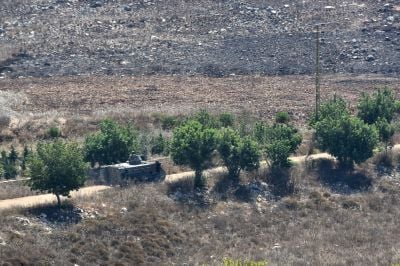
An Israeli drone also fired a stun grenade on Mansouri, near the residential neighborhood of al-Sayyad, and the Israeli army carried out an explosion in Tayr Harfa (Bint Jbeil). Sporadic Israeli gunfire also struck the central Serail neighborhood in the town of Nabatieh. A bullet struck the Hamdani building, located in the market, shattering the window of a flat. Another landed in a butcher’s shop, while a third hit a car in the same neighborhood.
Early on Thursday evening, two paramedics from the Islamic Health Committee were slightly injured in an Israeli drone strike targeting the area where they were working in Nabatieh Fawqa, the organization said in a statement.
In its latest official update, the Health Ministry reported one person killed and one injured by Israeli attacks in the past 24 hours, bringing the death toll to 4,329 and the number of injured to 12,233 in Israeli attacks since March 2.
Bodies found in Zawtar Gharbieh
Hezbollah organized the funerals of two of its fighters in Tayr Debba (Sour).
At least three bodies of several people killed have been found in Zawtar Gharbieh after teams from the Lebanese Red Cross, the medical service of the al-Rissala Scouts — affiliated with the Amal movement — and the Islamic Health Committee entered the village, reports our correspondent in the South.
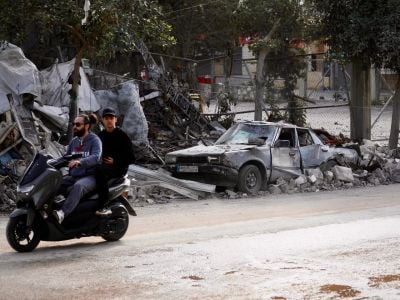
Regarding the evacuation of Zawtar Gharbieh, Prime Minister Nawaf Salam held a meeting on Thursday at the Grand Serail to discuss ways of facilitating the return of residents of South Lebanon to their homes, with the Secretary-General of the Higher Relief Committee, Bassam Naboulsi, the Head of the Council for the South, Hashem Haidar, and the Head of the Disaster Management Unit at the Presidency of the Cabinet, Zahi Shahine.
Israel's war caused the forced displacement of more than a million people since 2 March. Salam said that, following the deployment of the Lebanese Army, roads and basic services will be restored, with temporary accommodation provided for the population rendered without homes, pending reconstruction.
Fadlallah and the ‘pilot zones’
Two days after the meeting between Presidents Joseph Aoun and Donald Trump in the Oval Office, Hezbollah continued to criticize a visit it deemed fruitless, whilst many elected representatives and ministers praised the president’s visit to Washington. Hezbollah's parliamentary bloc, "Loyalty to the Resistance," accused Lebanese authorities of leading the country "down a dead-end path" marked by "successive concessions that undermine the state’s sovereignty ... and reveal its dependence on and submission to foreign control."

For his part, Hezbollah MP Hassan Fadlallah stated that the "pilot areas" agreed in the framework agreement between Lebanon and Israel are parts of southern Lebanon that the Israeli army "has failed to occupy." He argued that what happened in the Zawter Gharbieh area “in no way constitutes an Israeli withdrawal.”
“What has taken place is merely a reinforcement of the Lebanese Army’s deployment in liberated villages and towns that the enemy failed to occupy, thanks to the blood of our martyrs and the sacrifices of our fighters,” the MP emphasized in a speech in Hadath, in the southern suburbs of Beirut. He also accused Lebanese authorities of presenting this episode as “a fictitious achievement,” denouncing “dancing on the blood of the martyrs” and “contempt for the sacrifices” of Hezbollah militiamen.
Reporting contributed by our correspondent, Muntasser Abdallah.

