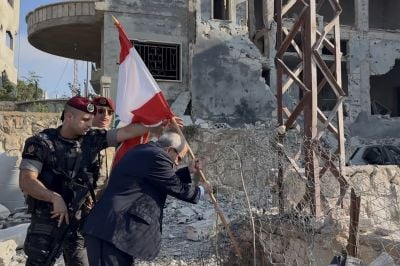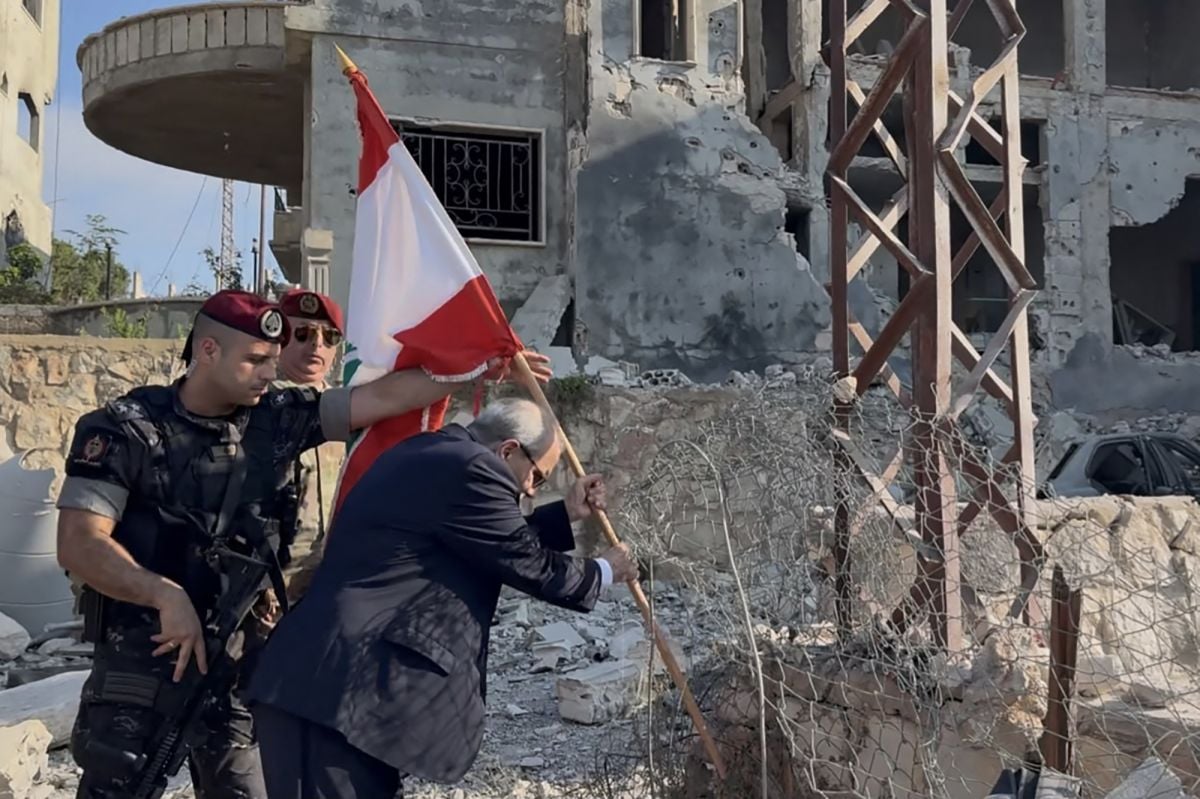
Prime Minister Nawaf Salam plants a Lebanese flag in the 'pilot zone' village of Zawtar Gharbieh, in southern Lebanon, during a tour on July 22, 2026. (Photo shared by our correspondent Muntasser Abdallah)






SOUTH LEBANON — By planting the Lebanese flag in the ruined village square, Prime Minister Nawaf Salam on Tuesday sought to project the image of a state reestablishing its presence in southern Lebanon. During a visit to Zawtar Gharbieh (Nabatieh), one of the “pilot zones” outlined in the framework agreement between Lebanon and Israel, the prime minister stated that “the objective remains the complete withdrawal of Israel from all Lebanese territory,” as the Lebanese Army begins to deploy in the area.

Following this symbolic gesture, Salam welcomed the “beginning of the Israeli withdrawal from our land.” “From the outset, we have stated that our goal is the full withdrawal of Israel from all our territory. What we are witnessing today is only a beginning, but we are determined and unwavering. We will continue to mobilize all our political and diplomatic efforts to achieve a total withdrawal from Lebanese territory,” the prime minister declared.
Addressing the residents of southern Lebanon, he assured them that the state had “begun to allocate all its resources” to facilitate their return. “The Lebanese Army and security forces are present to protect our citizens upon their return. Alongside the army’s deployment, we will continue reopening roads, clearing rubble, and providing essential services to allow residents to return to their villages safely and with dignity,” he said.
مع بدء الانسحاب الاسرائيلي كلمتي من زوطر الغربية صباح اليوم:
— Nawaf Salam نواف سلام (@nawafsalam) July 22, 2026
أودّ أن أوجّه كلمة إلى اللبنانيين جميعًا، ولا سيّما إلى أهلنا في الجنوب، من بلدة زوطر الغربية. إن هذه لحظة وطنية تحمل أبعادًا سياسية ومعنوية كبيرة، لأنها تمثّل بداية الانسحاب الإسرائيلي من أرضنا.
لقد أكدنا منذ البداية… pic.twitter.com/c6OgiDHZ8R
Salam also stated that the authorities had “begun preparations to restore all essential services, including water, electricity, and telecommunications,” as well as to provide prefabricated housing and the necessary equipment for the transition. “The return of life in the South is not a simple slogan, but a national objective to which the state is fully committed. The return of our people to their land is the most authentic expression of Lebanon’s unity and sovereignty,” concluded the head of government.
At the end of June, Social Development Minister Haneen Sayed announced that 400,000 displaced people in Lebanon, out of more than one million since the resumption of the war on March 2, had “returned to their region of origin,” or “the equivalent of 40% of the displaced.”
Salam was accompanied on this visit by the Minister of Defense, Michel Menassah; the Chief of Staff, Hassan Audi; the Secretary-General of the Supreme Defense Council, Mohammad Mustafa; the Head of the Development and Reconstruction Council, Mohammad Qabbani; the Head of the Council for the South, Hashim Haidar, and the Director of the Central Operations Room at the Grand Serail, Zahi Shahine.
Residents express anger
According to our photojournalist Mohammad Yassine, the prime minister’s brief visit sparked restrained anger among several dozen residents gathered at the entrance of Zawtar Gharbieh.
They criticized the authorities for failing to inform them in advance of the visit and for not giving them the opportunity to speak directly with the head of government.
Contacted by our correspondent, Zawtar Gharbieh's mayor, Abdel Ezzeddine, said the prime minister should have stopped for a few minutes to greet residents, which would have had “a positive moral impact and shown his attention.”
Some residents also attempted to persuade the soldiers deployed at the site to allow them to enter the village.
Later in the day, Lebanese Army Commander-in-Chief Rodolph Haykal visited Zawtar Gharbieh.
Zawtar Gharbieh is one of the "pilot zones" provided for in the framework agreement between Lebanon and Israel, in which the Lebanese Army is to deploy and dismantle Hezbollah’s infrastructure, a precondition set for an eventual, possible, Israeli withdrawal. Lebanese Army units began deploying to the village on Tuesday morning. That same day, the Lebanese Army said Israeli soldiers had fired towards its troops as they began their mission according to the agreement.
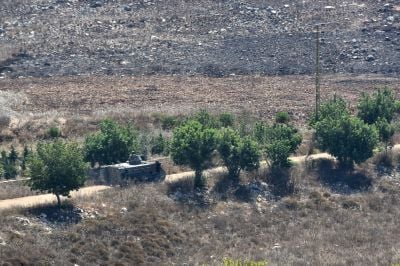
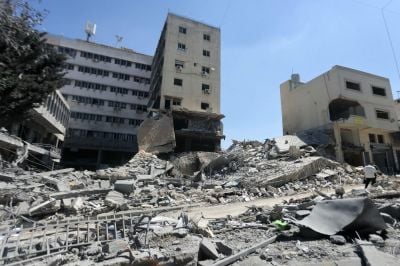
Unlike the other zone, located around Froun and Srifa in the central sector and south of the Litani River, the Israeli army was operating in Zawtar Gharbieh and detonated several buildings there before its withdrawal. Positioned on the outskirts of the locality, they blew up several buildings there and prevented residents from returning to their homes.
On the night between Tuesday and Wednesday, Israel carried out several strikes, according to reports from our correspondent in southern Lebanon. Between 10 p.m. and midnight, an Israeli drone fired a stun grenade on Mansouri (Sour). Israeli forces also carried out a violent strike on the outskirts of Kfar Tibnit (Nabatieh).
After midnight, the Israeli army fired machine-gun rounds towards Haddatha (Bint Jbeil), whilst explosions were reported in the Jebb Soueid area, between Majdal Zoun and Mansouri (Sour). Israel also carried out explosions between Beit Yahoun and the outskirts of Braasheet, causing fires in homes, as well as in Haddatha (Bint Jbeil).
President Joseph Aoun was in Washington on Tuesday where he was received at the White House by his U.S. counterpart Donald Trump, who is sponsoring the agreement between Lebanon and Israel.
Concluded in late June, the framework agreement provides for the deployment of the Lebanese Army in “pilot zones” evacuated by Israel, which continues to occupy parts of southern Lebanon designated as a “security zone,” in exchange for the dismantling of Hezbollah’s infrastructure. The group, which has rejected the agreement with Israel, refuses to disarm.
Israeli flag raised in Doubieh
On the ground on Wednesday, Israeli operations targeted several areas in south Lebanon.
In Houla, in the Marjayoun district, bulldozers demolished homes on the western outskirts of the town, while Israeli artillery fired three shells at the village. Homes were also set on fire in Mais al-Jabal. In the same area, an Israeli force advanced toward Doubieh, the western outskirts of Mais al-Jabal, Wadi Slouki and the outskirts of Houla. Soldiers searched several homes, carried out patrols and raised the Israeli flag over the Doubieh citadel, according to our correspondent.
In Burj al-Muluk, an Israeli unit advanced to the southern outskirts of the village, where it raided a resident’s home, inspected his phone and questioned him before withdrawing toward Tall al-Nahas. The man had returned with his family to this area located below the “Yellow Line,” which remains off-limits to residents. In the Sour district, Israeli army stun grenades targeted the town of Mansouri twice, first in the morning and then before noon. In addition, an Israeli drone struck Nabatieh Fawqa, wounding an elderly man who had gone to his home to retrieve personal belongings, according to initial information. Israeli artillery also repeatedly targeted the Ali Taher hill.

On Wednesday afternoon, the Israeli army continued its demolition operations, carrying out a series of large-scale demolitions against homes and infrastructure in the villages of Kounin and Beit Yahoun, in the Bint Jbeil district, according to our correspondent. The particularly powerful explosions caused violent tremors in surrounding areas, according to residents of several nearby localities, while large columns of smoke rose from the targeted areas.
On Tuesday night into Wednesday, the Israeli army detonated a series of explosions in several areas of southern Lebanon, according to our correspondent in the region. At least 20 demolitions were recorded. Israeli forces carried out blasting operations in Kfar Tibnit (Nabatieh), Majdal Zoun, Khiam, Deir Siryane, Mais al-Jabal, Kounin and Houla. According to Israeli media, the explosions in Majdal Zoun were heard as far away as northern Israel. Machine-gun fire also targeted Haddatha (Bint Jbeil), while in the area of Beit Yahoun and Braasheet (Bint Jbeil), explosions caused fires in homes.
The day after the Lebanese Red Cross (LRC) announced that a mine explosion had wounded two of its rescuers, the Israeli army said in a message posted on its X account that “the explosive device was most likely planted by the Hezbollah terrorist organization.” “The incident occurred in the Mayfadoun area (Nabatieh district), located outside the southern Lebanon security zone [the term used for Israeli-occupied territories in southern Lebanon],” the Israeli army further stated on one of its X accounts. It should be noted that, according to the LRC, the incident occurred precisely at the entrance to Zawtar Sharqieh, which has not yet been taken under the control of the Lebanese Army.
Hezbollah opened a new front with Israel in early March in support of Iran. Israel responded with large-scale strikes that have killed more than 4,300 people and displaced hundreds of thousands, according to Lebanese authorities.