







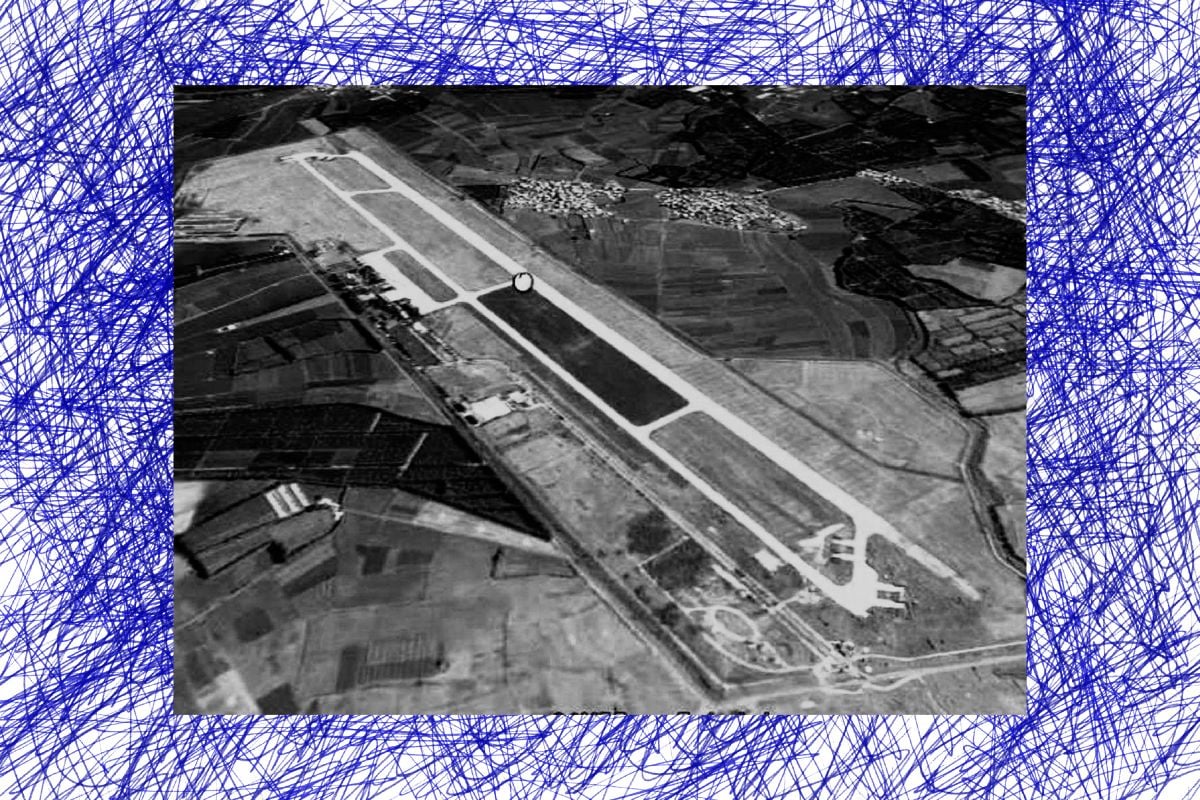
Qleiaat's airport (Credit: Michel Hallak/ L'Orient Today)






On Feb. 6, the government approved the Public Works Ministry’s request to “gradually” reactivate Qleiaat’s airport, also known as the Rene Moawad Airport, in Akkar, north Lebanon.
The issue has resurfaced with nearly every security upheaval since the 1975–90 Civil War, with many questioning whether Lebanon, given its small size, actually needs a second airport.
So, what’s the deal with the Qleiaat airport? What exactly is on the table? Could the country benefit from a second airport economically?
Let’s break it down.
1- What is it?
Reopening Qleiaat was explicitly mentioned in the ministerial statement of Prime Minister Nawaf Salam’s government in January 2025, with the Cabinet pledging to study and potentially reactivate the facility.
In 1938, the airport was developed by the French army when Lebanon was still under the French mandate.
In 1966, the Lebanese Army took control and modernized it into a military base.
In 1989, it was renamed Rene Moawad Airport, in tribute to the president who was elected on that site and later assassinated.
In 2006, during the Hezbollah-Israel war, the airport was hit by the Israeli army, which systematically targeted Lebanese runways. After repairs, the Lebanese Air Force resumed control.
Starting in 2010, discussions began about transforming what had become the Rene Moawad Air Base into a civilian commercial airport.
So far, the project has never materialized.
Which brings us to the next question.
2- What has been on the table so far?
The debate resurfaces every time Lebanon faces a security crisis.
Beirut-Rafik Hariri International Airport is the country’s only functioning civilian airport, located near Beirut’s southern suburbs, a Hezbollah stronghold.
Since the war between Israel and Hezbollah broke out in October 2023, the area has been heavily struck at times, raising concerns about the airport’s vulnerability.

In February 2025, two Iranian planes were banned from landing at Beirut airport, highlighting how geopolitics can directly affect Lebanon’s only aviation gateway.
Against that backdrop, Qleiaat suddenly looks less like a luxury and more like a contingency plan.
On Feb. 6, the government approved the gradual reactivation of Rene Moawad Air Base for an initial four-year phase.
Information Minister Paul Morcos said the Public Works Ministry intends to bring the infrastructure back into service under international safety standards and full operational capacity.
The project will be carried out in coordination with the International Finance Corporation, a member of the World Bank Group, which will conduct the necessary technical studies.
The broader rehabilitation is estimated to cost between $100 and $120 million.
If completed, the airport could handle up to 2 million passengers annually, easing pressure on Beirut’s airport.
Earlier debates had included proposals to award the project directly to a subsidiary of Middle East Airlines with a possible $15 million advance.
For now, the government endorsed a phased relaunch, pending technical studies.
3- Would this benefit Lebanon economically?
Beyond politics and security, does it make economic sense?
Many argue that Lebanon’s small surface area does not automatically mean it should have only one civilian airport.
Cyprus, smaller than Lebanon, operates three civilian airports. Jordan has three. Israel has three. Lebanon has one.
Supporters argue that the economic impact on the North would be significant.
To some experts, an airport supports the entire surrounding area. North Lebanon would benefit in terms of tourism, transport, hotels and restaurants.

Akkar MP Walid Baarini previously said the project could create around 2,000 jobs and have a positive spillover effect on both Lebanon and Syria.
There is also the capacity issue.
Beirut’s airport, opened in 1953 and expanded multiple times, has officially been able to handle around six million passengers annually since 2005.
But that ceiling was surpassed years ago. Passenger numbers exceeded eight million in 2017. After a pandemic slump, traffic once again crossed the six million mark in 2022 and 2023.
With a cease-fire between Hezbollah and Israel in place since late November 2024 and a relative diplomatic easing between Lebanon and its neighbors, economic actors are hoping for a rebound in travel.
For many experts, a second airport would complement, not compete with, Beirut airport.
Whether Qleiaat becomes reality this time is another question.
But for now, it is officially back on the table.
I don't see any discussion on the traffic nightmare getting trough Jounieh, also no political mention of the airport . Granting MEA monoapoly would be terrible for the country.
18 February 2026 15:58