







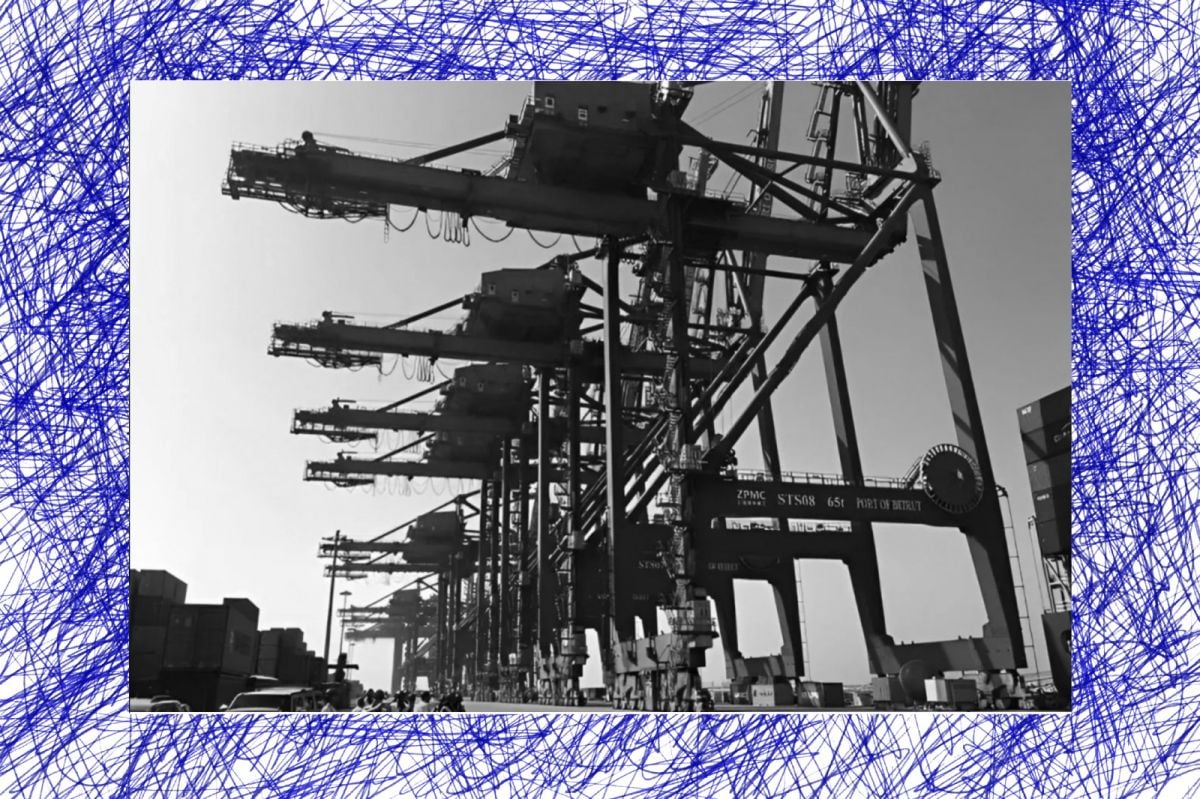
Photo at the Beirut Port. (Credit: Philippe Hage Boutros/L'Orient-Le Jour)






On Jan. 16, Gracia Azzi was appointed as head of the Directorate of Customs, a decision that quickly reignited debate around accountability in Beirut.
Azzi is implicated in the investigation into the Aug. 4, 2020, Beirut Port explosion and in a separate corruption case dating back to 2018, prompting strong reactions, including from families of the blast’s victims.
How does the port work, what do Lebanese Customs actually do, and how did Azzi end up with this senior position?
Let’s break it down.

1. How does the Beirut Port actually function?
The Beirut Port is owned by the Lebanese state, but it has long operated without a unified, modern port authority.
Since the early 1990s, the port has been managed by the Gestion et Exploitation du Port de Beyrouth (GEPB), known as the interim management committee, appointed by the government and formally placed under the supervision of the Public Works and Transport Ministry.
Despite its temporary status on paper, this committee remained in place for decades. It should, however, be noted that GEPB’s management has changed recently, meaning the current team is not the same as the one in place in 2020, when the explosion occurred.
Also, the port terminal has been operated by CMA-CGM under contract since 2021.
The committee oversaw port operations, infrastructure, warehouse leasing, and coordination with private operators.
Some key activities, including container handling, were delegated to private companies under contract.
In the wake of the 2020 explosion, and as part of the port’s reconstruction, the government said it is considering restructuring port governance to align it with international standards.
But at the same time, several state bodies operated inside the port independently of the management committee, including customs, General Security, State Security, and the Lebanese Army. Each answers to a different ministry or authority.
The result was a fragmented structure, with overlapping responsibilities and no single chain of command responsible for safety, storage, or risk management across the port as a whole.
But since July 2021, the Beirut Port has been subject to Lebanon’s Public Procurement Law, meaning its contracts and tenders are now overseen by the Public Procurement Authority, a watchdog tasked with enforcing transparency and competition in state spending. It is not attached to any ministry. It was created by Parliament.

2. What role do customs play at the port, and why are they part of the Aug. 4 investigation?
A couple of things are crucial to understand.
The Lebanese Customs is a state authority attached to the Finance Ministry, while the Beirut Port is linked to the Public Works and Transport Ministry.
Customs are not responsible for running the port itself, but are the first point of contact when cargo enters or leaves the port. They inspect shipments, check whether the goods match their documentation, and collect duties and fees.
In more concrete terms, they give clearance for goods to enter or remain “on hold” in the port until the necessary procedures are completed.
Now, regarding the ammonium nitrate, what happened, in technical terms, is that the shipment did not receive customs clearance, reportedly due to a legal issue involving the ship itself.
Because the goods could not be released or remain on the ship or in open storage, they were reportedly transferred to a warehouse inside the port while the legal situation was unresolved.
At the time, Azzi served as a member of the Higher Customs Council, the body involved in oversight of customs operations.
This is why customs officials appear in the investigation into the Aug. 4, 2020, explosion.
Judge Tarek Bitar, who is leading the investigation into the explosion, has pursued several senior security and administrative officials, including customs officials, on the basis of their alleged knowledge of the danger and failure to act.
Being “pursued” in this context means being formally charged or summoned as part of the judicial process. It does not constitute a conviction.
Azzi is among those pursued in the Aug. 4 case, alongside other officials.
Senior positions in Lebanese Customs, including the director general, fall under Grade 1 civil service appointments, the highest level in the public administration.
So, in Azzi’s case, the appointment was proposed by the Finance Ministry, to which the customs are attached. It was approved by the government.
How? Because, as Prime Minister Nawaf Salam mentioned, there is the principle of “presumption of innocence.”
This means there is no legal provision that automatically bars someone from being appointed to a senior government post while under investigation, as long as no final judgment has been issued.
3. Where does the Beirut Port stand today?
More than five years after the Aug. 4, 2020, explosion, the judicial investigation remains unfinished, though it has recently resumed procedural movement.
Judge Bitar is still formally in charge of the probe, which remains active despite ongoing legal challenges.
For Azzi, as long as the investigation is not complete and no official judgment has been issued, her appointment remains official.
At the same time, the port itself is back in the spotlight for a different reason: a sharp rebound in activity and revenues.
In December, about 103,000 containers entered or left the Beirut Port, nearly double the volume recorded in the same month a year earlier and the highest monthly figure since Lebanon’s 2019 financial crisis.
This surge has translated into higher public revenue. Weekly transfers to the Treasury have more than doubled, rising from around $1.3 million to roughly $2.9 million, according to port officials.
Container traffic accounts for 80 percent to 90 percent of the port’s revenue, with the remainder from bulk cargo.
Alongside this recovery, the port’s administration says it is tightening oversight. In January, Port General Manager Marwan al-Nafi announced that the Beirut Port is now fully committed to Lebanon’s Public Procurement Law, placing major purchases and projects under the supervision of the Public Procurement Authority.
Financial and technical experts have been appointed to assess the port’s accounts, and an internal audit committee has been created for the first time.
With Lebanon relying on imports for roughly 80 percent of its basic needs, the Beirut Port remains a central artery for the economy and a key source of public revenue, even as accountability for the 2020 disaster remains unresolved.

 8 p.m. recap: Israel again threatens Beirut’s south suburbs; 2 ships hit near Hormuz; Riyadh football matches canceled