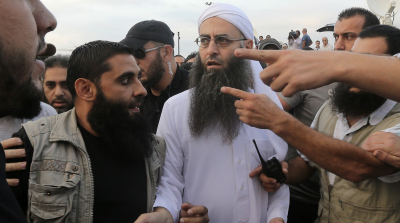
The Salafist sheikh Ahmad al-Assir. (Credit: AFP)






Sat in a motorized wheelchair, Hilal Hammoud — an official with the Resistance Brigades (Hezbollah) who filed complaints against Salafist cleric Ahmad al-Assir and singer Fadl Shaker over an alleged attempted murder in Saida in May 2013 — appeared before the Beirut Criminal Court on Friday to give testimony.
When asked by the presiding judge, Bilal Dennaoui, he explained that his disability is due to muscular atrophy and not related to the attack in which he claims he was hit by bullets during a shooting that lasted "eight minutes."
Ahmad al-Assir and Fadl Shaker occupied the two defendants’ docks on either side of the bench, which also includes Nadim Nachef and Sara Breich, as masked, helmeted soldiers stood guard nearby.
Hilal Hammoud accused the two detainees of inciting their followers to trigger the armed incident, although they deny any wrongdoing. In parallel, the two men are involved in the case of the bloody clashes with the army in Abra (Saida) in June 2013: Fadl Chaker, who turned himself in last October after taking refuge in the Ain al-Hilweh camp for about twelve years, is currently on trial before the military court, while Ahmad al-Assir has already been tried and convicted for his role in these events.

At the end of Friday's hearing, the lawyers for the sheikh and the singer, as well as those for Bilal Halabi, Hadi Kawas, and Abdel Nassar Hneineh — three other defendants who are not in custody — asked Judge Dennaoui for time to prepare their closing arguments. At a previous hearing, on Jan. 9, the judge offered to hear arguments at the next session, ahead of his judgment.
Known for running prompt hearings, the magistrate had to postpone the next session to April 24 to avoid the possible arrest of these three defendants during Ramadan, which begins in about ten days, and to avoid scheduling conflicts with Good Friday in April, as the court convenes only on Fridays.
Standing for two hours
Ahmad Assir wore black-rimmed glasses, his beard now more salt than pepper, and donned a black skullcap and a camel-colored abaya, the same colors he wore at the previous session.
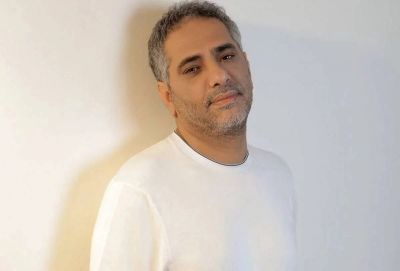
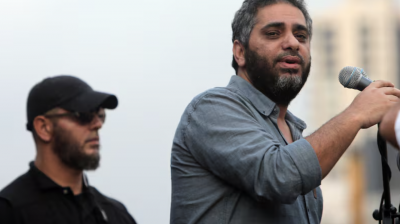
With his gaze obscured by dark-tinted glasses, Fadl Chaker, for his part, was dressed in a crisp white shirt and black trousers, paired with black sneakers trimmed in white.

Both men stood for over two hours during the hearing, even though at the Jan. 9 session, they had been invited to sit, only standing when called to speak. On Friday, while Chaker stood upright, al-Assir spent most of the time leaning on the podium in his box, squatting down twice to stretch his legs.
Provocation and heavy gunfire
Asked by Judge Dennaoui to recount his version of the day’s events, Hilal Hammoud said he had gone to his parents' home, located near Chaker’s office and an apartment block where the head of al-Assir’s office lived, in the Bilal Abdel Rabah mosque neighborhood in Saida. The Hezbollah official said that to avoid any "provocation," he discreetly crossed a checkpoint that was "sometimes" set up by elements affiliated with the Salafist sheikh.
According to his account, things escalated twenty minutes later when he stepped onto the veranda of his parents’ third-floor apartment. Men gathered below the building, including Bilal Halabi — Chaker’s wife’s driver — who insulted him, calling him a "pig." "You’re pigs yourselves!" replied Hammoud, explaining to the court that pigs are known for mating with their mothers. The plaintiff claims he immediately contacted a party official to report being "provoked.'"
Events quickly accelerated. “Hadi Kawas, a supporter of Ahmad al-Assir, pointed a weapon at me and said he wanted to crush my neck, which prompted me to threaten him in the same way,” said Mr. Hammoud. According to him, Halabi opened fire with a Kalashnikov, hitting the veranda and forcing him to seek refuge inside the apartment. Still according to the plaintiff, the gunfire came from Chaker’s office and the residence of Abdel Nasser Hneineh (one of the three defendants). He claimed that about 180 bullets struck the apartment during this barrage. When asked by Mohammad Sablouh, al-Assir’s attorney, if there were photos showing the impact of bullets, Hammoud said no, noting his home was later damaged during the Abra events.
The plaintiff said he then sought refuge in his next-door neighbor’s apartment before armed individuals broke down his parents’ apartment door. "A crowd of about 400 people, some armed, gathered below the building," Mr. Hammoud said, claiming he heard Chaker’s voice urging them to burn the building down if he did not come out.
Asked by the singer’s lawyer, Mr. Amata Moubarak, "How could you hear and recognize his voice amid the gunfire?" Hammoud replied: "The shooting lasted eight minutes, but the tensions continued for nearly five hours — from the start of the attack around 4:50 p.m., until about 9:45 p.m., when an army patrol came to extract me from my neighbor’s apartment."
The judge then asked: "What stopped the armed men, during those five hours, from storming your neighbor’s house and killing you?" The plaintiff replied: "It was probably thanks to Zaher Midani, a relative of my neighbor’s wife who was with them and prevented it."
Recalling that the plaintiff had already withdrawn his legal action against Chaker, the presiding judge asked him why. Hammoud replied that the designated successor of Hassan Nasrallah, Hashem Safieddine — assassinated by Israel in October 2024 — had instructed him to drop any action as soon as he was requested to. At the previous hearing, the singer had claimed he paid a sum for the withdrawal through intermediaries, but did not specify the amount. Hammoud denied this. Chaker then asked to speak, stating that what matters to him is being cleared by the court, even though the civil party has dropped its complaint.