





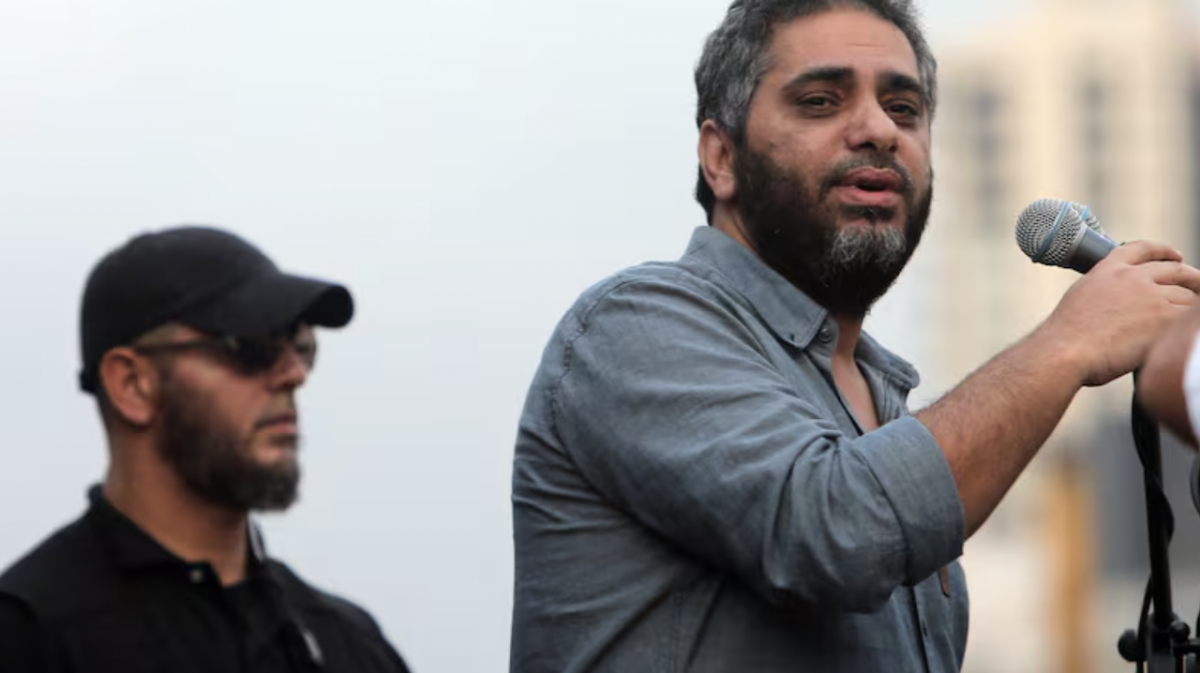
The singer and former Salafist Fadl Shaker at a political rally in Beirut, in 2012. (Credit: AFP)






SAIDA — After 12 years spent on the run, the famous Lebanese singer, Fadl Shaker, turned himself in to the Lebanese Army on Saturday. Shaker had retired from music more than a decade ago and grown close to Salafist sheikh Ahmad al-Assir, a hard-line Sunni cleric who was a vocal opponent of Hezbollah and especially the party's alliance with the Syrian Assad regime.
Shaker was convicted in absentia in 2020 to 22 years in prison for his alleged participation in the 2013 armed clashes in Saida, during which 18 Lebanese Army soldiers were killed. At least 20 Assir-aligned fighters were also killed, and hundreds of people reportedly wounded. Assir was sentenced to death in 2017 — a sentence later commuted to 20 years of hard labor — for the incident, which lasted several days.
In a YouTube video uploaded on the second day of the Saida clashes, Shaker hurled insults at his enemies and taunted the military, saying “we have two rotting corpses that we snatched from you yesterday,” an apparent reference to two slain soldiers.
Shaker, who insists he was not directly involved in the fighting, surrendered to the army’s intelligence services at the entrance of Saida's Ain al-Hilweh Palestinian refugee camp, where he was believed to have been in hiding for several years in a home that also housed his own recording studio.
Shaker reportedly experienced increased threats and pressure after returning to music with the release of two hit singles and an album released in recent months. The pressure eventually culminated in his surrender. He was transferred directly to the Ministry of Defense in Yarzeh as part of an agreement to settle his case, potentially leading to his eventual release or extradition from Lebanon.
According to judicial and security sources cited by AP, now that Shaker is being held by Lebanese authorities, the sentences that he received while on the run will be dropped, and he will be questioned in preparation to stand trial on new charges of committing crimes against the military.
According to L'Orient Today's correspondent in the South, Shaker was convinced to come out of hiding after being given security guarantees and as well as by the involvement of certain Arab countries. The singer left his home by taking a passage controlled by an Islamist group before arriving at the Lebanese Army checkpoint at an entrance point into the camp — which is outside of Lebanese police and army control — where he was handed over to the military.
In a statement published Sunday morning, the Lebanese Army command confirmed the artist’s surrender. "On Friday evening, following a series of contacts between the army and the concerned parties, the defendant Fadl Abdel Rahmane Shmandar, known as ‘Shaker,’ surrendered to an intelligence patrol at the entrance to the Ain al-Hilweh camp in Saida," the statement said.
'Fabricated' charges
Shaker's charges in the Saida clashes involved supplying arms and ammunition to Assir. In a statement reported on in the press on July 10, the singer framed himself as a victim and once again declared his innocence, asserting that the charges against him "were fabricated from scratch," blaming "political score-settling."
Shaker, whose father is of Palestinian descent, ended his musical career with the outbreak of the Syrian revolution and subsequent civil war. It was around this time that he drew closer to Assir's fundamentalist Salafist movement.
He made a first — and unsuccessful — attempt at a musical comeback in 2017, but had better luck this year with his new songs going viral, amassing more than 113 million views on YouTube.
After the fall of Bashar al-Assad on Dec. 8 and the rise to power of interim president Ahmad al-Sharaa, the singer released a song dedicated to Damascus. At the end of April, the Syrian artists’ union awarded Shaker the title of "honorary member" in recognition of his "remarkable artistic career" and his "humanitarian commitment to the cause of the Syrian people."
Reporting contributed by L'Orient Today's correspondent in the South, Muntasser Abdallah.