


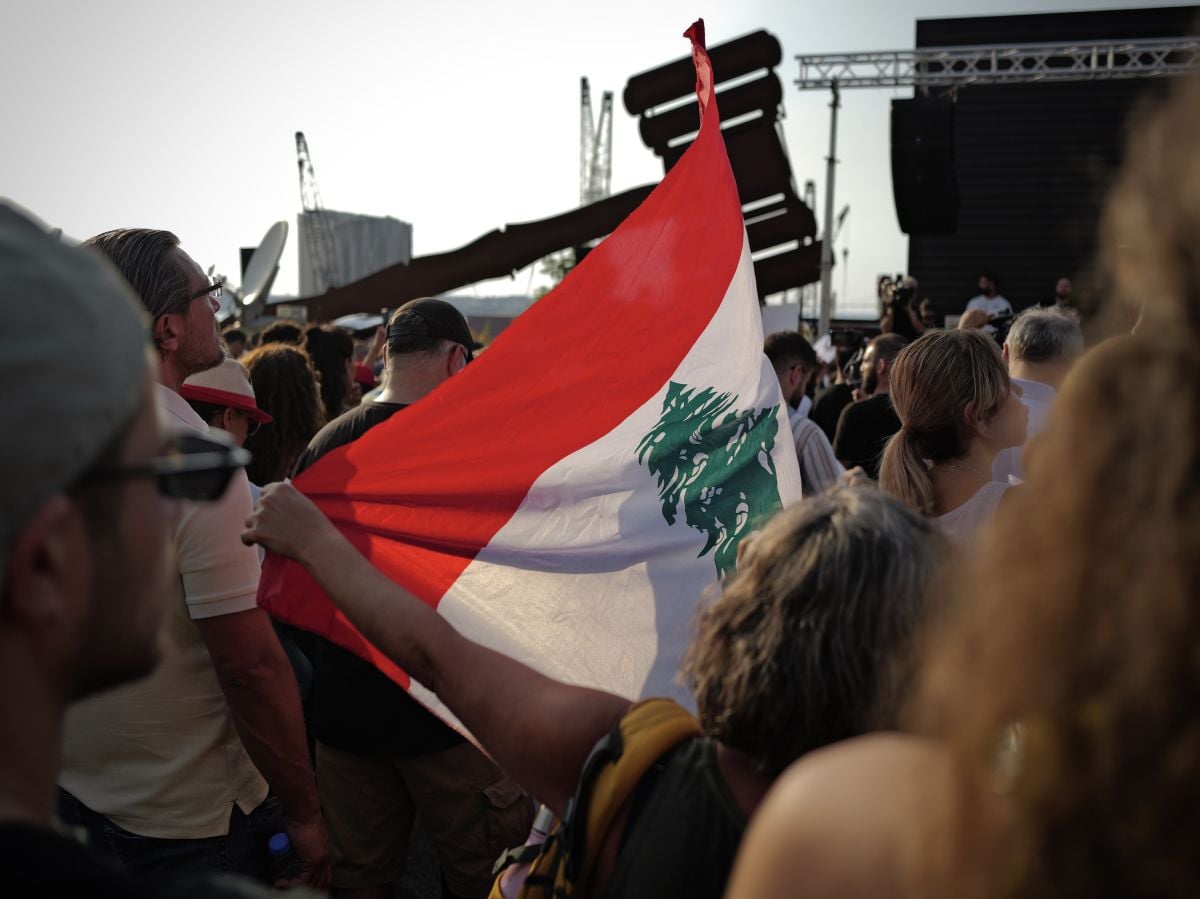
Protesters gathered in front of the port of Beirut on Aug. 4, 2026, six years after the deadly explosion in the Lebanese capital. (Credit: Matthieu Karam/L’Orient-Le Jour)






BEIRUT — Lawyer Akram Azoury asked the Lebanese state in a letter dated Aug. 12 to renew its request to Bulgaria for the extradition of Igor Grechushkin, the owner of the MV Rhosus. The vessel transported and later offloaded the hundreds of tons of ammonium nitrate that exploded at the Port of Beirut on Aug. 4, 2020, in a disaster that devastated entire sections of the capital, killing more than 235 people and injuring more than 7,000 others.
Azoury, who represents several victims of the Aug. 4 blast, argues that Bulgaria’s main justification — Lebanon’s use of the death penalty — for refusing to extradite Grechushkin would no longer apply following Parliament’s vote to abolish capital punishment on Tuesday.
Grechushkin, who has been the subject of an arrest warrant since 2020 issued by former Beirut port blast investigative judge Fadi Sawan, was arrested in Bulgaria on Sept. 5, 2025, following an Interpol red notice. Lebanon subsequently prepared a case file seeking his extradition, but Bulgaria refused the request over concerns that he could face the death penalty.

In October 2025, Judge Myrna Kallas, who is in charge of international judicial assistance, traveled twice to Bulgaria to deliver a written Lebanese pledge that the death penalty would not be sought or imposed on the Rhosus owner.
Lebanon and Bulgaria have an extradition agreement containing a clause allowing the requested state — in this case, Bulgaria — to refuse an extradition request unless the requesting state provides adequate assurances that a death sentence will not be carried out.
'Bringing explosives into Lebanon'
Grechushkin, a Russian-Cypriot national, has been identified by several press investigations as the Rhosus’ charterer rather than its owner. The vessel’s owner is reportedly Cypriot businessman Charalambos Manoli.
Grechushkin is wanted for “bringing explosives into Lebanon, a terrorist act resulting in the deaths of a large number of people, and disabling machinery with the aim of sinking a ship,” according to a statement issued by the Bulgarian prosecutor’s office on Sept. 16, 2025.
The extradition ultimately did not take place, with Bulgarian authorities formally rejecting the request on Dec. 15, 2025, Azoury’s letter recalls.
According to the lawyer, the principle of res judicata — under which a final judicial decision cannot reverse a judicial decision — applies to the Bulgarian ruling only as long as the death penalty remains applicable in Lebanon, which, he argues, will no longer be the case following Parliament’s vote on Aug. 11, 2026.
"Furthermore, Lebanon now has the right to request Igor Grechushkin’s extradition from any country, including Cyprus, whose nationality he holds, since the argument of capital punishment has been eliminated," the letter continues.

Azoury also recommends “speeding up the signing of the law and its publication in the Official Gazette.”
The blast at the Port of Beirut, caused by the detonation of what is believed to have been nearly 500 tons of ammonium nitrate, was one of the most powerful non-nuclear explosions ever recorded. It devastated entire neighborhoods of the capital and left more than 300,000 people homeless in the aftermath.
The Rhosus was originally carrying an estimated 2,750 tons of ammonium nitrate bound for Mozambique. While en route in 2013, the vessel stopped at Beirut port to offload equipment ordered by the Energy Ministry at the time. The ship, which was in poor condition, was detained at the port following an inspection, and its cargo was unloaded and stored without adequate safety precautions.
The vessel eventually sank several years later, before the 2020 explosion. The ammonium nitrate stored in Warehouse 12 caught fire on Aug. 4, 2020, triggering the blast.
Judge Tarek Bitar, who is leading the investigation, closed his probe last March. His indictment has yet to be published, six years after the disaster, pending the prosecutor’s closing arguments, which could be submitted in the coming months.

 7 p.m. recap: 1 person killed near border with Lebanon; 200 kilos of explosives carried by mules; Riyadh shuts its airspace