


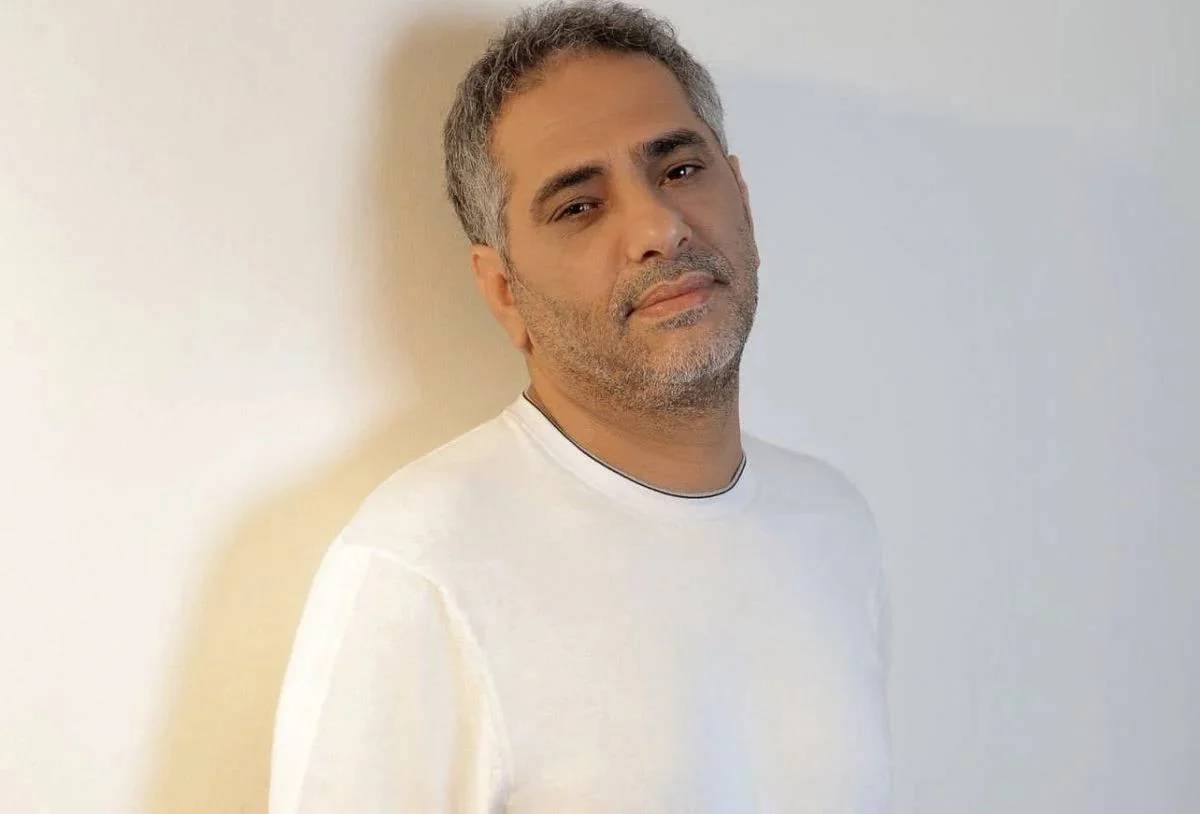
Fadl Shaker. (Photo taken from his X account)






The Beirut criminal court, presided over by Bilal Dennaoui and also composed of Nadim Nashef and Sara Breish, held a hearing dedicated to the May 2013 attempted murder of Hilal Hammoud, a commander in Hezbollah's Resistance Brigades in Saida, in which Salafist sheikh Ahmad al-Assir, crooner Fadl Shaker, and four others — Bilal Halabi, Hadi Kawas, Abdel Nassar Hneine, and Fadi Beyrouthi, who did not appear — are implicated.
With a heavily reinforced security system and a large deployment of army and security forces in and around the Justice Palace, both Assir and Shaker were questioned for three hours in the presence of the public prosecutor at the Court of Cassation, Michel Merzli.

Dark sunglasses
Dressed in a black leather jacket, matching sweater and trousers, and also wearing black sunglasses, Shaker was seated in the defendant’s box on the left side of the magistrates, while Assir, wearing a camel-orange abaya and a black skullcap, sat to the right of the tribunal.
At least five soldiers surrounded each defendant in their box, while two more were posted in two corners of the courtroom, behind the magistrates. Others stood in the middle and at the entrance to the room, which was filled with about thirty people in total. All wore helmets and balaclavas, heavily equipped, their weapons and ammunition visible on their vests and backs.
The plaintiff, Hammoud, did not attend and was represented by his attorney, Nassir Ahmad. Amata Moubarak was present for Shaker's defense, while three lawyers, including Mohammad Sablouh, represented Assir.
Hammoud had withdrawn his complaint against Shaker and the other defendants, except for Assir. Nevertheless, all the parties were heard by the criminal court, as public prosecution was not terminated and the depositions were useful in reconstructing the attempted assassination.
In response to a question from the court about the withdrawal of the complaint, Shaker acknowledged having paid Hammoud a sum through intermediaries, but did not specify the amount.

In his complaint, Hammoud stated that as he was heading to his parents’ house, near the Bilal bin Rabah mosque in Saida, he came under heavy gunfire for "eight minutes," which he attributed to Assir’s supporters and to Halabi, the driver for Shaker’s wife. He accused the latter of inciting the attack through threats made over the mosque loudspeaker.
At the beginning of the hearing, Dennaoui, assisted by Breish, read out the indictment, which had been issued while Shaker was a fugitive living in the Ain al-Hilweh camp.
Having finally turned himself in to army intelligence on Oct. 5, the singer now appears in person at his trial, as well as for the proceedings related to the bloody clashes with the army in Abra (Saida) in June 2013, for which he was heard by the military tribunal on Thursday, while Assir has already been tried and convicted for his role in those events.
Hands in pockets
During the reading of the indictment, Assir, Shaker and the other defendants present stood listening attentively and calmly, showing no signs of nervousness. Dennaoui then invited them to sit, only requiring each to stand when about to begin individual questioning. Conducting the session methodically and strictly, the judge ensured the order of speaking was respected, reminding parties to address him, and only when given the floor.
During his interrogation, Shaker denied leading an armed faction, asserting he was protected by a group of about a dozen people led by his brother Abdel Rahman (killed during the Abra events).
He justified the existence of this group by claiming the state had not acted to stop threats from associates of the former Syrian regime, adding that his villa was robbed and burned before he took up residence above the Bilal bin Rabah mosque. The singer said he did not know how to use weapons, denied knowing the plaintiff, but acknowledged knowing him as a Resistance Brigades officer in Saida. As Shaker was responding to questions, Dennaoui caught him with his hands in his pockets and instructed him to remove them.
Assir denied under questioning that he was financed or armed by Shaker, also denying his presence at the scene of the attack and stating that as soon as he was informed of the incident, he contacted the ISF to take appropriate measures. As for Halabi, Kawas and Hneine, they all denied any involvement in the attempted murder.
The hearing was postponed to Feb. 6 for a confrontation between the plaintiff and the defendants.
This article was originally published in French on L'Orient-Le Jour.

 7 p.m. recap: 1 person killed near border with Lebanon; 200 kilos of explosives carried by mules; Riyadh shuts its airspace