


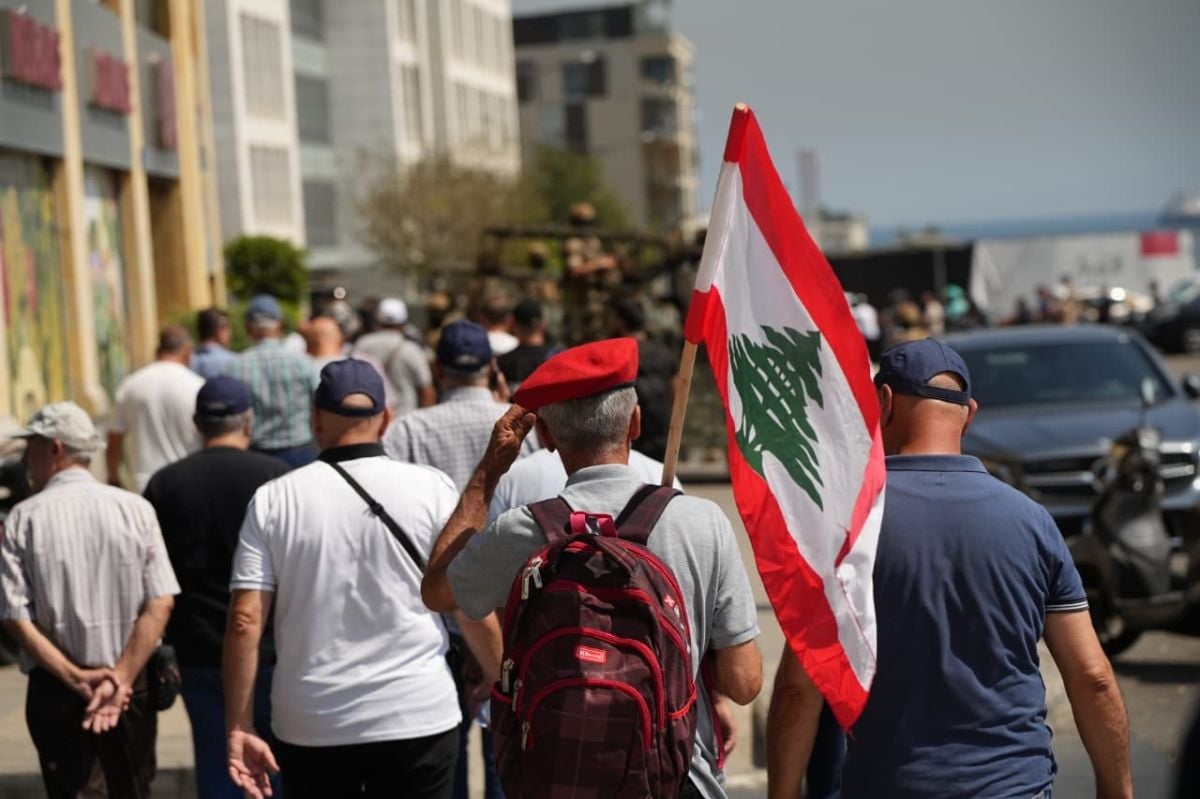
Protests near Parliament, on Aug. 11, 2026. (Credit: Mohammad Yassin/ L’Orient-Le Jour)






BEIRUT — The general amnesty law, awaited for years, was adopted less than an hour after the start of Wednesday's parliamentary session. The vote on this critical text came on the second day of a session convened by Parliament Speaker Nabih Berri last week, despite the walkout of Hezbollah and Free Patriotic Movement (FPM) MPs, as well as MPs Ibrahim Kanaan and Simon Abi Ramia (formerly of the Free Patriotic Movement). This was a way of protesting the dispute that erupted between Prime Minister Nawaf Salam and Defense Minister Michel Menassah following the debate on the bill, which is dear to the Sunni community but about which the army has expressed reservations.
The debate began Tuesday evening before being interrupted due to a lack of quorum, amid tensions between Salam and the defense minister. The prime minister had refused to allow the minister to deliver a prepared address to Parliament, as the Lebanese Army opposes granting this measure to individuals guilty of killing soldiers. Salam maintained that it was his prerogative to speak on behalf of the government, while MPs from the FPM and Hezbollah invoked Article 67 of the Constitution, which stipulates that ministers have free access to Parliament and must be heard upon request.
In this context, prior to Wednesday's session, Berri convened the prime minister and the defense minister to try to resolve their disagreement. Deputy Parliament Speaker Elias Bou Saab was also present. According to information from L'Orient-Le Jour, the defense minister stated that he would not participate in Wednesday's session unless he was allowed to deliver his address. However, Salam was adamant in his refusal, which prompted the minister to leave the chamber to avoid further escalating the situation with Salam. "He probably wants to avoid a government crisis," commented one MP on condition of anonymity.
The relationship between Salam and Menassah is 'very good'
A source close to the government told L’Orient-Le Jour that, following contacts made Tuesday by the parliament speaker, it had been decided to accept only the presence of the defense minister, without him delivering a speech. “We’re not going to get into a debate about this. What matters to us is that the relationship between Salam and Menassah is very good — they made contact on Tuesday — just as Nawaf Salam’s relationship with the president of the republic is more than good,” the source stated.
This was a way of putting an end to analyses suggesting that, behind his standoff with the defense minister, Salam intended to send a message to the president of the republic — with whom Menassah is close — amid disagreements over the general amnesty.
Speaking after the FPM withdrawal, MP Salim Aoun asserted that “the defense minister was prevented from presenting the position of the army and his Ministry” and that by withdrawing, the FPM “wanted to avoid endorsing such a violation.” During the session, Elias Bou Saab stated that Nawaf Salam's decision to prevent the defense minister from speaking on this specific issue was “a mistake,” in addition to being “unconstitutional.” “Whoever claimed that some were trying to pit a particular minister against a specific community was mistaken. There is a military institution whose decisions and opinions must be respected,” he insisted, before concluding that the political agreement that enabled the passage of the text would allow the government to “turn the page.”
For his part, Fouad Siniora, former prime minister, reacted to the standoff between Nawaf Salam and Michel Menassah. “The Constitution is clear. It stipulates that the head of government speaks on behalf of his team. That’s what should have been done in Parliament, instead of creating yet another controversy for the country,” he told L’Orient-Le Jour, recalling that the defense minister had already expressed the army’s position during the joint committee debate. “There’s no need to say more, just as we didn’t need the precedents set by the deputy speaker of Parliament on this matter,” added Siniora, in a pointed remark aimed at Elias Bou Saab.
The Assir case
The final version of the text, in any case, benefited from the support of the main Sunni components, which were initially divided, with, on the one hand, certain MPs demanding the release of as many detainees as possible, including Islamist Ahmad al-Assir, incarcerated since 2015 for his participation in the deadly clashes against the army in Abra, in the South, in 2013, and, on the other, those who pleaded for the rapid adoption of the law. A parliamentary source explained to L'Orient-Le Jour that Assir benefits from both the law abolishing the death penalty and the amnesty law. First, the death penalty was replaced by life imprisonment. Then, thanks to the amnesty, the life sentence is replaced by 12 years of effective detention. He should therefore be released in April 2028.
The Lebanese Forces (LF) planned to support any text that would garner the support of all Sunni MPs. Speaking after the session, Sunni MP from Tripoli Achraf Rifi thanked the LF and the Kataeb and declared that the vote “demonstrated that general amnesty is a national cause that transcends political and sectarian divisions.”
However, some Shiite and Christian MPs — with the exception of those from the Lebanese Forces — opposed extending the amnesty to detainees who had not yet received a final sentence. “The MPs preferred to include a clause in the text concerning the acceleration of trials rather than releasing hundreds of detainees,” stated MP Nabil Badre, noting that some parliamentarians likely fear the flight of those still awaiting trial.
Meanwhile, Free Patriotic Movement leader MP Gebran Bassil expressed regret over Parliament’s adoption of the general amnesty law in a post on X. “Just as Lebanon had scored a positive point by abolishing the death penalty, it dealt a blow to justice, with Parliament adopting a general amnesty law for the third time, thereby encouraging impunity, when it should have granted pardons to a number of people who were victims of injustice,” he wrote.
“How can you, the government of the ‘24 ministers acting in solidarity,’ ask the army to fight Hezbollah and terrorism while granting amnesty to those who killed its soldiers?” he added.
Lebanese in Israel
Of course, Islamist detainees are not the only ones to benefit from the amnesty. There are also the Lebanese who fled to Israel after the Israeli army withdrew from the South in 2000. Ghada Ayoub, a Lebanese Forces MP from Jezzine who has made this issue her rallying cry, asserted on her X account Wednesday that the Lebanese who found refuge in Israel and who were not members of the South Lebanon Army (a pro-Israeli group led by Antoine Lahed) will benefit from the amnesty law, “which will allow them to return home,” emphasizing that Law 194/2011, “presented by the Free Patriotic Movement (the main Christian rival of the Lebanese Forces), in full alliance with Hezbollah, and concerning the return of Lebanese in Israel has remained a dead letter.”
Ziad Hawat, an LF MP from Jbeil, told al-Jadeed TV on Thursday that the new amnesty law applies to any Lebanese resident in Israel who was not a member of the South Lebanon Army (SLA) and is not subject to any criminal convictions. “They can therefore return to Lebanon after the publication of the new law in the official gazette, provided they renounce their Israeli citizenship,” he said.

 7 p.m. recap: 1 person killed near border with Lebanon; 200 kilos of explosives carried by mules; Riyadh shuts its airspace