












When President Joseph Aoun called on Hezbollah to “show reason,” he once again seemed to forget that he was addressing a party that has elevated the rejection of reason into a political posture.
Hezbollah leader Naim Qassem was quick to remind him of that fact, using the bluntness and excess that now pass for his arguments.
To those calling for disarmament, Qassem responded with a phrase dripping with contempt, whose force is softened in translation from Arabic into English: “You don’t have the guts for that.”
The remark encapsulates an entire worldview: the denial of the state’s legitimacy, the belittling of its institutions, and the entrenchment of a hierarchy in which armed force supersedes national sovereignty.
After deploying Mahmoud Qomati, a member of its political council, to respond to Aoun’s remarks on the eventual disarmament with thinly veiled threats of civil war, the party appears to have realized that this tactic no longer works.
As everyone knows, in Hezbollah’s logic, when political arguments run out, only intimidation remains.
Accusations of “American tutelage” and dire warnings are rolled out to shift responsibility for the chaos being foretold onto the state itself.
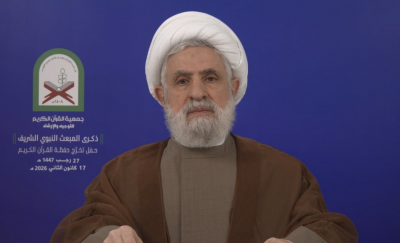
By choosing escalation against the state — its president, its government, and its foreign minister — Qassem has nonetheless laid bare the extent of the strategic confusion now gripping Hezbollah.
Behind this supposed “renewed confidence” lies a calculation as fragile as it is dangerous: the sense of relief stemming from the possibility of a U.S. pullback from striking Iran.
“Sheikh” Qassem, however, seems to forget — or chooses to ignore — that if the risk of U.S. action against Tehran recedes, even temporarily, the likelihood of an Israeli strike against his party mechanically increases.

The rejection of reason he now displays protects neither his camp nor Lebanon; on the contrary, it hands Israel yet another pretext to intensify its attacks.
Yes, “not one stone will be left standing, and no one will be spared.” But this will not be the result of the so-called “anomaly known as the foreign minister,” nor of some external conspiracy.
It will be the direct consequence of the real anomaly: a state within a state that persists in confusing illusion with reality. And so one is left to ask: “To whom are you reciting your psalms, David?”
This show of bravado comes just as Lebanon had barely begun to benefit from a positive diplomatic momentum, with the announcement of a support conference for the Lebanese Army, scheduled to take place in Paris on March 5.
Instead of accompanying this effort, Hezbollah once again chose confrontation.
This time, Qassem explicitly targeted the international community, represented by the “Quintet,” [the group of five countries involved in the Lebanese issue, including Saudi Arabia, Qatar, Egypt, the United States, and France], accusing it of pressuring Lebanon rather than Israel.
It is a familiar reversal of roles: Any attempt to strengthen the state is framed as betrayal, and any demand for sovereignty as a foreign plot.
The timing is no coincidence. His intervention comes at a critical moment, as the Lebanese Army prepares to present its plan for the withdrawal of weapons north of the Litani River, following the completion of the first phase south of the river.
One does not need to be particularly astute to understand that Hezbollah intends to block this step before it even begins.
To that end, Qassam goes so far as to deny the very existence of successive phases, claiming that the Nov. 27, 2024, agreement contains only a single stage — one that, according to him, Lebanon has already fully implemented.
Where Aoun — rightly or wrongly — seeks to reconcile Lebanon’s contradictions, Qassem works methodically to exacerbate them.
The president is trying to reestablish the state as a space of mediation between sovereignty and national cohesion; Hezbollah’s secretary-general, by contrast, continues to pull the country back toward a logic of escalation and blind alignment with Iran.
This is particularly true because the debate is not solely about weapons, but about the very nature of the state. Is it a state that abides by its own Constitution, the Taif Agreement, and international resolutions, or an open arena for permanent power struggles?
Aoun is seeking the first option, meaning anchoring Lebanon in a constitutional, rules-based state.
Qassem, for his part, insists on the second, which is a system governed by power balances and armed leverage.
Aoun knows, from experience, that the monopoly over legitimate violence is not secured by decree, but through trust and legitimacy.
Qassem, by contrast, acts as though raising his voice were enough to turn the clock back.
For behind this verbal escalation lies a more uncomfortable reality: Hezbollah is on the defensive.
Regionally isolated and confronted with a state tentatively trying to reclaim its voice, it now has little left but the rhetoric of fear to conceal the erosion of its position.
One central question remains: Does Qassem himself have the guts to carry out the threats he brandishes?
This article was translated from L'Orient-Le Jour by Sahar Ghoussoub.