












We have entered a decisive moment — one in which the Iranian uprising will either finally force the regime to yield or, conversely, break once again against the wall of propaganda and repression.
Predicting whether the regime will fall is a perilous and ultimately futile exercise, for the simple reason that we know nothing — or very little — about what truly matters. What are the inside dynamics ? Who makes the decisions beyond Supreme Leader Ali Khamenei ? What calculations are being made by the Revolutionary Guards and the army ?
We can — and indeed must — analyze and anticipate the various scenarios based on what we know, while simultaneously acknowledging that our knowledge is too limited to be fully reliable.
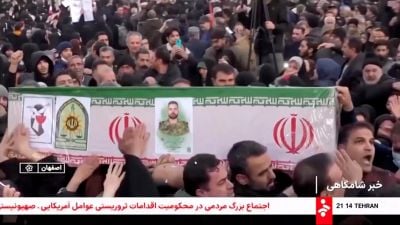
What we are seeing for now is that the Islamic Republic is deploying its usual playbook, previously used in Iran, Iraq, Syria and Lebanon. Protesters are labeled as terrorists, the uprising is framed as a foreign conspiracy, internet and telecommunications networks are cut, and repression is in full force.
The regime believes its survival depends on its ability to crush the movement, and that showing a willingness to make significant concessions in negotiations would amount to signing its own death warrant. As long as the security apparatus holds, the regime will not fall, regardless of the scale of the protests.
While divisions likely exist within the regime, they have so far not resulted in significant public positions or defections. Internally, the success of a revolution depends not only on the organization of the opposition — its structure and armament — but even more on the resilience of the forces tasked with defending the regime.
A large portion of these forces must believe that the regime is finished for it to truly collapse, regardless of its objective vulnerabilities. If the situation does not evolve, the fate of the Iranian revolution rests entirely in the hands of Donald Trump.
The U.S. president has been briefed on the various military options available for intervention, while also threatening to act if protesters are killed — which, in all likelihood, appears to be happening on a significant scale.
Trump has already used his hammer on numerous occasions, most recently in Venezuela. He did so multiple times in the Middle East and even against Iran when he ordered the assassination of Qassem Soleimani in 2020 or the bombing of [nuclear] sites at Fordow, Natanz and Isfahan last June. But all these interventions had a specific objective and were calibrated to be both decisive and limited in time.
In comparison, the current situation is far more complicated. U.S. forces could target military sites or symbols of power, and might even be able to eliminate the Iranian supreme leader and part of the establishment. But it is very difficult to know whether such actions would be decisive. They could embolden protesters to push further and pressure the regime into negotiating its surrender.
But they could also enable the regime to rally some of the discontented against the external threat, driving it to fight for its survival at the expense of the last Iranians, Yemenis, Iraqis and Lebanese. If Washington does nothing, it will lose credibility, as happened with Barack Obama’s retreat in 2013. Yet its intervention is not carefully calibrated and risks rendering the situation even more chaotic.
It is common to criticize U.S. foreign interventions, particularly in the Middle East — and for good reason: they have often had catastrophic effects, especially in Iraq. No one knows how the regime would respond to such an intervention, which could trigger a regional conflict, let alone what would come after it if it were to bring down the regime.
The opposition at home is neither structured nor armed. The opposition abroad is divided, and the only figure that stands out is the Shah’s son, Reza Pahlavi, whose sudden popularity in Iran — 47 years after the revolution that toppled his father — appears partly linked to Israeli influence.
There are a thousand and one reasons to fear a U.S. intervention — especially when the president is Trump, whose international actions are largely driven by an imperialist and neo-colonialist vision. There is also reason to fear it in the Middle East which is already undergoing profound realignment, and more often than not in fragments, where Israel acts as the main destabilizing force.

But without outside intervention, the revolution is likely to be nipped in the bud and the regime, though doomed, will gain a little more time. In these circumstances, there is no good solution. Just a lesser evil compared to the other, depending on what one considers most important.
Even a Venezuelan scenario, which would allow the regime to survive by sacrificing Khamenei or changing policy — which would be seen as optimal by Trump and many countries in the region — would not be a lasting solution or particularly beneficial for Iranians.
Arguably the wisest way to prop up the protesters is by offering them logistical and political support and increasing pressure on the regime without intervening militarily.
But would that be enough to alter the behavior of a regime that, over the past 47 years, has: confronted Iraq, Israel and the United States ; has been among the most sanctioned and most isolated in the world ; has repeatedly been delegitimized by its own population ; has accumulated defeats in recent years — yet has never changed its operating mindset ?
This article was originally published in French in L'Orient-Le Jour and translated by Joelle El Khoury.

 8 p.m. recap: Israel again threatens Beirut’s south suburbs; 2 ships hit near Hormuz; Riyadh football matches canceled