












If Lebanon is ever to become a sovereign state, it must confront two major challenges. On the one hand, a neighboring country that occupies a large part of its territory, which has invaded it on at least three occasions in the past, which is vastly superior to it militarily, which pursues an expansionist agenda whose contours remain unclear, and which is prepared to destroy everything around it in the name of its security.
On the other hand, there is a militia subservient to a foreign regime, which has dragged Lebanon into several wars against its will, which seeks to maintain its dominance, and which threatens to undermine civil peace if its weapons are challenged.
Two major obstacles for a structurally fragile country, whose various constituents make no secret of their deep disagreements over the causes of the problem, let alone the best way to resolve it.

On one side of the political spectrum, some argue that making a (cold) peace with Israel is more realistic than doing so with Hezbollah, and that the priority is to stabilize the southern border, recover lost territories, and neutralize the militia.
On the other side, others maintain that Israel remains the principal enemy, that ending the occupation must come first, and that the issue of Hezbollah's weapons — if it is to be addressed at all — should be resolved through negotiations with Iran.
The highly charged reactions, from both camps, to the signing of the memorandum of understanding between the United States and Iran, followed by the framework agreement between Lebanon and Israel, illustrate the extent of the polarization surrounding the debate.
Each side saw the agreements as a capitulation, with the perceived beneficiary varying depending on their perspective.
Neither of the two proposed solutions is, however, satisfactory. The U.S.-Iran agreement provides genuine leverage over Israel, but it also makes Iran an absolutely indispensable player in Lebanon. If one is genuinely committed to Lebanon's sovereignty, the agreement only makes sense if one believes it is possible to reach an acceptable compromise with Tehran over Hezbollah's role and influence — a view we do not share, for reasons we have already explained.
The framework agreement between Lebanon and Israel also has numerous flaws. It is highly favorable to Tel Aviv, which unfortunately reflects the reality on the ground. It does not impose any timetable for the withdrawal of Israeli troops and even stipulates, in Article 13, that Lebanon waives its right to pursue legal action over potential war crimes committed by its neighbor on its territory.
One could argue that, in any case, it is worthless, since it is no more enforceable than the one that was supposed to bring an end to the war in Gaza. Or that it risks entrenching the Israeli occupation under the pretext of ending it, and that those who welcome its conclusion do so only because the Islamic Republic and, by extension, Hezbollah are its main losers.
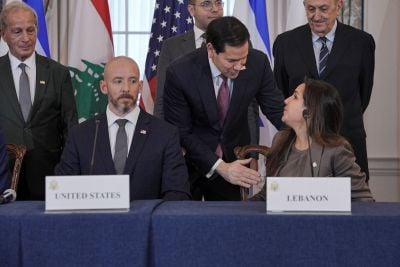
None of this is entirely untrue, but it misses the essential point: this agreement, unlike the one negotiated between Tehran and Washington, has been approved by the Lebanese authorities and outlines the contours of a path that could finally turn Lebanon into a sovereign state.
It ties Lebanon’s future not to the calculations of the Islamic Republic but to decisions taken and implemented by Beirut. In that sense, it is the lesser of the two evils and deserves that the conditions for its success be outlined.
The first objective of the agreement is to stabilize the southern border. It is not about normalizing relations with Israel, or going "to party in Tel Aviv", or abandoning the Palestinian cause, or even less about turning Israel into an ally, but about ensuring that there are no more wars between the two countries.
It is somewhat less than a peace agreement — which would be poorly received domestically and by Saudi Arabia — but more than a mere security arrangement.
For many Lebanese, the very idea of signing an agreement with Israel, after the genocidal war it waged in Gaza and while it occupies and bombs us, is extremely painful to accept. This feeling is entirely understandable given the scars of the past, as well as the recent conduct of Israel in Lebanon and across the region.
However, this is not a matter of sentiment but of reason. Since 1948, at least eight wars have opposed Lebanon and Israel, with an unequivocal outcome: Beirut has never gained anything, has always paid a heavy price for the conflict, and has not in any way improved the situation of the Palestinians.
Lebanon therefore has no interest — except an ideological one — in remaining in a permanent state of war with its neighbor. Better still, given the change of regime in Syria, it could, for the first time in eight decades, maintain non-hostile relations with both of its only neighbors, which would constitute a paradigm shift.
While a large majority of Lebanese, including within the Shiite community, supports stabilizing the border, many believe that this does not depend on Beirut but on Tel Aviv and its expansionist projects.
Although the last three wars were initiated from Lebanese territory and Israel did not build any settlements during the 22 years it occupied it, this idea cannot simply be dismissed out of hand. All the more so when a minority of Israelis openly express their desire to colonize southern Lebanon, and when this minority is increasingly influential on the Israeli political scene. And when Israel defines itself as a new "Sparta" and seeks to impose its will by force on all its neighbors, including, as in Syria, those that officially harbor no hostility toward it.
One could argue that Israel has not gone to war with any of the countries in the region with which it has signed peace agreements, but that would probably not be enough to reassure the most skeptical voices.
Even Egypt, Jordan, and even Saudi Arabia fear an Israel without safeguards and see it as one of the main sources of instability in the region, not to mention its refusal to make any meaningful concessions to the Palestinians.
In order for the first objective of the agreement to be achieved, Lebanon will need guarantees. Since the balance of power will always be in Israel’s favor, regardless of the equipment the Lebanese Army receives, these guarantees must be diplomatic in nature. A demarcation of the land borders, and even more importantly, a commitment by the United States and European countries — particularly through a military presence — to act as guarantors, will be necessary.
It is, however, the second objective that will be by far the most difficult to achieve and that constitutes the agreement’s main weakness. It makes the withdrawal of Israeli forces conditional on the "disarmament" of Hezbollah, which in practice risks amounting to a long-term occupation of the territory.
In this sense, many experts and diplomats view the agreement as a trap for Lebanon, as they believe it is incapable of "disarming Hezbollah" and that such an action, if it were ever undertaken, would inevitably trigger a civil war.
The reality, however, appears far more complex. On the one hand, it is necessary to agree on what "disarming Hezbollah" actually means before declaring whether it is feasible or not. On the other hand, it would be misleading to rule out the many possible scenarios that lie between continued Hezbollah dominance —and by extension Iranian dominance —over Lebanon against its will and the outbreak of a new civil war.
Above all, clarity is needed on the objective: either one considers that sovereignty is a commendable but naive aspiration, and accepts that it will always depend on the will of Iran, which is the underlying logic of the U.S. agreement. Or one believes that Lebanon’s sovereignty is the overriding priority, and that the debate should concern only the means of restoring it.
The issue of the "disarmament of Hezbollah" has suffered greatly over the past two years from both a lack of clarity and the spread of misinformation. The debate has been shaped by two main ideas that have done more to obscure than to clarify the issue.
On the one hand, there is the belief that the main problem lies in the Lebanese Army’s lack of capacity ; on the other, there is the assumption that disarmament would necessarily entail an open war between the army and the militia.
After numerous conversations with Lebanese and foreign officials, it appears that the main issue in this regard is not one of capacity, but of will. The Lebanese Army has traditionally shown strong reluctance to use force, particularly in internal affairs. It did so only in a limited and reluctant manner in 1948, remained neutral in 1958 when the country was on the brink of civil war, refused to engage alongside other Arab states in 1967, and eventually imploded when it abandoned its neutrality during the civil war.
Moreover, over the past three decades, it has fought only Sunni Islamist forces, which it views as its primary threat. From its perspective, Hezbollah is a partner — sometimes difficult or even hostile — but not an enemy to be neutralized. The fact that the army is composed of at least 30% Shiites reinforces this perception, as well as fears of a breakdown in the event of a confrontation with the pro-Iran militia.
In this context, the will must first come from the political authorities, particularly the President of the Republic, before the issue of capacity can be seriously addressed. It is his responsibility to take the necessary decisions if part of the army refuses to implement the executive branch’s directives. However, this would be far easier if the military receives substantial international support throughout the process.
The mission in question is not to fight every Hezbollah militiaman or to search every house for weapons, but to gradually neutralize its capacity to cause harm. The military dimension is of course essential to enforcing the state’s authority across the entire territory, but it cannot be the alpha and omega of a policy aimed at the "disarmament" of Hezbollah.
Hezbollah has multiple roles, and each of them will need to be addressed if it is to be effectively neutralized.

This first requires breaking with the idea that it is an indispensable component of the nation, and instead treating it as a criminal organization that must be confronted by the official authorities. It means excluding it from Cabinet, and cleansing the ministries, senior state institutions, and especially the security apparatus of its influence.
It also means cutting off its financial and military resources through a robust policy of containment. Finally, it entails restoring the authority of the state by arresting party officials who threaten civil peace.
Hezbollah will not take this lying down. It will resort to intimidation and attacks. It will mobilize the streets against the army and attempt to bring down the Cabinet. But while it is supported by foreign countries and by a majority of the population, the Cabinet can hold its ground, and the longer it does so, the more Hezbollah will lose its ability to intimidate the rest of the country.
The greatest difficulty, however, will be ensuring that this policy is not seen as targeting an entire community. For this reason, it should be accompanied by a genuine national dialogue on the future of Lebanon’s political formula, and should also allow for the swift launch of the reconstruction of the South, which must fall entirely under state responsibility.
This is precisely why the agreement with Israel must be substantially improved. It is understandable that Israelis may doubt Lebanon’s willingness to neutralize Hezbollah, but it will be impossible for Beirut to do so as long as Israel continues to occupy the territory.
Disarming Hezbollah against its will is not a matter of months, but of many years. Withdrawal should therefore not be conditioned on its full completion, but on more realistic and gradual steps that would allow Lebanon to demonstrate that it is finally ready — however long and difficult the process may be — to regain its sovereignty.
This editorial first appeared on L'Orient-Le Jour and was translated from French by Joelle Khoury.