


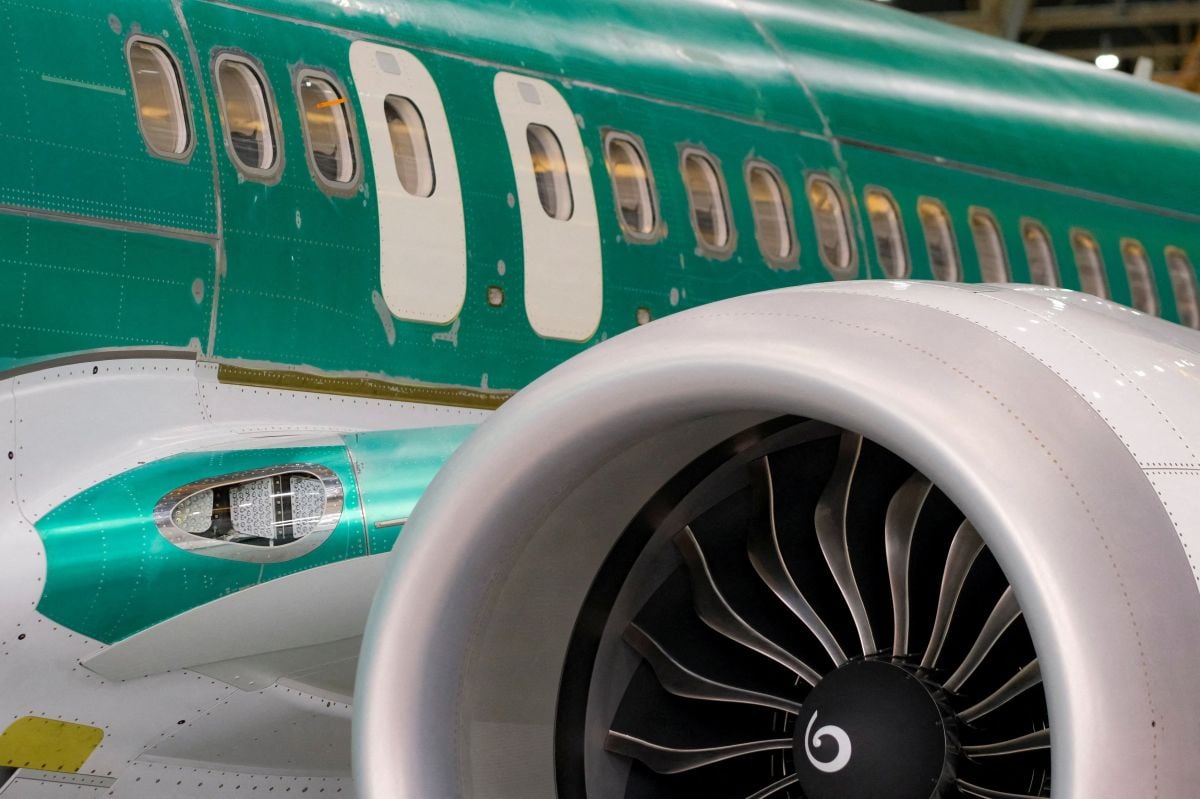
The engine of a 737 MAX on the final assembly production line during a media tour of the Boeing factory in Renton, Washington, U.S., April 15, 2026. (Credit: Genna Martin/Reuters)






BEIRUT — Boeing announced Monday that it has reached an agreement with aviation startup Archer Aviation to sell it several projects and technologies in exchange for a stake in the company.
Under the deal, Archer will take control of Wisk Aero, which develops electric vertical takeoff and landing (eVTOL) aircraft designed for autonomous flying taxis; SkyGrid, which specializes in air traffic management; and Insitu, a drone maker that serves, among others, the defense sector.
In return, Boeing will receive shares representing 19.75% of Archer’s capital before the deal closes and will be able to appoint a director to Archer’s board, according to Reuters.

The transaction still requires regulatory approval and is expected to close by the end of the year. Archer shares surged Monday on the New York Stock Exchange following the announcement.
Archer is developing a flying taxi service using its electric Midnight aircraft. The company hopes to use the aircraft in New York to connect Manhattan with airports in less than 15 minutes. It also aims to have its aircraft ready for the 2028 Los Angeles Olympics to showcase its technology.
By acquiring Boeing’s businesses, Archer hopes to speed up the development and commercialization of its aircraft.
“This is a decisive turning point for Archer and the future of physical artificial intelligence in aerospace and defense,” CEO Adam Goldstein said in a joint statement.
Defense technologies
The deal is also expected to strengthen Archer’s presence in the defense sector. According to specialized outlet Breaking Defense, technologies from Wisk, SkyGrid and Insitu are expected to be integrated into Archer’s artificial intelligence platform, ZEE.
Insitu supplies technology to armed forces in 35 countries. Its acquisition is particularly significant for Archer because it gives the startup access to an established and profitable business, while its main eVTOL business has yet to generate significant revenue. Insitu generates more than $200 million in annual revenue, according to Reuters.
The agreement also includes “collaboration and technology sharing” between the two companies. Boeing will retain access to Wisk’s main autonomous flight technologies, allowing it to use them in its current and future commercial and defense aircraft.
The deal is part of Boeing CEO Kelly Ortberg’s strategy to sell assets considered non-essential and refocus the company on its core commercial aviation and defe n se businesses.
Boeing will nevertheless continue to support Archer financially. According to Breaking Defense, citing The Air Current, Boeing has committed to invest up to $55 million in Archer during an upcoming funding round. It could also purchase up to $200 million in additional shares at a pre-set price.
At its most recent earnings presentation in May, Archer said it had completed the third of four stages of certification by the Federal Aviation Administration (FAA) for its Midnight aircraft.
Despite growing interest in eVTOL aircraft in recent years, the sector is still struggling to achieve large-scale commercialization, mainly because of regulatory and development challenges.
As progress has slowed, several companies have increasingly turned to defense, cargo transport and government markets, which could generate revenue more quickly.

 7 p.m. recap: Houthis strike Riyadh airport again; Yemeni forces claim Bab al-Mandeb gains; Abbas postpones Palestinian polls