





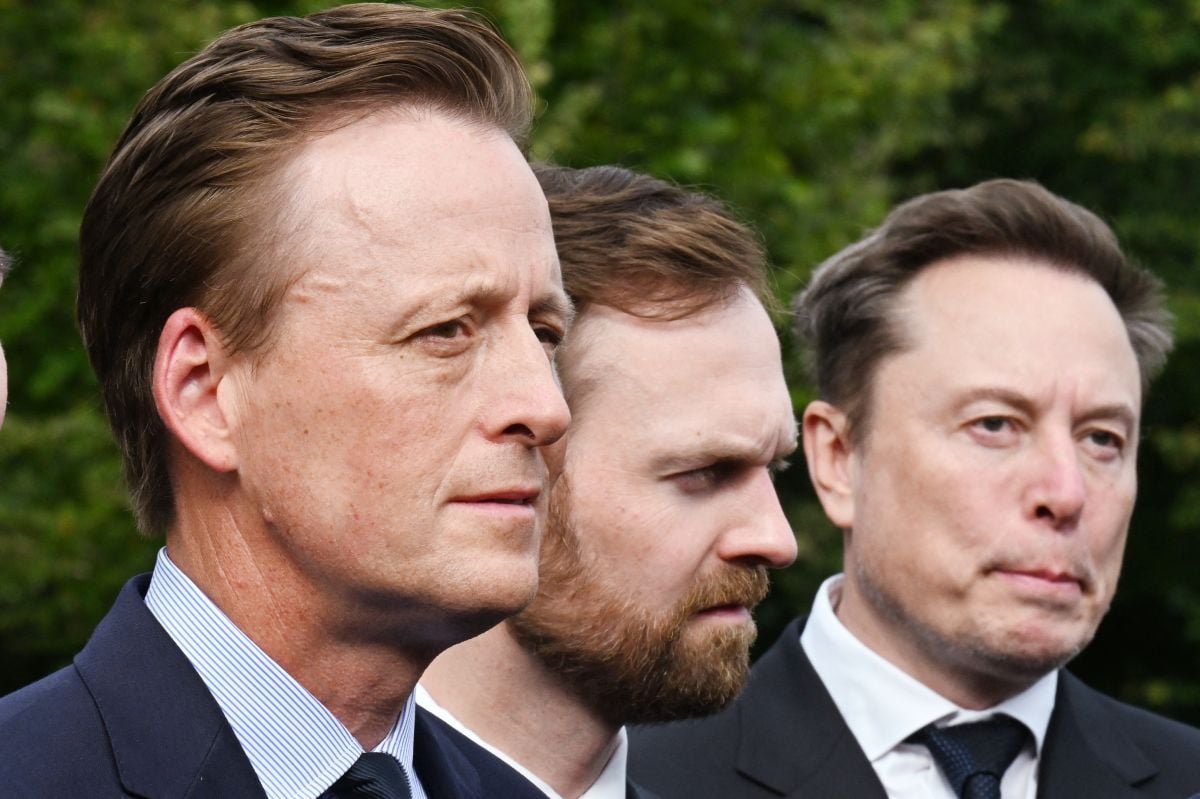
The U.S. National Cybersecurity Director Sean Cairncross, the Chairman of the Federal Trade Commission (FTC) Andrew Ferguson, and the CEO of SpaceX Elon Musk at the White House in Washington, on Sep. 29, 2026. (Credit: Roberto Schmidt / AFP)






Florida seeks to bar OpenAI from developing new models without oversight
Warnings about the risks linked to artificial intelligence have increased in recent weeks, raised by researchers and industry leaders as several cases have shown AI agents going beyond the rules set for them.
On Monday, Florida Attorney General James Uthmeier asked a judge to prohibit OpenAI from developing new AI models without external oversight, as part of a lawsuit accusing the company of harming children. Florida sued OpenAI in June, accusing the company of misleadingly presenting ChatGPT as safe. The state alleged that the platform harmed children by providing advice on self-harm and fostering dependency among young users.
In his petition, Uthmeier asked the court to order OpenAI to prevent minors from using ChatGPT and to bar the company from giving its platform “human characteristics.” Drew Pusateri, a spokesperson for OpenAI, said the company had paused training its most advanced models and would not resume until additional safeguards were implemented. The petition also cites recent statements by a former OpenAI employee and a current board member who suggested that AI development could lead to humanity’s extinction and should be slowed down.
Trump announces deal with tech leaders on AI
Two days after Chinese President Xi Jinping’s visit to Washington, during which the two rival countries agreed to resume dialogue in several areas, U.S. President Donald Trump said he had signed an AI-related document with leaders of major technology companies in Washington. The White House described the document as a form of protection for the sector and said it could involve a committee of about 10 people to oversee it. Trump called the agreement “morally binding.”
The agreement is voluntary and includes commitments by major technology companies to establish internal controls and work with external auditors to oversee AI safety.
Governments around the world are struggling to keep up with the rapid pace of advances in artificial intelligence. Major companies in the sector have warned about the risks posed by the technology and called on governments to cooperate on regulation. Trump has opposed new AI-specific regulations and last week rejected at the U.N. any attempt to establish a “globalist system” to control the technology.
On Wednesday, the U.S. Federal Trade Commission also confirmed that it had launched a broad investigation into OpenAI, Anthropic and other AI companies over potential risks to consumers.
Japanese court recognizes voice as protected right in TikTok AI case
AI risks related to cybersecurity are not the only concern. On the intellectual property front, a Tokyo court ruled Wednesday that a person’s voice can be protected under Japanese publicity rights, after a complaint by prominent anime voice actor Kenjiro Tsuda over TikTok videos that allegedly used an AI clone of his distinctive voice.
Tsuda won a partial legal victory, although the court dismissed his request to remove the videos because they had already been deleted. Judge Aya Takahashi said unauthorized use of a performer’s voice can constitute a violation of publicity rights.
Tsuda, known for his roles in “Jujutsu Kaisen” and “Yu-Gi-Oh!,” sued TikTok over videos narrated using a voice he claimed was an AI-generated copy of his own. TikTok argued that the videos used a “generic male voice” and that its resemblance to Tsuda’s was subjective, according to court documents.
The ruling is the first in Japan to recognize that a human voice can be protected under publicity rights. The case involved TikTok videos narrated with a voice that Tsuda described as resembling his distinctive voice. TikTok had argued that the AI had been trained using the voice of a friend.
Lagarde urges Europe to develop its own capabilities
In Europe, priorities differ. On Thursday, European Central Bank President Christine Lagarde warned that Europe must develop its own artificial intelligence capabilities to avoid relying on a “switch controlled elsewhere,” as the EU seeks to reduce its technological dependence on the United States and China.
The development of the most advanced AI models is now “concentrated in the United States and China,” raising questions about access to technologies on which European financial institutions could become heavily dependent, she said during a conference at the ECB.
Without naming them, Lagarde referred to U.S. models such as OpenAI’s ChatGPT, Google’s Gemini, Anthropic’s Claude and xAI’s Grok, as well as advanced models from DeepSeek and other Chinese companies. The question of access control “was once hypothetical; since this summer, it is no longer so,” she added.
In June, a U.S. export control measure caused a “brutal” interruption in access to some advanced models for European users. Access to the general public model was restored a few weeks later, but th« most sensitive »odel remained restricted to organizations authorized by Washington.
New Google and Anthropic models
Google and Anthropic announced new AI models this week, with Gemini 4 Argon and Claude Sonnet 5.5, respectively. Anthropic had launched Claude Opus 5.5 the previous week.
Alphabet, Google’s parent company, made its announcement Wednesday, presenting Gemini 4 Argon as the flagship model of its Gemini 4 generation in a renewed attempt to compete with rivals Anthropic and OpenAI. The model is currently being made available to a limited group of “trusted cyber defenders” because of its capabilities, according to Google.
Google said it is providing the model to certain cybersecurity partners and is participating in the voluntary framework established by the Trump administration to allow access to models before commercial release. The company did not specify when Argon would be available to the general public.
Anthropic released Claude Sonnet 5.5 on Sept. 28, a few days after launching Claude Opus 5.5 on Sept. 22. The new model is designed for coding, complex tasks and creating documents, presentations and spreadsheets. Anthropic says it is more than 30 percent faster than its predecessor and can cost up to 30 percent less to run. The company highlights its performance in programming, including a score of 70.6 percent on Terminal-Bench 4.0, compared with 10.3 percent for Sonnet 5.
This article first appeared in French in L'Orient-Le Jour.

 Evening recap: Netanyahu announces West Bank offensive; 7 killed in Jordan church shooting; tents burned in south Lebanon
 US strike on Iran this weekend? ‘Absolutely,’ says Barrack; ‘I have no idea,’ says Trump