






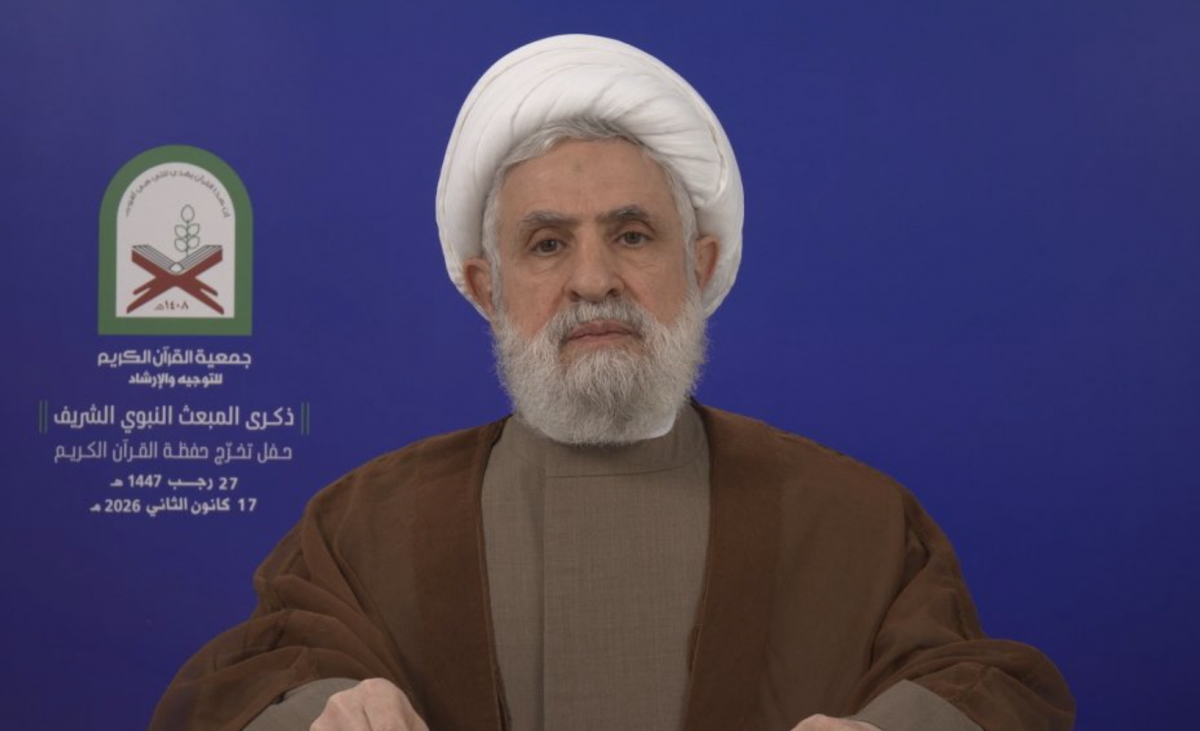
The Secretary General of Hezbollah, Naim Qassem, during a speech on Jan. 17, 2026. Photo published on the party's channel, Al-Manar.






Hezbollah Secretary-General Sheikh Naim Qassem on Saturday escalated his rhetoric against Lebanese figures calling for a state monopoly over weapons, and thus the full disarmament of his organization, describing the demand as an “Israeli-American” agenda.
“If we are not all united, no one will survive,” he said. The leader harshly denounced “groups under American tutelage who encourage Israeli aggression,” singling out Foreign Minister Joe Rajji of the Lebanese Forces. Qassem accused Rajji of being “aligned with the Israeli position” and of seeking to “drag Lebanon into civil war.”
“Undermining Lebanon’s stability and the resistance, as an essential component of the country, will affect everyone. Not a stone will be left, and no one will be spared,” Qassem said, in a barely veiled threat. “If this resistance, this social base, and these people are not preserved, and if we are not all united, no one will survive,” he added.
Qassem’s speech came after the president urged Hezbollah to show “reason” over handing over its weapons. The Lebanese Army completed the first phase of a disarmament plan targeting the pro-Iranian group in early January, covering areas south of the Litani River, and is set to begin four additional stages in February across the rest of the country. Hezbollah has refused to surrender its weapons north of that zone, fueling concerns over potential internal unrest.
'There is no foreign minister in the country'
Qassem devoted a significant portion of his address to attacking Foreign Minister Joe Rajji, whom he accused of acting “against government policy and the presidential mandate” and of “granting Israel the right to attack Lebanon.”
“What patriot behaves like this?” he asked. He accused Rajji of “playing with civil peace” by inciting discord and calling on the Lebanese army to confront “the people,” adding that the minister wanted to “drag Lebanon into civil war.”
Earlier this week, Rajji, an outspoken critic of Hezbollah and Iranian influence in Lebanon, said the group’s weapons had become “a burden on the Shiite community,” adding that “as long as weapons are not fully monopolized by the state, Israel unfortunately retains the right to continue its attacks under the agreement.”
Qassem responded by saying the government “bears responsibility for addressing this anomaly called the ‘foreign minister,’” whom he accused of failing to represent Lebanon’s position. He called for Rajji’s removal, silence, or alignment with what he described as the national stance. “One of the reasons for the government’s poor performance is the absence of a foreign minister who voices Lebanon’s demands,” he said.
The Hezbollah leader also argued that Israel “has no connection” to UN Security Council Resolution 1701, which calls for the disarmament of militias in Lebanon and forms the basis of the ceasefire that took effect in November 2024. He described the resolution as “a purely Lebanese matter,” alongside issues such as arms monopoly and national defense strategy.
'Israeli-American demand'
Qassem said the government decision last August to enforce a state monopoly on weapons amounted to an “Israeli-American demand aimed at encircling the resistance,” rather than a Lebanese choice.
“If we do not have weapons and do not defend ourselves, who guarantees that Israel will not violate every inch of Lebanese soil?” he asked. “The resistance will remain, and Lebanon will not be without resistance,” he insisted.
He also urged the Lebanese state to secure the withdrawal of Israeli troops from Lebanese territory, where Israel still controls at least five points near the border. “After the cease-fire agreement, the state became responsible for protecting the country and its people, after decades of neglect,” he said.
Finally, Qassem addressed the uprising in Iran over the past three weeks, saying its aim was to “bring down the Iran of the resistance.” Echoing Iran’s Supreme Leader Ali Khamenei, he accused U.S. President Donald Trump and Israeli Prime Minister Benjamin Netanyahu of activating “agents.”
“We stand with Iran and believe it is steadfast and strong. God willing, it will remain a stronghold of jihad and resistance,” he said.
According to the Norway-based NGO Iran Human Rights (IHR), at least 3,428 protesters have been killed by security forces, though the group says the toll could be significantly higher. Other estimates cited by IHR put the number of deaths above 5,000, possibly reaching 20,000.
