


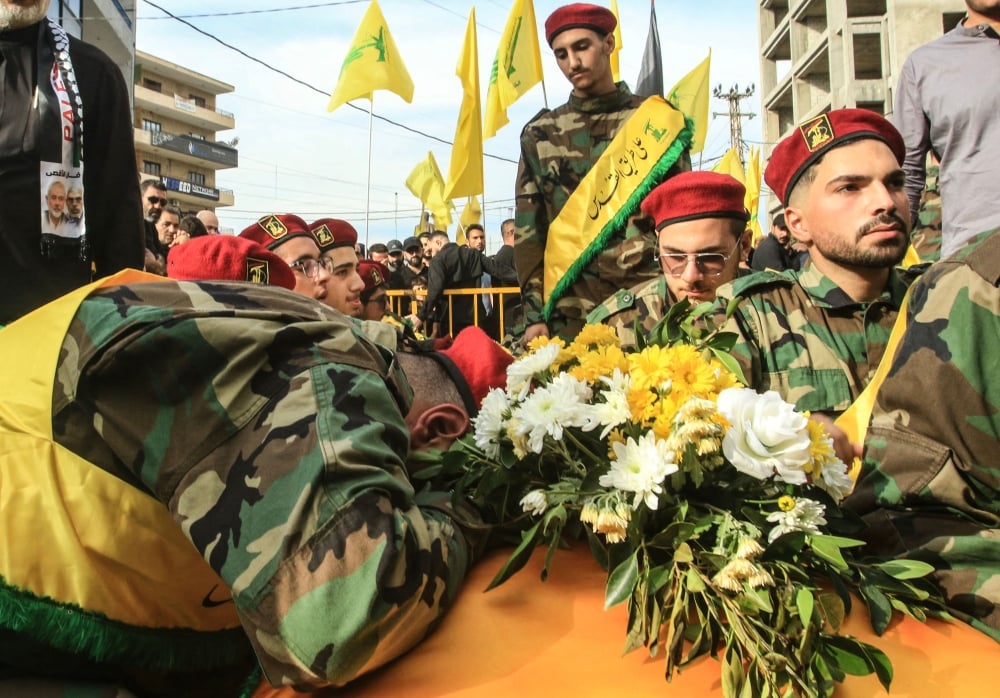
Hezbollah members mourn over the coffins of their comrades killed in recent Israeli attacks during their funerals in Nabatiyeh, southern Lebanon, on Nov. 2, 2025. (Credit: Mahmoud Zayyat/AFP)






Ahead of a new Cabinet meeting at the Presidential Palace in Baabda, partly devoted to restoring the state's arms monopoly and the disarmament of non-state groups, Hezbollah sent an open letter Thursday morning to President Joseph Aoun, Prime Minister Nawaf Salam and Parliament Speaker Nabih Berri.
In the letter, Hezbollah reiterated its opposition to disarmament and its refusal of engaging in "political negotiations" with Israel. This refusal comes as Aoun has repeated in recent days that Lebanon "has no choice but to negotiate with Israel," while U.S. and Israeli pressure for direct talks is mounting. For his part, Speaker Berri said Tuesday that such negotiations could be conducted through the cease-fire monitoring committee established on Nov. 27, 2024, with potential participation from “civilian or military” experts.
'The Israeli enemy is not only targeting Hezbollah'
Directly criticized by a segment of Lebanon's political class and population, Hezbollah warned against "becoming entangled in the traps of new negotiations." According to the party, "Lebanon’s duty at present is to insist on the cessation of aggression in accordance with the cease-fire text and to pressure the Zionist enemy to abide by it and not to submit to extortion or to enter political negotiations with the Zionist entity under any circumstances. Such a course serves no national interest and poses existential risks that threaten Lebanon’s very sovereignty and survival."
"Let it be clear to all Lebanese that the 'Israeli' enemy does not target Hezbollah alone, but all of Lebanon. It further seeks to strip Lebanon of every capacity to reject the Zionist entity’s extortionist demands and to impose submission to its policies and interests in Lebanon and the region. This demands a unified, dignified national stance that compels respect for our country and people and safeguards Lebanon’s sovereignty and honor."
The party also regretted "the hasty decision by the Lebanese government" made during a series of Cabinet meetings held between August and September, after which the Lebanese Army was tasked with following up on the matter.
Returning to last November’s cease-fire, Hezbollah recalled that "the Israeli army continues to violate it by air, sea and land." Hezbollah again asserted that the truce provides "a mechanism to implement U.N. Security Council Resolution 1701 adopted in 2006, which defined the area of operation as exclusively southern Lebanon, south of the Litani River and stipulated that this area should be cleared of weapons and fighters and that the Israeli enemy should withdraw behind the well-known Blue Line."

Lebanese authorities, Washington and Tel Aviv, for their part, insist that disarmament applies to the whole Lebanese territory.
"While facts on the ground confirm that Lebanon and Hezbollah have strictly abided by the contents of the cease-fire declaration from the moment of its issuance until today, the Zionist enemy has nonetheless continued its violations and breaches of the declaration [in land, sea, and air]. It continues to do so to this moment, disregarding all calls to cease these hostile practices." Hezbollah said.
'Hasty decision' by the Lebanese government
Instead, the enemy has exploited these calls to blackmail Lebanon, imposing conditions and demands to evade halting its aggression, persisting in its project to subjugate Lebanon, humiliate its state, people and army." For Hezbollah, this blackmail aims solely to "drag [Lebanon] into a political agreement through which it would extract Lebanese recognition of the enemy’s interests in our country and region — along with recognition of the legitimacy of its forcible occupation of others’ land in Palestine."
"Although the government’s hasty decision regarding the exclusivity of arms was presented by some as a gesture of Lebanese goodwill toward the enemy, the latter exploited this governmental mistake to impose the issue of disarming the resistance throughout Lebanon as a precondition for ending its hostilities. This was neither stipulated in the ceasefire declaration nor can ever be accepted or imposed," the party insisted.
In this context, Hezbollah again maintained that "the monopoly on weapons must not be enacted at the request of a foreign party or in response to Israeli blackmail, but in a national framework." It then stressed that its letter reflects its "desire to short-circuit attempts to lead the Lebanese state into new cycles of negotiations that serve only the objectives and interests of the Zionist enemy and authoritarian forces hostile to justice and fairness."
"Out of Hezbollah’s keenness for national understanding, the protection of sovereignty, and the preservation of security and stability in Lebanon; and in contribution to strengthening and supporting a unified Lebanese position against the Zionist aggression and its ongoing violations of the cease-fire," resulting from the efforts of American mediator Amos Hochstein. It also expressed its intention to "contribute to the strengthening and support of a unified Lebanese position against Israeli aggression and its ongoing violations of the cease-fire."
Following the latest warnings from U.S. envoy Tom Barrack, who called Lebanon a "failed state" and warned of an Israeli offensive if there were delays in Hezbollah's disarmament, his predecessor Hochstein said the government and military should be "given leeway."
"As a founding component of Lebanon our final homeland for all its sons- we reaffirm our legitimate right to resist occupation and aggression, and to stand beside our army and our people in defending the sovereignty of our country. Legitimate defense does not fall under the rubric of “a decision of war or peace,” but is rather an exercise of our right to resist an enemy that wages war upon us, continues its aggression, and seeks to subjugate our State," the party concluded.
 2 Israeli soldiers injured in 'operational accident,' as army continues attacks in the South