


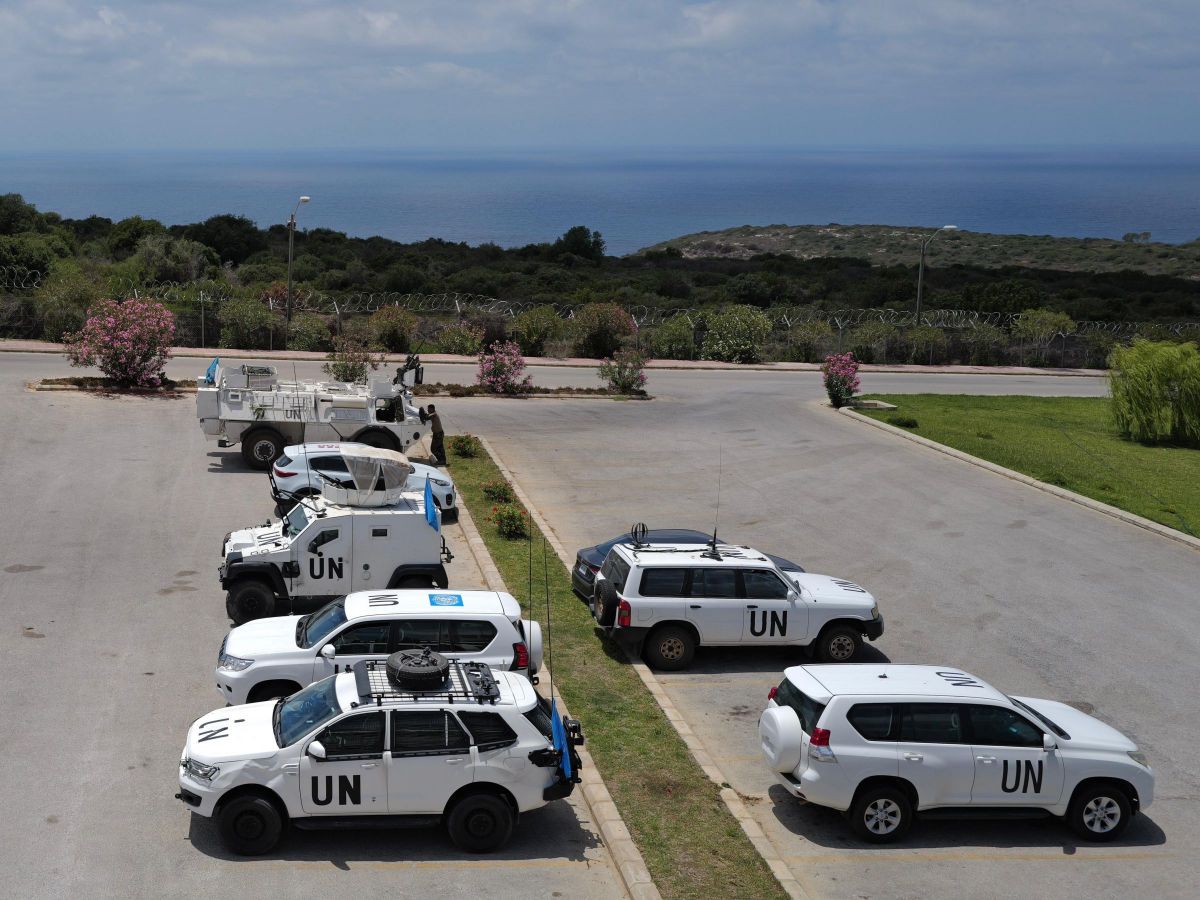
Vehicles of UNIFIL parked at the Blue Helmets’ headquarters in Naqoura, southern Lebanon, on July 8, 2025. (Credit: Matthieu Karam/L’Orient-Le Jour)






Lebanese Parliament Speaker Nabih Berri said on Tuesday that negotiations with Israel, called for by Washington and considered unavoidable by President Joseph Aoun, could be held through the cease-fire monitoring committee (the "Mechanism"), potentially involving "civilian or military" experts.
This option was discussed as the head of state once again stated that talks are a "consensual choice" in Lebanon, while Israel has not yet made a decision on the matter, according to him.
According to our political columnist Mounir Rabih, the expansion of the "Mechanism" to include civilians — a suggestion made by U.S. envoy Morgan Ortagus — has gained broad agreement in principle among the various centers of Lebanese power.
The formula Lebanon is considering accepting allows the army to involve "civilian and technical" figures to review specific files. This somewhat vague proposal may not satisfy Israel, which has called for "diplomatic and official" participants.
During a meeting in Ain al-Tineh, the speaker confirmed that Ortagus had raised the issue of negotiations during her visit to Beirut last week, shortly before a "Mechanism" meeting in southern Lebanon.
This committee includes Lebanese, Israeli, American and French representatives, as well as the United Nations Interim Force in Lebanon (UNIFIL).
According to Berri, negotiations could take the form of meetings of this group, "which must meet regularly," and which could consult "civilian or military experts if needed."
He recalled that indirect negotiations between Beirut and Tel Aviv on the maritime border demarcation had taken place this way, leading to an agreement in October 2022.
These talks occurred through U.N. and U.S. mediation, technical committees, but without direct contact between Lebanese and Israeli officials.
The U.S. administration is pushing for direct negotiations on the land border demarcation, an end to attacks and an Israeli withdrawal from the South.
U.S. envoy Tom Barrack notably threatened last week with Israeli escalation if talks are not launched quickly. On Saturday, Barrack said Lebanon is "running out of time."
Hezbollah, through its Secretary-General Naim Qassem, rejected any new agreement with Israel on Friday.
'Lebanese will say no to normalization'
Berri also stressed that Israeli reports, also mentioned by Ortagus in Beirut, that Hezbollah continues to receive arms via Syria are "pure lies."
"The United States, which controls the skies with satellites, knows this perfectly well," he asserted.
He further declared that Hezbollah had "fully respected the terms of the cease-fire agreement," which stipulates the dismantling of its arsenal, starting with the area south of the Litani, a region where the Lebanese Army has been able to deploy "more than 9,000 soldiers and officers."
"What is holding back the deployment of troops to the internationally recognized borders is that the Israeli army continues to occupy large parts of the South," the speaker criticized, referring to the six positions still occupied along the border.
The November 2024 cease-fire agreement provides for a total Israeli army withdrawal from the South and an end to the strikes, which also continue in the South and the Bekaa Valley and have claimed more than 300 lives since the start of the truce.
Berri also dismissed the possibility that Lebanon will normalize relations with Israel. "I am confident that the Lebanese will say no to normalization."
Reactivating 'Mechanism'
For his part, Aoun, who hosted a British delegation led by British Under Secretary of State for the Middle East and North Africa Hamish Falconer, stressed the importance of reactivating the "Mechanism."
The head of state, who brought the negotiation topic back to the table on Oct. 13 during the Gaza peace summit in Sharm al-Sheikh, said he did so "to end the Israeli occupation in the South and its consequences," emphasizing that it was a "national consensual choice."
He again called on the international community to pressure Israel to withdraw from Lebanese territories it still occupies, "which would allow the State to fully provide security and launch the reconstruction process."
Aoun had made a similar call earlier in the day during his meeting with Dutch Defense Minister Ruben Brekelmans.
For his part, Lebanese Foreign Minister Joe Rajji, who also received the British delegation, insisted that diplomacy is "the only possible way" and that Hezbollah "must understand this," emphasizing the need to keep Lebanon out of regional power politics.
"It is up to Israel to prove its commitment to honoring its obligations under the cease-fire agreement, withdraw from occupied Lebanese territories, return the prisoners and cease its daily attacks," Rajji added.
The British minister, for his part, condemned the ongoing Israeli attacks, noting that Lebanon will face a "critical period" until the end of the year, which is the deadline for disarmament.
 2 Israeli soldiers injured in 'operational accident,' as army continues attacks in the South