





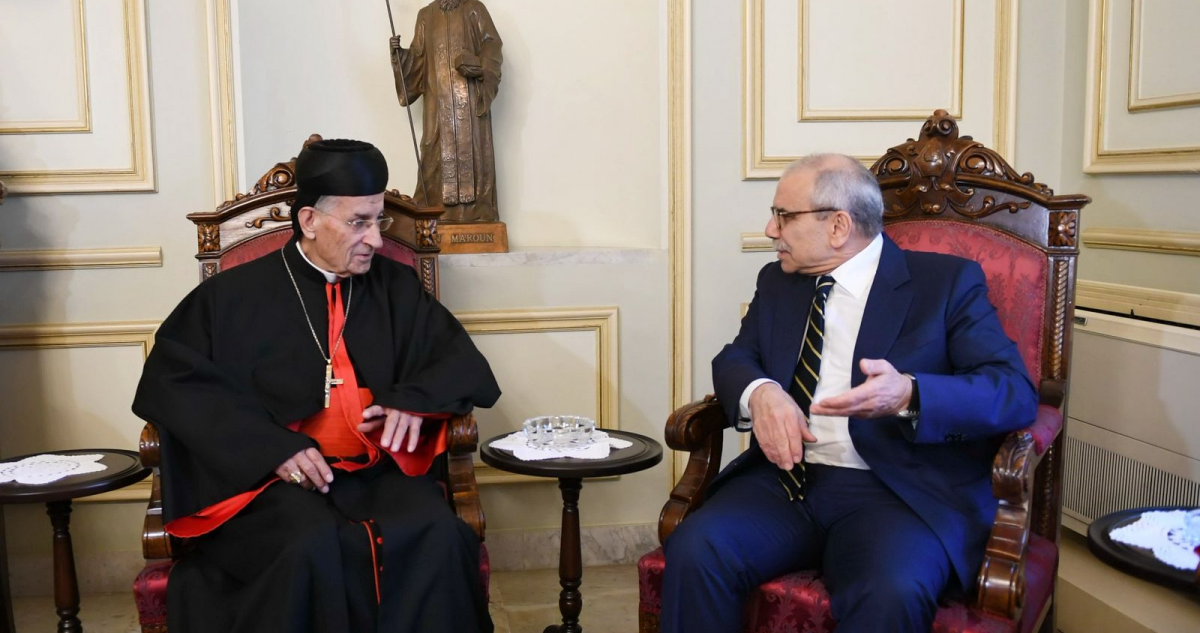
Prime Minister Nawaf Salam received by the head of the Maronite Church, Bechara Rai in Bkirki, on Oct. 31, 2025. (Credit: NNA)






BEIRUT — Following a meeting with Maronite Patriarch Bechara Rai in Bkirki on Friday, Prime Minister Nawaf Salam announced that the Lebanese Army would present, within the next week, another progress report on its project to disarm Hezbollah, as pressure mounts on Lebanese authorities, both diplomatically and through escalating Israeli attacks.
"A decision has been made, and the army has presented us with an action plan," Salam told reporters. "In less than a week, we expect a new report from the army commander and there will be no going back on the arms monopoly."
The army gave its first monthly progress report during the first week of October. According to sources within Cabinet, ministers were impressed by the army's presentation, during which it explained that Hezbollah's infrastructure south of the Litani had been 80 percent dismantled and the party was cooperating with the process.
The Lebanese Army was tasked by Cabinet in August with drawing up a plan for achieving a state monopoly on arms. The plan was approved by ministers in September. The plan divides Hezbollah's disarmament into five stages, beginning with the area south of the Litani, then expanding to the region between the Litani and Awali Rivers, then to Beirut and its southern suburbs and surroundings, onto the Bekaa, and finally, the fifth stage covers the entire country.
'Serious measures' regarding Palestinian weapons
As Lebanese authorities come under pressure following the shooting of a young Lebanese man by Palestinian gunmen in Shatila refugee camp, Salam defended his government's project to disarm the camps, reiterating that "more than 20 truckloads of heavy weapons have been handed over."
"This is an ongoing process that is not yet complete," he said.
As for state security overall, Salam insisted his government was doing "everything possible" to address Israel's escalating attacks on Lebanon. According to Salam, efforts are being made "through the cease-fire monitoring committee" and "Arab and international relations" in an attempt to bring Israel's violations of the ostensible cease-fire agreement, in place since last November, to an end.
'Parliament must act quickly'
Salam called on Parliament to "do what it must" to ensure the May 2026 legislative elections are not delayed, as Parliament Speaker Nabih Berri refuses to add an amendment to the 2017 electoral law to Parliament's meeting agendas.
The prime minister promised that the elections "will take place within the constitutional timeframe," stressing that Cabinet "is working based on that principle," and that Foreign Affairs Minister Joe Rajji's draft electoral bill amendment is on the agenda for Cabinet's next meeting.
Cabinet has formed a small ministerial committee to examine the application of the electoral law, "which contains gaps and ambiguities," Salam noted, calling the issue a "purely legislative matter that goes beyond the government's jurisdiction."
Several MPs boycotted Tuesday's Parliament meeting, which was subsequently postponed due to a lack of quorum. The protesting MPs are pushing for an amendment to the 2017 law that would allow Lebanese overseas to cast their ballots for all 128 seats based on their place of origin. Hezbollah and its allies, including Berri's Amal movement, are calling for the current law to be applied by creating a special constituency of six deputies for the diaspora.

 7 p.m. recap: Iran warns Egypt, Israeli soldiers vote in south Lebanon, Haret Hreik responds to Kataeb