





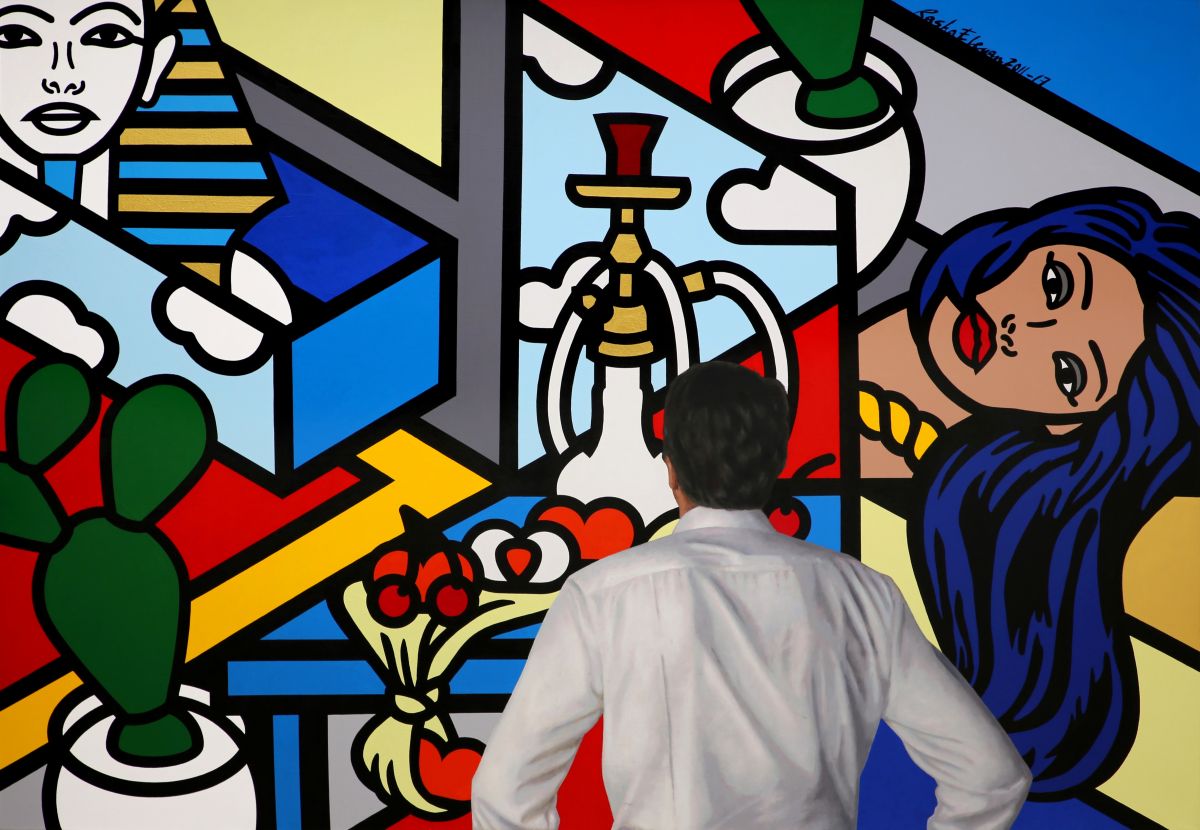
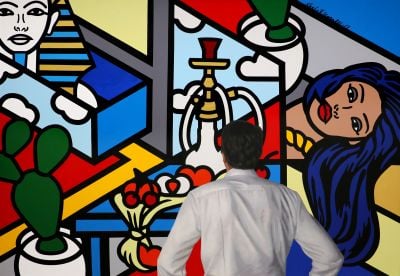
A visitor in front of the painting "Summer Fruit, Egypt Revolution" by Rasha Eleyan, exhibited at the Middle East Institute in Washington. (Credit: MEI)






The Middle East Institute (MEI) exhibition, "Arab Pop Art: Between East and West," is listed among the "must-see" events in the fall 2025 guide of Washington City Paper.
The artists' renown plays a significant role, starting with Moroccan Hassan Hajjaj, known as the "Andy Warhol of Marrakech," and Palestinian Rasha Eleyan, whose instantly recognizable pop style has made its mark on the British art scene where she resides. Opened last September, the exhibition runs until Jan. 23, 2026.
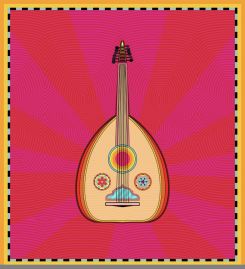
In total, fourteen artists from North Africa and the Middle East present regional motifs, everyday objects, and images of Eastern political figures. You'll find the oud, portraits of al-Rais (former Egyptian president Abdel Nasser), alongside windsurf boards, Coca-Cola cans decorated with Arabic calligraphy, neon signs quoting popular proverbs, and playful reinterpretations of global brand images.
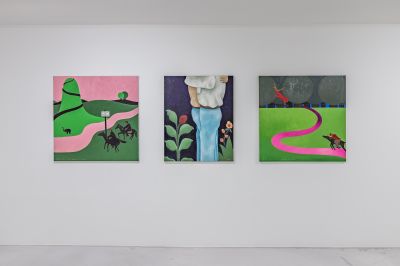
The thirty-five works on display fill the MEI's rooms with visuals that stay true to their Eastern heritage while asserting a modernist cultural code.
"This is the first exhibition of its kind held in the United States, historicizing Pop Art that emerged in the Arab world at the turn of the 1960s," notes Lyne Sneige, director of the MEI Arts and Culture Center. She explains that this movement "plays a political role by seeking to deconstruct the reductive Western perspective imposed on the Middle East."
Arab Pop Art has experienced a real boom since the 2000s, fueled by the rise of social media and new digital technologies. Since then, artists have used satire and an acute awareness of urban culture to comment on their era's social issues. Audiences, in turn, enjoy decoding their creations, spotting how issues like hybrid identity, consumerism or cultural appropriation are tackled.
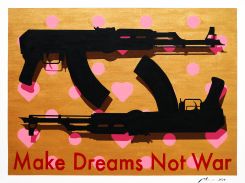
Make dreams not war
Artist Marwan Chamaa and his slogans — "Make Dreams Not War" and "Make Love Not Hate" — fully embrace their words and their repercussions. "A successful work is one that sparks dialogue," he told L’Orient-Le Jour.

Dividing his time between Lebanon and the United States, he explains that "his works speak frankly, never shying away from responding to their audience." For him, the priority is to reach human consciences and "mutually remind ourselves of our shared values, especially when we lose sight of their importance."
Some members of the Lebanese diaspora spent longer in front of Chamaa's canvases. Nostalgia for their homeland may partly explain the attraction, there is another reason: Pop Art reflects back an image of themselves that is both distorted and deeply real. The artist himself recognizes it: "Pop Art reveals deep truths. It doesn't seek to polish the mirror, but to confront us with the true reality of the world around us."

 7 p.m. recap: Iran warns Egypt, Israeli soldiers vote in south Lebanon, Haret Hreik responds to Kataeb