







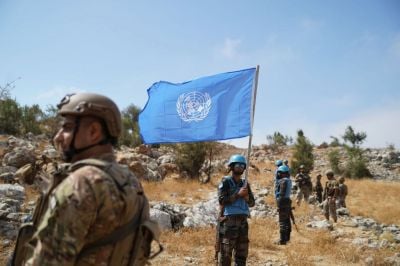
Lebanese soldiers and UNIFIL peacekeepers in Kfar Shuba, in the Hasbaya district, southern Lebanon, on Aug. 26, 2024. (Credit: Mohammad Yassin/L’Orient-Le Jour)






In his 42nd semiannual report to the Security Council on the implementation of Resolution 1559 (2004), covering the period from April 25 to Sept. 11, 2025, the U.N. secretary-general assessed the progress and the political and security challenges facing Lebanon. The report will be reviewed during Security Council consultations scheduled for Monday, Oct. 13.
Adopted in 2004, Resolution 1559 reaffirmed the fundamental principles of Lebanon’s sovereignty, unity and political independence, as well as the state’s exclusive authority over all its territory.
“This objective remains at the core of the United Nations’ efforts,” António Guterres noted, emphasizing that peace and stability depend on a unified, sovereign state in control of its own decisions.

In his report, the U.N. chief observed that “on several occasions, Lebanese leaders have reaffirmed their commitment to ensuring the state’s monopoly on the possession of weapons.”
He “welcomes” the decisions made by the Cabinet on Aug. 5 and 7, 2025, assigning the Lebanese Armed Forces the task of drafting a plan to organize the disarmament of militias.
Presented on Sept. 5 and received favorably by the government, the plan serves as a gradual roadmap to ensure that only legitimate institutions hold weapons.

Even though the Shiite ministers withdrew from the discussions, the plan marks a major step forward in strengthening national authority.
It notably calls for tighter control south and then north of the Litani River, as well as measures to curb arms smuggling along the Syrian-Lebanese border.
The secretary-general highlighted the strong “statement” by President Joseph Aoun and Prime Minister Nawaf Salam, in both the inauguration speech and the ministerial declaration.
He described them as “an unequivocal and irreversible commitment. The extension of state sovereignty over all its territory and prerogatives, the limitation of arms, the exclusive authority to decide on war and peace and respect for international resolutions, including Resolution 1701, are shared responsibilities in the interest of Lebanon.”
The report also underscored the “determination” of Salam’s government “to secure Israel’s withdrawal from the five positions and two buffer zones, and to put an end to Israeli attacks.
Ongoing challenges: Hezbollah and regional tensions
In Resolution 1559, the Security Council called for the disbanding and disarmament of all Lebanese and non-Lebanese militias, a key provision that has yet to be fully implemented.
This requirement reflects and reaffirms the commitment made by all Lebanese parties under the Taif Accord.
In his report, Guterres noted that Hezbollah remains the most heavily armed militia in the country.
He said that the continued presence of its arsenals, as well as those of other groups, poses a serious obstacle to the sovereignty of the state and its exclusive authority over all its territory.
He also observed that Hezbollah has yet to begin a disarmament process and continues to maintain a military arsenal outside state control.
The secretary-general also welcomed the joint commitment of Aoun and Palestinian Authority President Abbas to a gradual disarmament within the Palestinian camps.
He noted, however, that regional tensions continue to worsen the challenges facing Lebanon, while Israeli violations north of the Blue Line undermine the country’s stability.
He reaffirmed that Israel must withdraw to the south of the line and end its aerial overflights of Lebanese territory, stressing that regional stability depends on reciprocity and mutual respect for sovereignty.
According to the report, the Israeli military has continued to violate Lebanese airspace, claiming to target Hezbollah infrastructure, fighters and capabilities, as well as those of other non-state armed groups.
The report further emphasized that the Lebanese Armed Forces play a central role in consolidating state authority.
The government continues to recruit and train soldiers to strengthen the army’s presence in the south.
The report indicated that, according to the Lebanese Armed Forces, about 9,000 troops are now deployed in southern Lebanon.
The secretary-general underlined the need to provide them with greater political, logistical and financial support to prevent any security vacuum and ensure full operational capacity across the country.
This article was translated from L'Orient-Le Jour by Sahar Ghoussoub.
