






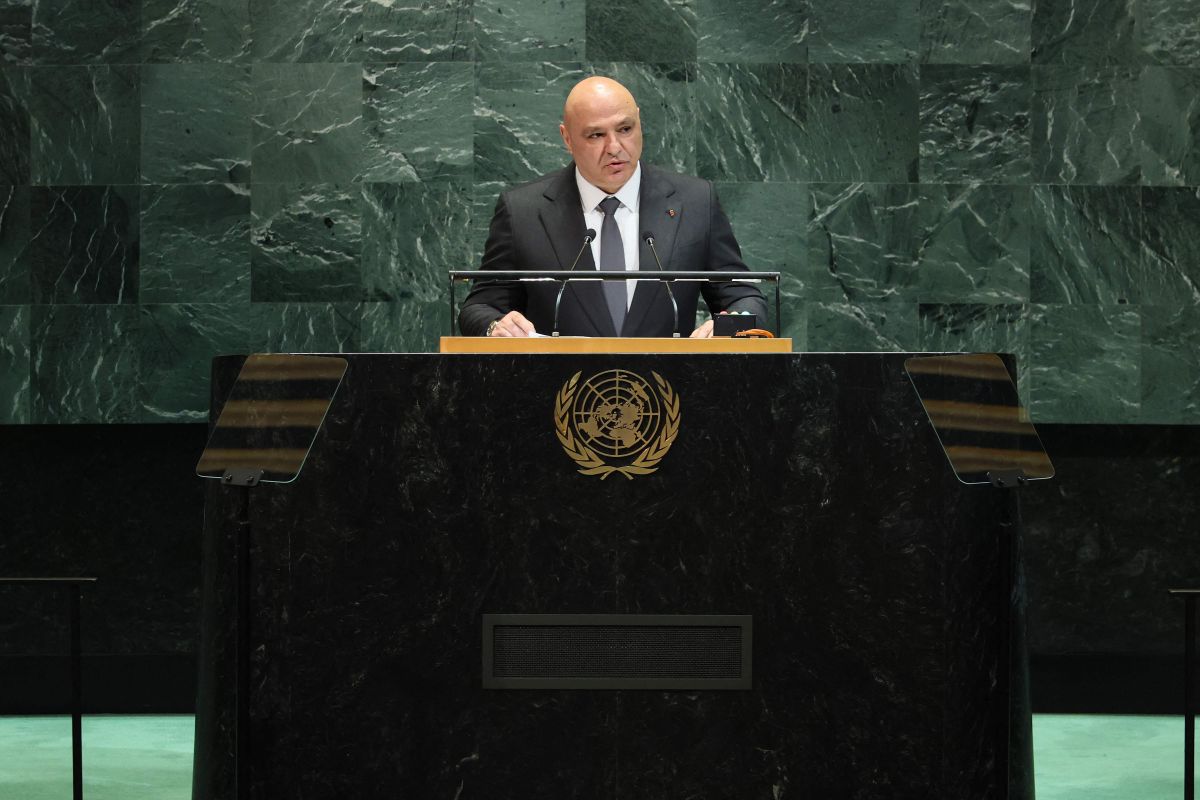
President Joseph Aoun speaks at the United Nations General Assembly at the United Nations headquarters on Sept. 23, 2025, in New York. (Credit: Michael M. Santiago/AFP)






President Joseph Aoun took to the podium on Tuesday to address the 80th United Nations General Assembly in New York for the first time since his election in January, and urged the international community to stand by Lebanon as it faces a war aimed at dismantling its "unique model of coexistence."
"I stand before you speaking of peace, development and human rights, at a time when some of my fellow citizens are facing death, parts of my country are under occupation, and my homeland and my people live in uncertainty," Aoun said, just days after Israel had bombed a family of six as they drove in their car in Bint Jbeil, southern Lebanon, killing all but the mother and one child.
Lebanon, he told the U.N., was in fact a model of religious coexistence and a lesson, that "there can be no development without peace, for growth cannot take place within chaos and prosperity cannot be achieved within conflict and wars. Peace is the only foundation for development."
Lebanon was a founding member of the U.N., Aoun pointed out, and it committed as early as 1945 to "save future generations from the ravages of war" and to "live in peace with one another as good neighbors." These principles, however, "remained on paper for 80 years as the blood of our people was spilled on the ground," the former Lebanese Army commander said.
Aoun said this failure to actualize the Declaration of Human Rights — which he pointed out was drafted in part by Lebanese philosopher and diplomat Charles Malek — could be attributed to several factors, including "the race to absolute dominance in all fields," however he singled out the globalization of the last 30 years and the world's various religious wars as particularly damaging to human rights.
"While Islamophobia and xenophobia grow in the West, the East is still haunted by the memory of colonialism and remnants of old religious wars."
"At the heart of this dilemma, Lebanon plays a unique role," Aoun said. "Amid the global clash between religious identities, Lebanon stands out as a nation where Christians and Muslims live together as equals."

'Insidious motivations to dismantle Lebanon's model'
"In a region where people are killed over their religious belief or even for displaying a symbol of faith, in a wary world torn between those who want to impose religious attire and other intent on banning it, Lebanon offers a unique, unmatched and irreplaceable model," Aoun said, pointing out that his same model allows him as an Arab Lebanese to serve as the only Christian head of state "from East Asia to the coast of Europe."
"It is clear to me today that many of the underlying causes of the war on Lebanon as well as the deeper more insidious motivations behind it, have been aimed at dismantling Lebanon's unique model," Aoun said, warning that the conflict is aimed at creating "perpetual ethnic rivalries."
Aoun told the assembly that saving Lebanon's model of coexistence requires "a simply a clear and firm stance, in words and action, aimed at liberating all Lebanese territory and securing the exclusive sovereignty of the Lebanese state, enforced solely by its legitimate armed forces, over its land."
The president noted that Lebanon, in agreeing to the Nov. 27, 2024, cease-fire deal with Israel, had dedicated itself to these principles, and that he had himself reaffirmed it — notably the state monopoly on arms — in his inaugural speech, and that Cabinet had then officially adopted it in August.
"We still await the same commitment of other relevant parties on our borders as well," Aoun said, referring to Israel and its endless stream of violations of the cease-fire agreement.

'Immediate cessation of Israeli aggression'
"Allow me to feel some pride for my country and my people, for they do deserve it," Aoun said, praising the Lebanese diaspora for its contributions in Lebanon and around the world.
The president then outlined the reforms undertaken by his government, which he listed as including transparent financial audits, fair banking restructuring, modernization of the administration, and the "fight against corruption and organized crime," as well as a legislative reforms "strengthening the independence of regulators and the judiciary," and Lebanon's compliance with international standards against money laundering and terrorism financing.
Still, Lebanon bears "heavy burdens," Aoun said, most pressing among them, the violence and instability on its southern border. "We call for the immediate cessation of Israeli aggression, the full withdrawal of its occupying forces from Lebanese territory and the release of our hostages" he declared, calling for the full implementation of U.N. Security Council Resolution 1701 and the maintenance of UNIFIL's mandate in partnership with the Lebanese Army.
He thanked the Security Council for renewing this mandate, stating that these forces help "restore lasting peace and security." Aoun also met with U.N. Secretary-General António Guterres on Tuesday, reportedly informing him that "the disarmament plan is ready to be implemented, but Israeli aggressions are preventing its full application."
"However, the deep underlying causes of our crisis extend beyond our immediate borders," Aoun noted. "This is why is our moral, human and political obligation to call for an immediate end to the devastation taking place in Gaza."
'Exclusive defense of the territory'
He also addressed Lebanon's heavy humanitarian burden, facing the the unprecedented influx of refugees on its soil, which he pointed out is the largest number capita in the world, and called for strengthened cooperation with the U.N. and direct negotiations with Syria, under Saudi Arabian auspices, to enable the return of Syrians and restore "good neighborliness beyond the ambiguities of the past."
Aoun wrapped up his speech by emphasizing the need to rebuild areas of Lebanon destroyed by Israeli aggression and to provide the army with the means necessary "so that it can fulfill its exclusive mission of territorial defense."

Then, returning to his opening words, he said: "While I stand here today advocating for peace, my countrymen are being killed."
"The conflict is still very fierce," Aoun said, between Lebanese being a country of "joy and peace" or a country of "sorrow and wars."
"We, in Lebanon, have made our choice. We choose to be a land of life and joy and we shall abide by it. I call upon you all, for the sake of peace in our region, for the good of humanity, stand with us, don't abandon Lebanon!"