


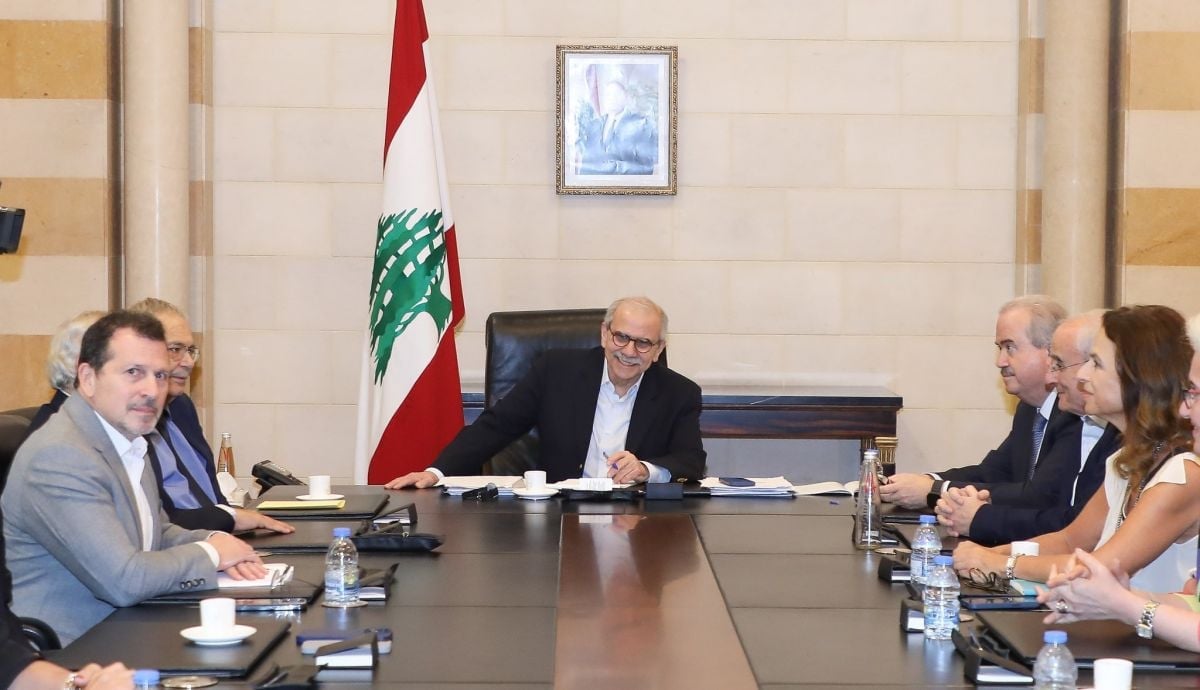
Lebanese Prime Minister Nawaf Salam chaired an informal ministerial meeting at the Grand Serail on Friday at 4:00 p.m. (Credit: X/Grand Serail)






BEIRUT — Prime Minister Nawaf Salam chaired a “consultative ministerial meeting” on Friday at 4:00 p.m. to discuss the latest developments in the country, primarily following Hezbollah’s unauthorized projection of images of its late former leader Hassan Nasrallah onto the Raouche Rock, a symbolic site on Beirut’s coastline.
Deputy Prime Minister Tarek Mitri said the meeting was convened “to reaffirm the government’s unity (...) and to emphasize the policy outlined in the ministerial statement, namely, to extend the sovereignty of the Lebanese State across all of its territory through its own forces.”
He added, “we also stressed the importance of applying the law to all citizens without exception, which places a great responsibility on the security forces to achieve this.”
“The Lebanese are equal before the law, and the State does not differentiate between one citizen and another, or between one group of citizens and another,” he continued.
According to Mitri, “the flagrant violation of the conditions of the permit granted for the Raouche gathering obliges us to take the necessary legal measures to preserve the authority of the State and ensure respect for its decisions.”
He concluded, “It goes without saying that the government is committed to the country’s stability, the unity of its citizens, and is determined to put an end to sedition and the hate campaigns that threaten our national coexistence.”
Salam had called the day before for legal action against those who violated the directives issued by Beirut’s governor (mohafez), who had authorized a gathering on the capital’s corniche under certain conditions but had explicitly banned any projection.
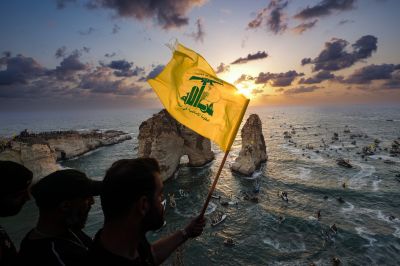
Thousands of supporters of Hezbollah gathered Thursday in Raouche to commemorate the death of Nasrallah, who was killed on Sept. 27, 2024, in a series of massive Israeli airstrikes that leveled several residential buildings in Beirut’s southern suburbs.
Despite the governor’s order, Nasrallah’s image was projected onto the iconic rock and surrounding buildings, alongside that of his late successor Hachem Safieddine, Speaker of Parliament Nabih Berri, and former prime ministers Saad Hariri and his father Rafic Hariri.
The display sparked outrage and political backlash. Rafic Hariri was assassinated in a car bombing in February 2005, and the Special Tribunal for Lebanon later convicted several suspected Hezbollah members for their roles in the attack, which also killed 21 others.
On Thursday evening, Salam also called for the arrest of individuals who shouted hostile slogans against the government and its decision to pursue Hezbollah’s disarmament. The chants included harsh insults aimed directly at the Prime Minister.
'Preventing the country from sliding into confrontation,' says army
For his part, Defense Minister Michel Menassa issued a statement on Friday defending the army’s decision not to intervene to stop the projection.
“The primary national mission of the Lebanese Armed Forces is to prevent unrest, to stop the country from slipping into the abyss of confrontation, to deter those who threaten civil peace, and to reinforce the foundations of national unity,” he said.
He added that the military “rejects unfair accusations” and “regrets having to bear the burden of the streets while others shirk their responsibilities.”
Since the fragile ceasefire between Hezbollah and Israel was established on Nov. 27, 2024, the Lebanese army has been tasked with dismantling Hezbollah’s arsenal south of the Litani River, in line with the cease-fire agreement.
Disarming Hezbollah remains Lebanon’s top strategic priority and a central issue in how the international community views the country’s situation. Foreign governments have made their stance clear: Lebanon will not receive aid or investment until Hezbollah is disarmed.
 Israeli army carries out demolition at Jabal Amel School in Houla as strikes continue