





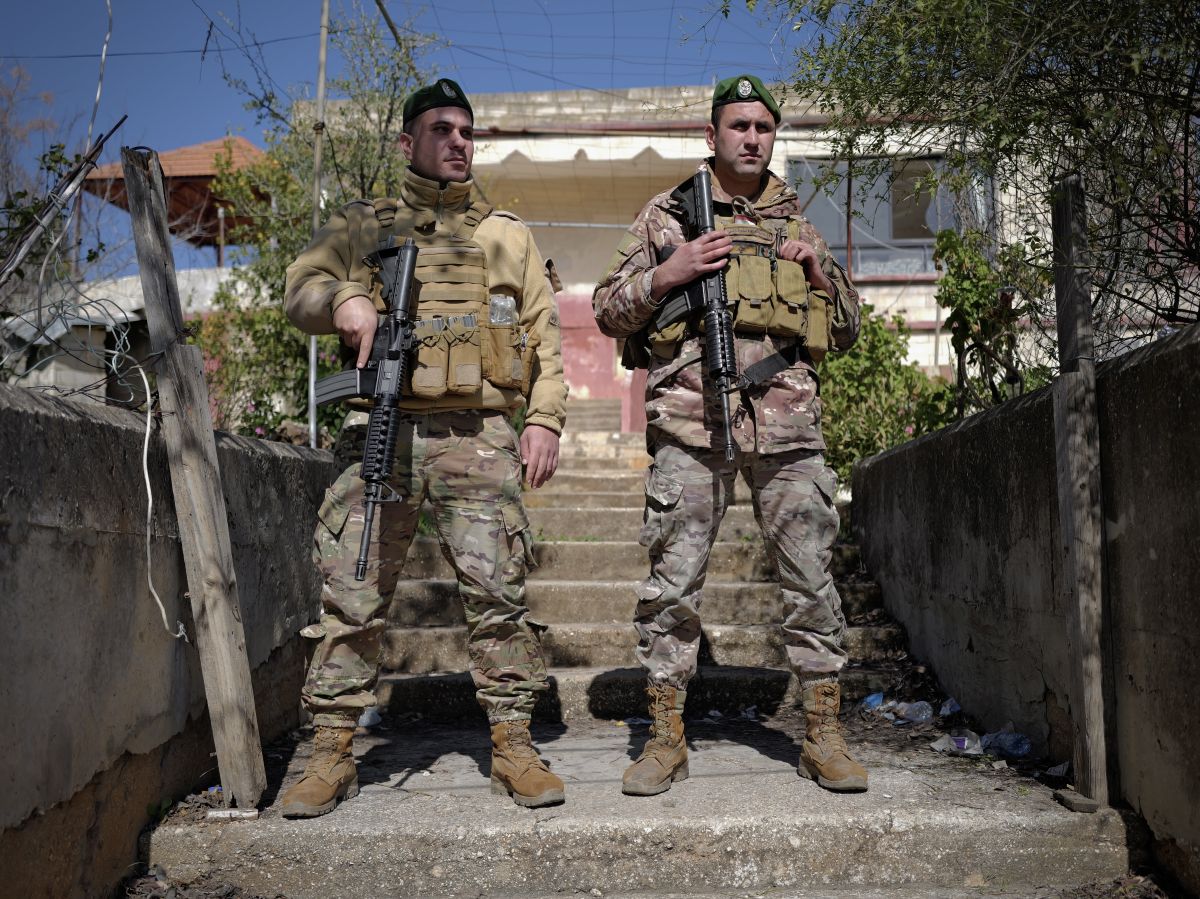
Two Lebanese soldiers deployed in the village of Houla, South Lebanon, a few hours after the withdrawal of the Israeli army, on Febr. 18, 2025. (Credit: Matthieu Karam/L'Orient Today.)






BEIRUT — Four items deemed "urgent" by the presidency of the Cabinet have been added to the agenda of the Cabinet meeting scheduled for Friday.
The session was originally set to focus on the plan prepared by the Lebanese Army to enable the state to reclaim the monopoly on arms — essentially, to disarm Hezbollah.
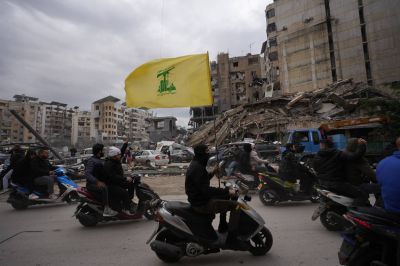
This meeting comes against the backdrop of political maneuvering aimed at calming tensions, as Hezbollah continues to refuse to hand over its arsenal to authorities, threatening escalation in the streets.
The army had been tasked on Aug. 5 with presenting this plan as Lebanon recovers from a devastating 13-month war with Israel, and as the cease-fire in effect since November is violated daily by the Israeli state.
Speaker of Parliament Nabih Berri, an ally of Hezbollah, called Sunday for dialogue on a defense strategy, a term his camp uses to refer to the issue of the militia's weapons.
In a document sent to ministers, the presidency of the Council reminded them that adding these four items to the agenda was decided "since the Cabinet has not met for over two weeks." The first of these points is the halt of chemical exports from the Tripoli and Zahrani petroleum facilities, "after it became clear that the certificate issued by environmental authorities in South Africa, authorizing the receipt and processing of these products, was falsified."
The Finance Ministry will also present the payment of financial allowances to the military for August, which was completed Monday, while the Cabinet will examine an "amicable agreement" between the Energy Ministry and the Kuwait Petroleum Corporation for Trading.
Finally, the Finance Ministry will present a draft decree to ratify a loan agreement granted by the International Bank for Reconstruction and Development (a World Bank entity) for “the evaluation of the renewable energy project and strengthening the energy system in Lebanon, in the amount of $250 million.”
'Outstanding issues,' says Hezbollah minister
The addition of these various items to the agenda appears to be part of an arrangement between the Cabinet and the Hezbollah-Amal alliance, ensuring that the Cabinet session is not limited to discussing the army’s plan alone — thus justifying the presence of both parties’ ministers.
A solution was reportedly reached as Deputy Parliament Speaker Elias Bou Saab made back-and-forth visits to involved parties in recent days, likely at the initiative of Berri.
He was received Monday at Ain al-Tineh, then Tuesday at Baabda and the Grand Serail. After his meeting with Prime Minister Nawaf Salam, Bou Saab emphasized that “the atmosphere seems favorable” for the session, which should take place “calmly” and avoid “additional conflicts.”
Labor Minister Mohammad Haidar, from Hezbollah’s quota, said Wednesday that ministers from Hezbollah and Amal have "no problem” participating in Friday’s meeting and that “their hand is extended to everyone,” but that they are still awaiting “answers to certain points raised,” to decide on next steps “in the coming hours.”
In a radio interview, Haidar noted that contacts are ongoing “at the highest level, to obtain a response to some remaining outstanding points,” so the tandem can decide how to proceed. He said things are not heading towards a withdrawal from the Cabinet session, as Shiite ministers — including Fadi Makki from the prime minister’s quota — did at the early August meeting.
“We cannot be imposed deadlines for handing over weapons. Dialogue is the only way to address our internal issues, to avoid turning the confrontation with the Israeli enemy into an internal conflict,” he warned.

As Hezbollah raises the stakes following the Cabinet’s Aug. 5 decision to task the army with coming up with a militia disarmament plan, the party’s TV channel, al-Manar, hinted on Tuesday evening in the introduction to its news bulletin that Naim Qassem’s bloc “would no longer cooperate” with the state, “even south of the Litani,” if deadlines to disarm were imposed.
The cease-fire agreement and previous texts such as U.N. Security Council Resolution 1701 stipulate that the party must surrender its weapons across the entire territory and that the zone south of the Litani — which marks the border area with Israel, stretching several kilometers north to Sour — must be free of all armed presence except for the regular Lebanese army and the United Nations Interim Force in Lebanon (UNIFIL).
The Prime Minister reiterated during a meeting with a delegation of local officials and dignitaries from Akkar (North Lebanon) “the importance of the state asserting its authority across all of its territory and enforcing the Taif Agreement regarding the monopoly on weapons.”
Since the truce began, the Lebanese Army has dismantled hundreds of Hezbollah military structures in this area, in collaboration with U.N. peacekeepers.

 Evening recap: Netanyahu announces West Bank offensive; 7 killed in Jordan church shooting; tents burned in south Lebanon
 US strike on Iran this weekend? ‘Absolutely,’ says Barrack; ‘I have no idea,’ says Trump