



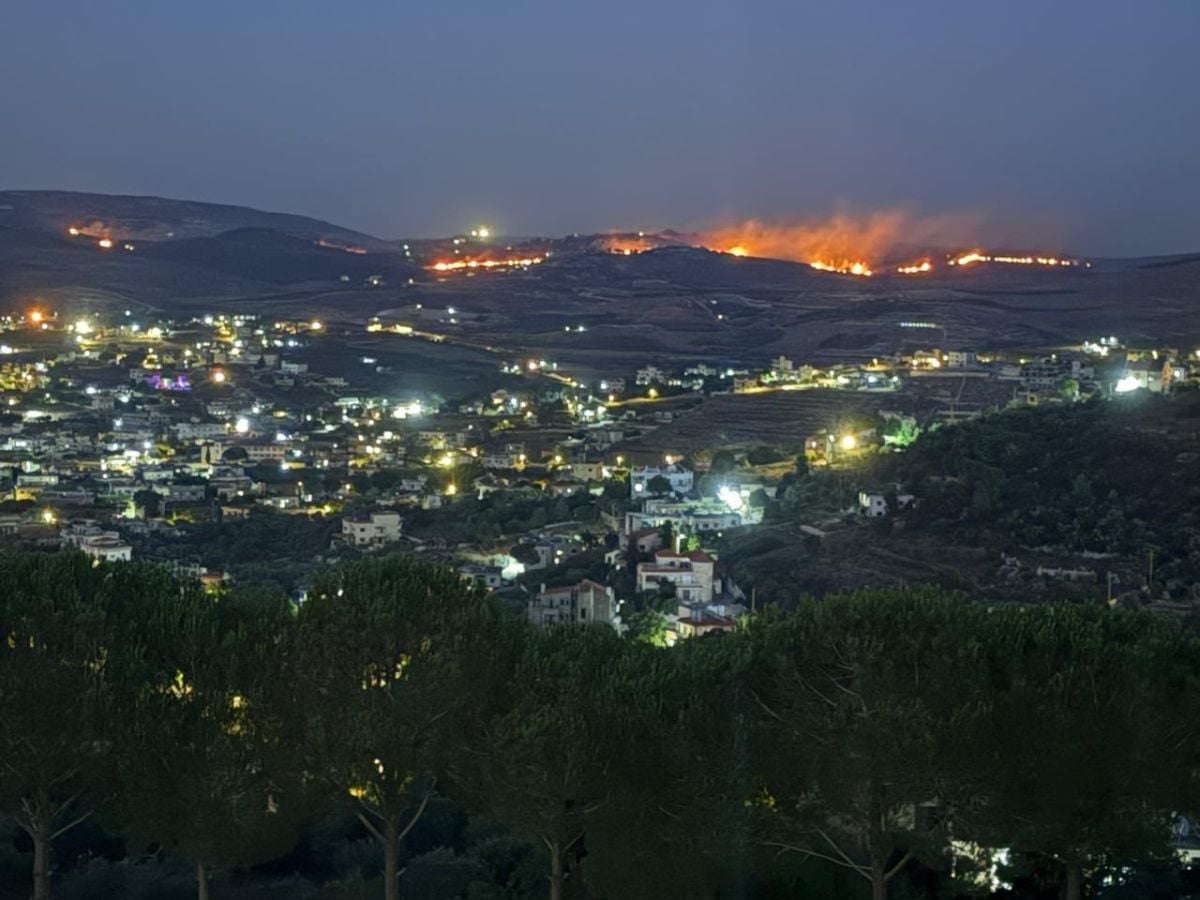
Olive groves set on fire by the Israeli army in Yaroun, in the Bint Jbeil district, on Aug. 3rd. (Credit: Photo shared with our correspondent in South Lebanon, Mountasser Abdallah)






SOUTH LEBANON — Following a weekend marked by a major wave of Israeli demolitions in southern Lebanon, Israeli forces set olive groves ablaze overnight between Sunday and Monday in the southern Lebanese village of Yaroun, in the district of Bint Jbeil.
Located less than a kilometer from the Israeli border, Yaroun lies in the central part of the area occupied by the Israeli army, which covers approximately 620 km² of Lebanese territory along the border. As the village is under occupation and access is prohibited, no action could be taken from the Lebanese side to try to bring the fire under control.
Hafez Ghacham, municipality chairman of Yaroun, told L’Orient-Le Jour that for more than 36 hours, the fire consumed over 120 hectares (nearly 1,200 dunams) of fruit orchards and olive groves, some of which were home to century-old trees, devastating an area known for its rich biodiversity.
The flames remained visible day and night, lighting up the sky over the village and the surrounding area. Even after the fire had been extinguished, smoke continued to rise from the charred land.
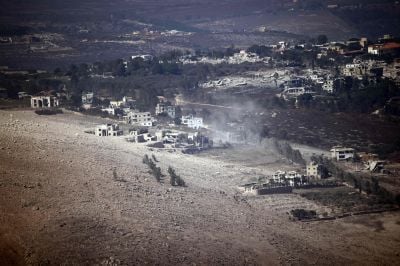
In a statement, the mayor said the fire was part of Israel's ongoing campaign of destruction and land clearing, which it said had already affected homes, places of worship, and private property in the village. It described the fires as an attack on the environment as well as on the area's heritage and culture, and called on the United Nations and the international community to respond to attacks targeting Yaroun and other parts of southern Lebanon.
The mayor reaffirmed residents’ attachment to their land and their right to return and rebuild, despite the extensive damage to homes and farmland. Describing the residents’ helplessness in the face of the flames, he said: “My heart broke at the sight,” Neither the residents nor the fire engines were able to reach the scene to put out the fire. “Together with several residents, we watched the fields burn until we were in tears,” he reports. “Houses can be rebuilt, but the old olive trees will take decades to return to how they were before.” He echoes the words of his 84-year-old father, who told him, faced with the scale of the destruction: “I’m more saddened by the trees than by the house.”
'Their memories, their history'
“The greatest loss is not limited to the burnt trees. It concerns an essential part of the villagers’ lives, their memories and their history,” said Ghacham. The destroyed olive trees belonged to the village families and had been passed down from generation to generation. Some were over a hundred years old, whilst others were at least fifty years old. “These trees,” he emphasizes, “were not merely a source of olive oil; they were part of Yaroun’s identity and its agricultural history.”

Every year, the villagers eagerly awaited the olive harvest, after months spent tending the trees, continues the municipality chairman. This period was an important economic and social event for families. The oil produced was also sent to relatives and children living abroad, “with a strong symbolic value linked to the land, the homeland and family memories."
Ghacham, what has been lost is therefore not just an agricultural harvest, but also a source of income for dozens of families who depend on the production of olives and olive oil. Referring to the agricultural losses, he estimates that the area affected by the fire covers around 1,200 dounoums (120 hectares). One dounoum produces an average of six cans of olive oil, he explains. According to his estimate, the destruction thus represents the loss of thousands of cans of oil, with a single can worth around $150. For many families, this production helped to cover essential expenses.
Yaroun, he points out, is a mixed village where both Muslims and Christians live. “The flames made no distinction between the olive groves of Christians and those of Muslims,” he says. According to him, what has been affected does not concern any one community in particular, but “the whole of the South: its land, its people, its culture, its dignity and its history.”
In a statement, the municipality of Yaroun directly accuses the Israeli army. “We are submitting these photographs of the devastation to the United Nations and to all those countries that claim to be committed to freedom and democracy whilst supporting this occupying power, in the hope that they will finally wake up and realize what it is doing in southern Lebanon,” the statement reads. The municipality does not spare the Lebanese authorities either, arguing that they “grant the occupying power the legitimacy to remain on our land under the pretext of negotiations and a disastrous framework agreement.” Lebanon is due to hold a new round of direct negotiations with Israel in Rome on Tuesday, a prospect that Hezbollah has rejected since it began in April.
This latest incident is the latest in a significant wave of Israeli destruction, including demolitions, explosions and the burning of houses in recent weeks. On Saturday, the municipality head of the occupied village of Zawtar Sharqieh (Nabatieh) had voiced his suspicions regarding “the theft of around 600 century-old olive trees from the village by the Israeli army,” after seeing satellite images showing a field of olive trees that had been completely cleared. Other olive groves had already been set alight in late July by the occupying forces in neighboring villages such as Ainata, from where the fire had spread to Aitaroun — both in the Bint Jbeil district — as well as near other border towns.
Night strikes on Ali Taher and home demolitions
Meanwhile, after an Israeli drone fired a stun grenade over Byout al-Siyad, in the Sour district, Israeli forces carried out large-scale demolition operations Monday morning between Taybeh and Qantara, in the Marjayoun district.
Southern Lebanon also saw renewed military activity overnight, with a series of powerful explosions, airstrikes and fires reported in several border villages, according to our correspondent.
Israeli fighter jets flew over the region before firing two missiles at the strategic Ali Taher hills. The strike on the site, which hosts several military installations, has fueled speculation that Israel may be preparing a ground operation to seize control of the area.
The Israeli army also carried out three major explosions in Haddatha, in the Bint Jbeil district. Shortly afterward, two massive explosions were heard between Majdal Zoun and Mansouri, in the Sour district.
"The earth shook beneath our feet because of the force of the blast," said a resident of Sour, stating that fires broke out at the scene and thick columns of smoke rose over the area, "like after a nuclear explosion."
On the eve of the resumption of direct Lebanon-Israel negotiations in Rome, scheduled from Aug. 4 to 6 under U.S. mediation, the "Gathering of Southern Border Villages" called on Lebanese authorities to suspend the talks "as long as the Israeli enemy continues to level, demolish and destroy border villages day and night despite the cease-fire."
The statement also condemned what it described as "incomprehensible and reprehensible silence in the face of this destruction, at local, Arab and international levels." The gathering called on Lebanese "to stand in solidarity against this destruction operation" and "forcefully demand an end to the occupation."
Despite the cease-fire agreement reached after months of war between Hezbollah and Israel, Israeli forces continue demolishing infrastructure inside what Israel describes as a "buffer zone" encompassing around 60 occupied villages in southern Lebanon.
 2 Israeli soldiers injured in 'operational accident,' as army continues attacks in the South