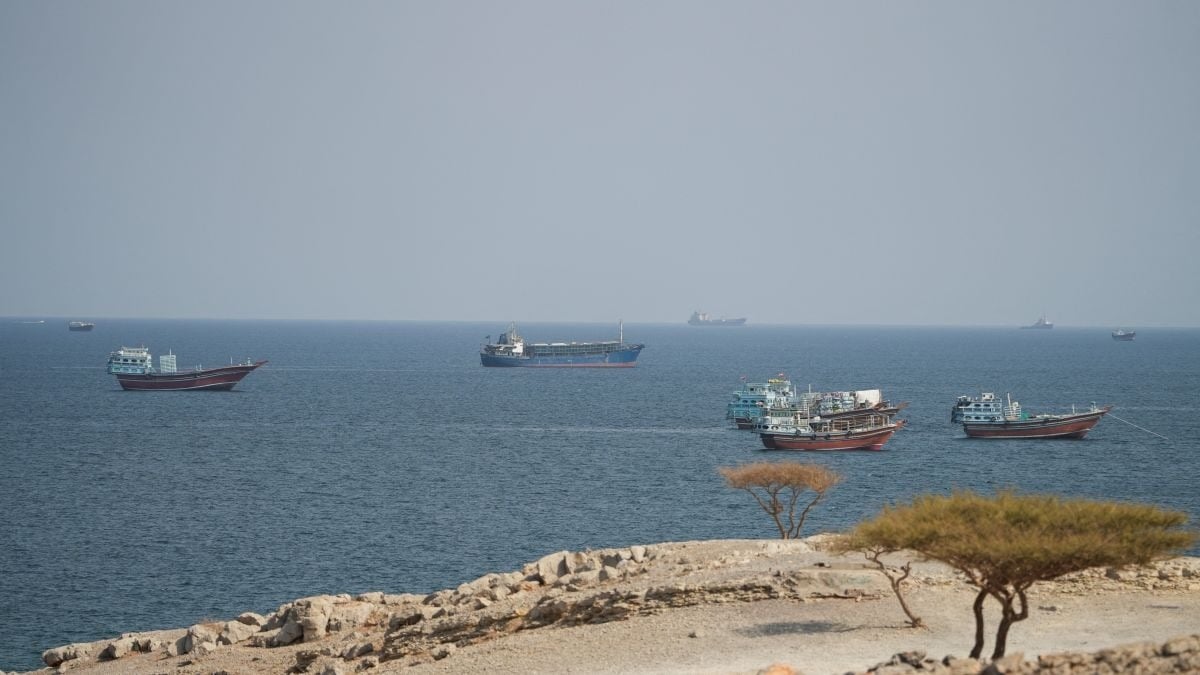
Ships in the Strait of Hormuz, seen from Musandam, Oman, on Oct. 2, 2026. (Credit: Stringer/Reuters)






Top story
Iranian officials made a series of statements Sunday morning, signaling that the country's leaders are not yielding to the United States. Mohammad Baqer Qalibaf, the parliament speaker, said that "the Strait of Hormuz will not be reopened until the seven Iranian conditions [in the agreement concluded in June in Islamabad] are fulfilled," according to the Nournews agency. He accused "the Americans of expressing a different message to the media," although, he said, "they recently submitted proposals through a mediator."
"They must understand that the era when they could drag things out and impose unilateral demands is over," he said. For him, the position of the Islamic Republic is "clear and firm."
Meanwhile, Iranian Foreign Minister Abbas Araghchi declared that there is "no military solution" to the conflict with the U.S. He stressed that in the event of confrontation, "our response will be stronger than before, and we will defend ourselves with even greater force." Speaking before foreign ambassadors, he judged that there is "no military solution, nor any solution based on new sanctions."
Why it matters
While official talks between Iran and the United States are at a standstill, discussions are reportedly continuing behind the scenes, as confirmed by Qalibaf's remarks Sunday. Officially, Iran had sent the United States a seven-day plan on Sept. 22, which would have allowed the reopening of the Strait of Hormuz, largely closed since the start of the conflict. Tehran claims to have received an American response on Sept. 30, without revealing its content.
The tough stance expressed by Iran’s two main negotiators, the parliament speaker and the foreign minister, could be a reaction to threats from U.S. President Donald Trump this week about new strikes against Iran if it turns out the country was involved in the FlyDubai plane incident, in which an Omani co-pilot allegedly attempted to crash the aircraft Wednesday with more than 150 Israelis on board. These threats come alongside reports of increased U.S. military presence around Iran, although no strike on Iranian territory has been reported since Sept. 1.
The partial closure of the Strait of Hormuz to ships, notably oil tankers, significantly affects fuel prices worldwide. Qalibaf's statement Sunday morning signal that his country continues to leverage its control over the strait in its talks with the United States.
What to watch for
Two Israeli soldiers were wounded in southern Lebanon over the weekend, one of them seriously, in what the Israeli army described Sunday as an "operational accident." In a post on X, it said that an investigation has been launched and is ongoing, adding that both soldiers were evacuated to a hospital inside Israel. According to initial findings, "the fighters were injured by a grenade that exploded near them as they were searching the town of Majdal Zoun (Sour)," Israeli media Kann News reported.
This development comes amid ongoing fears that the Israeli offensive in southern Lebanon may expand, as the Israeli army continues widespread strikes and destruction. Hezbollah has not claimed any operations against the Israeli army since a cease-fire was established between the two sides in June, but this has not prevented the army from making repeated accusations against it whenever incidents involving injuries in its ranks occur.
Elsewhere in the news
- Houthis claim attack on Aramco, Riyadh denies
Yemen's Houthi rebels claimed Sunday "a large-scale military operation, using several ballistic missiles and drones to target Aramco," the Saudi oil giant, in Riyadh. Hostilities continue between the pro-Iranian Houthis and Saudi Arabia, which supports the internationally recognized Yemeni government. It is not the first time Saudi oil company installations have been targeted. Despite reported fires, on Sunday, Riyadh denied the Houthis' attack through General Turki al-Malki in Asharq Al-Awsat newspaper. According to him, the Houthis' claims are "deceptive."
- Israeli soldiers assist settlers in seizing Palestinian olive groves
Israeli soldiers supported settlers who seized Palestinian olive groves on Saturday, and several injuries were reported across the occupied West Bank, according to witnesses and medics cited by AFP.
- Russia to intensify attacks on Ukraine in response to Zelensky's statements
Russia announced Sunday that it will "intensify" strikes on Ukrainian infrastructure in response to statements by President Volodymyr Zelensky, who vowed to step up Kyiv's attacks against Russian refineries. "Following statements made by Zelensky, Russian armed forces' strikes on military and industrial sites, as well as linked infrastructure, in Kyiv and other regions of Ukraine, will be intensified," the Russian Defense Ministry said in a statement.