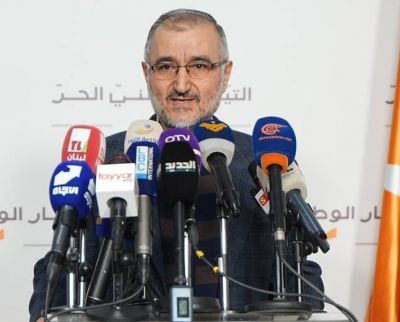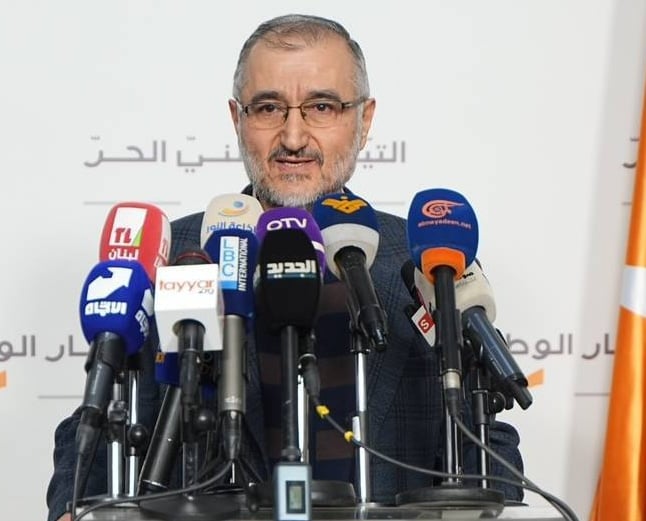
The political aid to the secretary- general of Hezbollah, Hussein Khalil, during a press conference. (Credit: Mohammad Yassin/L’Orient-Le Jour)






The Lebanese scene was weighed down Wednesday by explicit American positions — the clearest being that expressed by U.S. Senator Lindsey Graham, who said Israel would not withdraw from southern Lebanon before Hezbollah is disarmed. The first negative repercussions of the U.S. delegation tour, led by envoy Tom Barrack, were felt in Ain al-Tineh. Parliament Speaker Nabih Berri expressed his disappointment with the results of the visit.
In an interview with the pan-Arab daily Asharq al-Awsat, he said that "the Americans did the opposite of what they promised us," referring to the response expected from Israel to the "step-for-step" policy demanded by Beirut and supported — at least verbally — by Washington. However, Berri added, the positions of Barrack and of other members of the delegation ran counter to this approach, insisting on the withdrawal of Hezbollah's weapons before any discussion of a possible Israeli concession, whether it be withdrawal from Lebanese territory or an end to attacks in Lebanon despite the cease-fire in effect since November 2024.
Berri added that the U.S. delegation "brought nothing from Israel and, as a result, things have become complicated once again." Refusing to comment on the next step in light of this new obstacle, he emphasized that the situation "is not simple." Asked about the upcoming government meeting set for Sept. 2, which is to examine the army’s plan to disarm Hezbollah, he responded: "Any measure that leads to division in the country is to be condemned."
Setting Aoun against Salam?
Hezbollah on Wednesday accused the U.S. administration of wanting to turn Lebanon into an "American-Israeli colony" and of pushing the government to make "mistaken decisions" leading to total surrender. The party called on President Joseph Aoun to "end this political submission" and protect the Lebanese army from any discord that could threaten the country’s security and stability.
In his first public statement since the cease-fire, Hussein Khalil, political aide to Hezbollah’s secretary-general, issued a statement accusing Washington of wanting to "destroy all elements of resistance and defense from which Lebanon benefits" and having "succeeded in dragging the government into mistaken decisions as the first step toward complete surrender and total submission." American injunctions, "brazen and humiliating ... especially the demand to disarm Hezbollah," constitute "a clear and flagrant renunciation of the agreement brokered by the United States and France" in November 2024, which provided for the cessation of hostilities and all Israeli attacks, Khalil argued.
According to him, the Americans "wanted to completely wash its hands of all its explicit obligations and guarantees, as well as its commitments to pressure Israel to stop its daily attacks and withdraw from occupied areas in Lebanon, thus contradicting everything American envoys themselves had recently promised the three leaders (Joseph Aoun, Nawaf Salam and Nabih Berri)."
Khalil also accused Washington of trying to set "the Lebanese Army against its own people and the resistance," which he described as an "ignoble attempt to destroy two fundamental pillars of the country: the army and the resistance." He also warned Lebanese officials against "such deadly traps." The Hezbollah official refuted the claims of "some officials, especially at the head of the executive branch," who say the government's actions "are based on implementation of the Taif Agreement," calling this a "serious mistake." He stressed that the agreement provides Lebanon with the right to "take all necessary measures to liberate and defend its territory."
"This has been clear in the ministerial statements of all successive Lebanese governments after Taif," he added. "What we fear most is dragging the country into a civil war, which the Taif Agreement sought to avoid after long suffering inflicted on the Lebanese people."
The attack on Nawaf Salam could not be clearer. And the attempt to sow division between the Serail and Baabda was also evident.
"Those who look after the independence and security of this country, first among them the president, should work to put an end to this political submission to government decisions and protect the army from internal discord that threatens security and stability." Commenting on the disarmament issue, Jaafarite mufti Ahmad Qabalan, known for his closeness to the Hezbollah-Amal alliance, also called on the president "to lead a national rescue," because "Lebanon is today at the heart of a political catastrophe that threatens civil peace and national unity."
"There is no solution for saving this country without freeing government policy from foreign influence," said the Shiite dignitary, calling for a "historic partnership within the framework of the constitution, which preserves the rights of its founding components."
This article was originally published in French in L'Orient-Le Jour.