






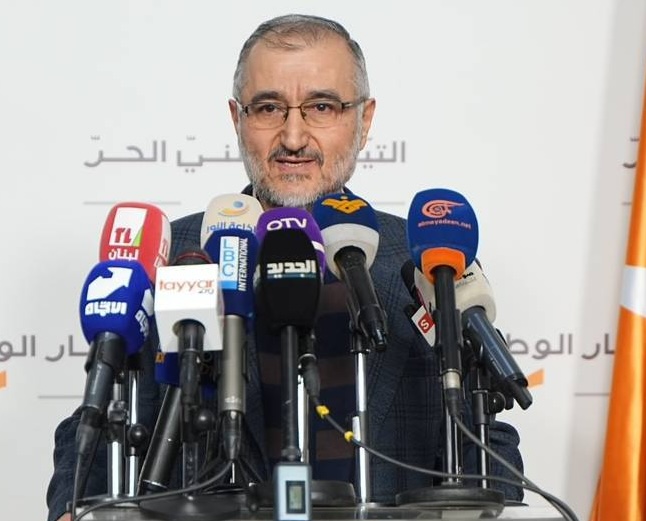
The political aide of Hezbollah's Secretary General, Hussein Khalil, during a press conference. (Credit: Mohammad Yassin/L'Orient-Le Jour)






Hezbollah on Wednesday accused the American administration of wanting to turn Lebanon into an "American-Israeli colony" and of pushing the Lebanese government into making "faulty decisions" leading to total surrender, calling on President Joseph Aoun to "put an end to this political submission" and to protect the Lebanese Army from any internal discord threatening the country’s security and stability.
According to the political aide to the secretary-general of Hezbollah, Hussein Khalil, Washington "wants to destroy all elements of resistance and defense that Lebanon benefits from, and turn it into an American-Israeli colony," with the American administration "having succeeded in getting the Lebanese government to make faulty decisions as a first step toward a complete process of surrender and total submission."
The American orders, "shameless and humiliating ... notably aimed at disarming Hezbollah," constitute "a clear and blatant renunciation of the agreement sponsored by the United States and France," in November 2024 that provided for a cease-fire and an end to all Israeli attacks, Hussein Khalil argued.
According to him, the American administration "wanted to completely wash its hands of all its explicit obligations and guarantees, as well as its commitments to put pressure on Israel to stop its daily attacks and withdraw from occupied areas in Lebanon, thereby contradicting everything that American envoys themselves recently promised the three presidents [Joseph Aoun, Nawaf Salam and Nabih Berri] with false promises."
Hussein Khalil also accused Washington of trying to pit "the Lebanese Army against its own people and the resistance," which he described as a "despicable attempt to destroy two fundamental pillars of the country: the army and the resistance." He also warned Lebanese officials against "such deadly traps."
'Protecting the Lebanese Army from internal discord'
The Hezbollah leader also refuted the claims of "certain officials, particularly those at the head of the executive branch," who say the government's actions "fall under the implementation of the Taif Agreement," calling this a "serious mistake." In this context, he emphasized that this agreement provides for Lebanon's right to "take all necessary measures to liberate its territory and defend it." "This was clear in the Cabinet statements of all successive Lebanese governments after Taif," he added. "What we fear most is dragging the country into a civil war, which the Taif Agreement was meant to avoid after the long suffering inflicted on the Lebanese people."
Hussein Khalil finally expressed hope "that those who care for the independence and security of this country, led by the president of the republic, will work to put an end to this political submission to the decisions of the Lebanese government and to protect the Lebanese Army from internal discord that threatens security and stability."
Parliament speaker and head of the Amal movement, Nabih Berri, expressed his disappointment on Wednesday with the results of a new visit to Lebanon by U.S. envoy Tom Barrack, who led an American delegation. This visit comes as the army is set to present its plan for disarming militias, including Hezbollah, to the government on Sept. 2.
On Aug. 5, the government tasked the army with developing a plan to disarm the militias in Lebanon, including the pro-Iranian party, by the end of the year. On Aug. 7, the Cabinet, in the absence of its Shiite ministers, approved the American roadmap for maintaining the cease-fire, which calls for the disarmament of Hezbollah but also an end to Israeli violations of the truce. Prime Minister Nawaf Salam has often recalled that "the process of a monopoly on arms ... is a national requirement and necessity, agreed upon by the Lebanese in the Taif Agreement before anything else." Small-scale demonstrations by members of the party in several regions of Lebanon accompanied these decisions.