






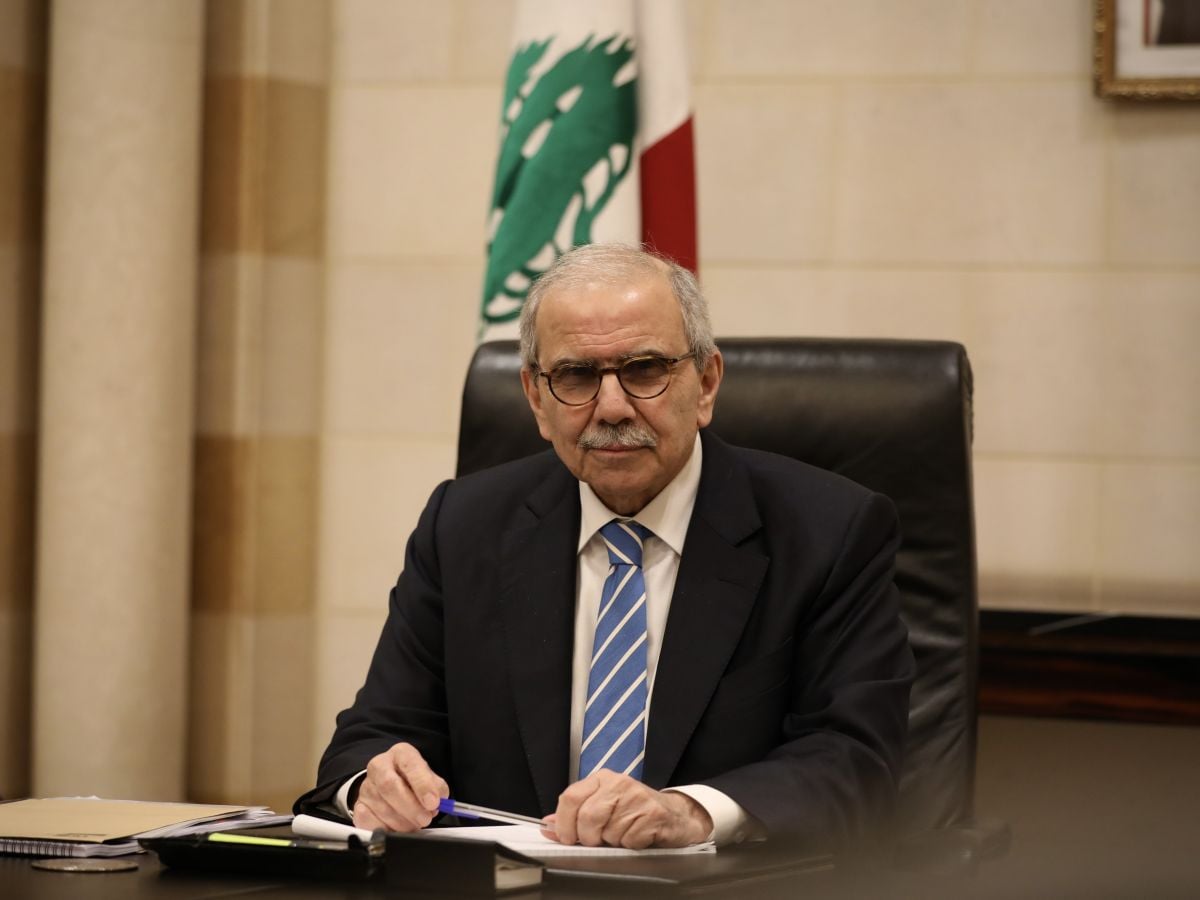
Lebanese Prime Minister Nawaf Salam at the Grand Serail. (Credit: Mathieu Karam/L'Orient-Le Jour)






Lebanese Prime Minister Nawaf Salam on Saturday called on Hezbollah, which he described as « a Lebanese political force, » to support the direct negotiations that Lebanese authorities are conducting with Israel.
’’If you are truly concerned about what you call your environment and the suffering of your environment, all that is being asked of you is to honor your commitments. We are not asking for anything more,’’ Salam said in an interview with Reuters.
’’Our problem with Hezbollah is its weapons. We consider the party a Lebanese political force and we want it to honor its Lebanese commitments. All we ask is that it keep its promises,’’ he added.
’’Hezbollah must be quicker than us, or at least move at the same pace as us, and announce its support for the negotiations we are conducting in Washington,’’ Salam told Reuters.
A Lebanese source familiar with the discussions told the agency that Tehran was irritated by Beirut's decision to negotiate independently with Israel, viewing it as the loss of an important bargaining chip in Iran's confrontation with Washington.
Lebanon is demanding a permanent cease-fire as the basis for negotiations that would lead to a full Israeli withdrawal and the return of hundreds of thousands of displaced civilians under the supervision of the Lebanese Army. Israel, meanwhile, seeks to dismantle Hezbollah as a military force, at least in South Lebanon, and obtain guarantees that its military capabilities have been eliminated before relinquishing occupied territory.
Nawaf Salam acknowledged the impact on Lebanon of negotiations taking place in Islamabad but reaffirmed the country's determination to negotiate as an independent state that ‘’no one represents in its place.’’
’’We are obviously affected by the negotiation process in Islamabad ... How could we not be, when a war and its consequences are unfolding on our territory ? We are affected by war, by peace and by de-escalation in the region. Islamabad, or any other place, will inevitably have an impact on us,’’ he said.
He added that ‘’if this process leads to a cease-fire and de-escalation in the region, we will obviously benefit.’’
Salam said Lebanon had chosen the least costly path and rejected the idea that Hezbollah's disarmament was an Israeli condition.
‘’Let's put an end to this confusion. The Lebanese agreed in the 1989 Taif Accord on extending the authority of the Lebanese state over all its territory. We reaffirmed this commitment in our ministerial statement, insisting on the monopoly of arms and the restoration of war and peace decisions to the hands of the state. Did Israel sit with us to draft this ministerial statement ? Of course not,’’ he said.
'Constant contact with Hezbollah'
The prime minister said he was ‘’in constant contact with Hezbollah.’’
’’All that is being asked is that it honor its commitments. The South is supposed to be a weapons-free zone. Hezbollah has given its confidence to the government twice, while the ministerial statement insists on the monopoly of arms. Nothing more than that is being asked of it,’’ he said.
Hezbollah has rejected the cease-fire plan agreed upon by the Lebanese and Israeli governments during the Washington talks. The group's secretary-general, Naim Qassem, whose party did not participate in the discussions, described the negotiations as ‘’shameful’’ and rejected the Washington statement, calling it ‘’a roadmap for the elimination of part of the Lebanese people and the subjugation of the rest.’’
Lebanon's Health Ministry says Israeli attacks since March 2 have killed around 3,700 people, including 730 women, children and rescue workers, and wounded more than 11,000 others. Authorities also estimate that about 1.2 million people have been displaced.
Washington has provided no guarantees regarding the future of the Lebanese-Israeli negotiations, but Salam said that ‘’it is better to leave the whistle to the American referee and not pay attention to political chatter.’’
Tehran has made a cease-fire in Lebanon a key condition for any broader agreement with Washington. The United States and Iran indicated Friday that they were close to an agreement aimed at ending the war between them. A senior U.S. official said both sides had agreed on a text and that Washington could sign a preliminary agreement in the coming days.

 8 p.m. recap: Israel again threatens Beirut’s south suburbs; 2 ships hit near Hormuz; Riyadh football matches canceled