





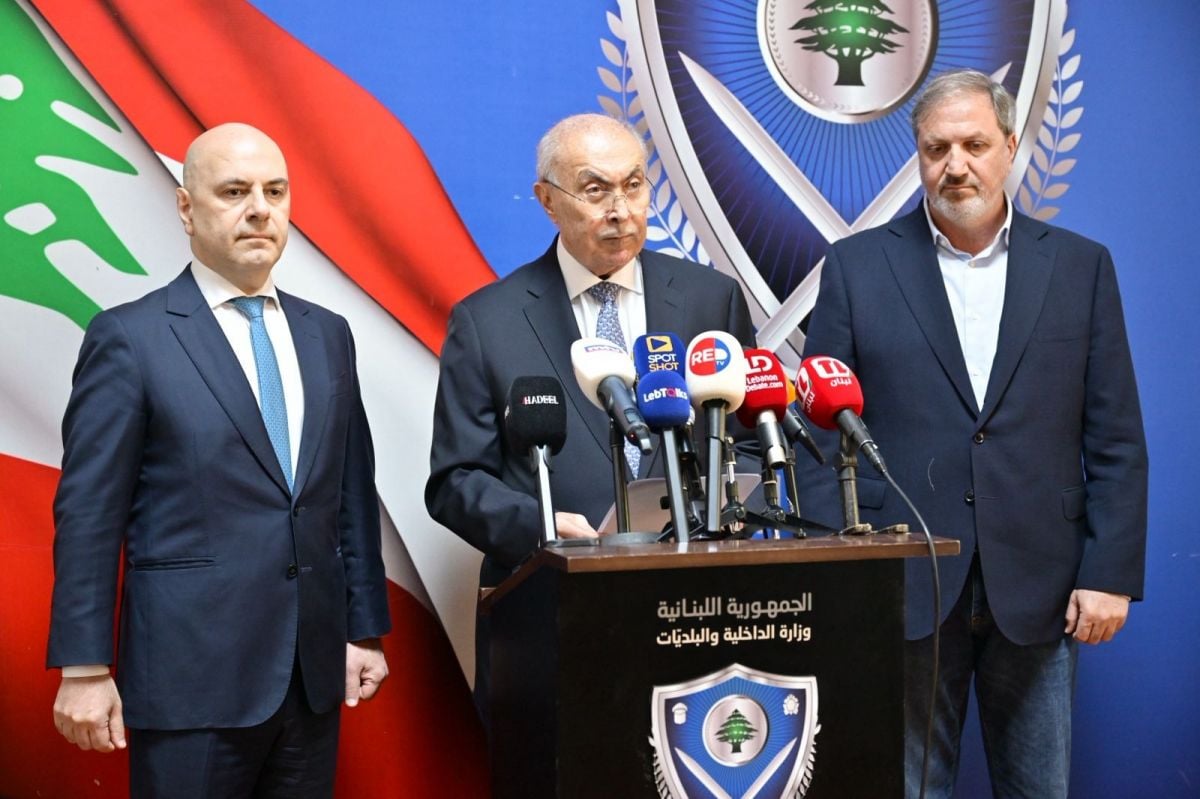
Beirut MP Fouad Makhzoumi speaks to the press at the Interior Ministry on June 12, 2026. (Photo provided by Makhzoumi's press office)






Just over a year into its term, the municipality of Beirut appears to be held back by divisions between its backers on the one hand, and its detractors on the other. Among the former are a number of political parties and Fouad Makhzoumi, a Beirut MP and architect of the so-called "consensus" list that decisively won the 2025 election. Opposing them are MPs who have not hidden their fears of a paralysis stemming from a mixed municipality, as shown by the latest dispute — which erupted a few days ago over procedural issues — potentially undermining the leadership Makhzoumi is trying to establish in the Lebanese capital.

All it took was for Makhzoumi to call a meeting between some of the city's MPs, the head of Beirut's municipality, Ibrahim Zeidan (a close ally of the Beirut billionaire), and the capital's governor, Marwan Abboud, for deep disagreements to come to light. According to information obtained by L’Orient-Le Jour, the meeting held on Monday June 8 included MPs affiliated with the parties that supported the consensus list in the last municipal elections. So it was only natural, some would say, that MPs from the "opposing camp," especially those from the opposition, were absent.
Ibrahim Mneimneh, an opposition MP, sees things differently. "Issues related to the municipality's activities and everyday matters concerning the city should be resolved within the municipality. But it is wrong to hold a meeting in the name of Beirut’s MPs without all of them being present," he told L’Orient-Le Jour. "The public feels like we [the opposition MPs] are neglecting our duties. But that is not true," he insisted.
The controversy escalated further the next day when Prime Minister Nawaf Salam welcomed the same delegation at the Grand Serail in Beirut. According to sources close to Makhzoumi, the meeting with Salam, himself hailing from one of the largest political families in the capital, was decided on the spur of the moment. "Nawaf Salam simply — and rather unusually — answered a call from Fouad Makhzoumi during the Monday meeting and gave them an appointment for the next day," said a figure close to the MP, noting that Paula Yacoubian, a Beirut MP from the opposition camp known for her criticism of the current municipal council, did still show up at the Serail.

In light of the growing controversy, Makhzoumi had to clarify his actions. In a message specifically addressed on X to Mneimneh, Waddah Sadek, and their colleague Melhem Khalaf, he pointed out that Monday’s meeting was part of the regular meetings held between the council's backers to closely monitor its work and that the meeting at the Serail had no political or parliamentary motive. He also apologized for "any misunderstanding" his approach may have caused.
Calls for resignation
In a move to mend fences, the MP informed all his colleagues about a meeting held Friday with Interior Minister Ahmad Hajjar, to discuss the needs of the city and its municipality. The boycotting MPs still refused to attend, while Khalaf had previously apologized for being unable to participate due to a tour in southern Lebanon. "It was perfectly normal for Waddah Sadek not to take part. Because this is not the way the city’s problems should be solved," commented someone close to Sadek, one of the sharpest critics of the municipal council.
"It’s not normal to bypass coordination meetings and go straight to ministries and decision-making bodies," Mneimneh added, recalling that all of the city's MPs took part in lengthy discussions ahead of the conference calling for the demilitarization of the capital — also organized last April by Makhzoumi. "But today, Makhzoumi seems to want to sideline his critics in order to establish himself as a key figure in the city, likely with the ambition to become prime minister," commented a Beirut political figure speaking on condition of anonymity.

"We have always warned against the interference of political parties in municipal affairs. But no one wanted to listen to us," said a close associate of Sadek. "The result: the current municipal council is paralyzed. For over a year, it hasn’t accomplished anything for the city because of divisions among its components, which only reflect the political tensions at the national level." On Friday, the MP published a video calling for the municipal council’s immediate resignation.
For his part, Mneimneh took a more nuanced stance: "We have given the council a one-year grace period. If its members are unable to find solutions, they should be transparent with the public and consider stepping down."
This article originally appeared in French on L'Orient-Le Jour.


 Midday news recap: Hebron attack sparks Israeli crackdown, international meeting in Istanbul for regional 'de-escalation'