







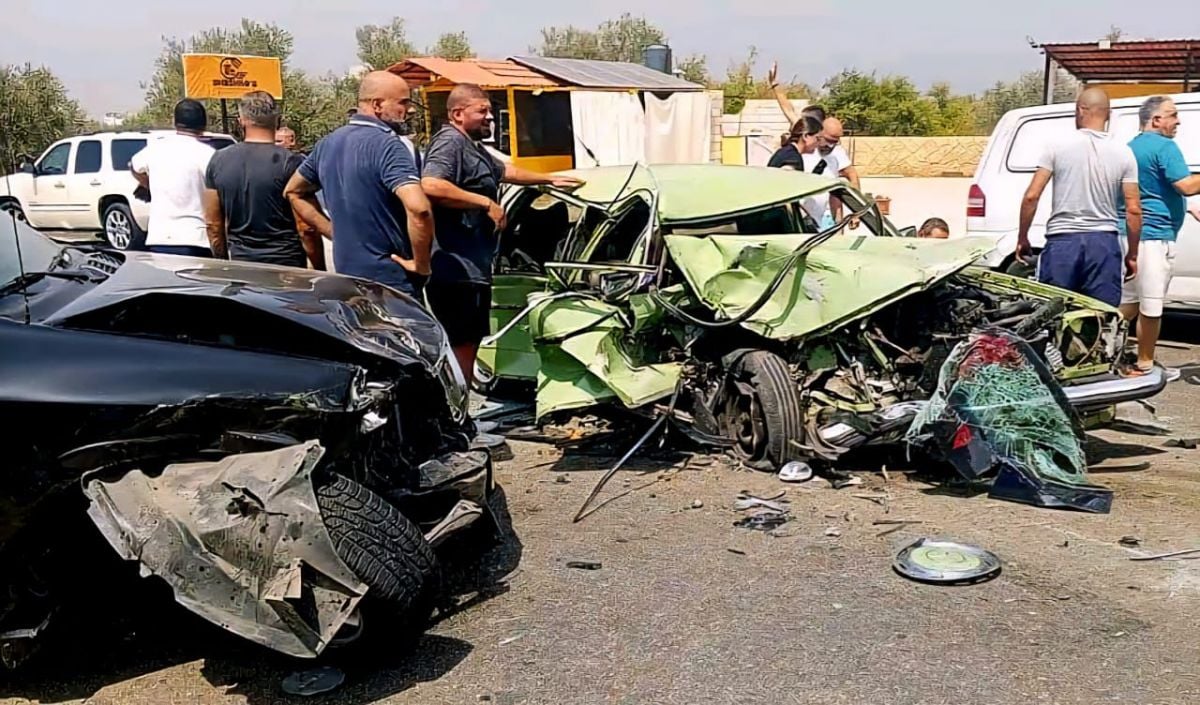
Fatal crash on the Bseirma–Koura road in northern Lebanon leaves one dead and several injured, Aug. 11, 2025. Photo provided by our correspondent Michel Hallak.






Lebanon’s summer influx always throws its dark and beat-up roads into a state of chaos, and every year seems to be getting worse. Over 10 days, from Aug. 5 to Aug. 14, 28 people were killed and at least 93 were injured in road accidents across the country, according to the Traffic Management Center.
Crunched-up motorcycles and overturned cars are appearing regularly in the news, and the traffic filling up the distance between most people’s Point As and Point Bs is a regular topic of conversation.
But the problem isn’t just reckless drivers. Lebanon’s economic collapse is gutting basic infrastructure and road maintenance, forcing many to rely on older, poorly maintained vehicles and cheap imported mopeds.
Streetlights are mere poles more often than not, potholes multiply faster than they are filled and traffic lights stay broken for months.

Amid the recent surge of deadly incidents, the Interior Ministry called a meeting with its Traffic Safety Committee on Aug. 6, after the 2019 resignation of Prime Minister Saad Hariri sent the committee into an unplanned six-year hiatus.
Overseen by Interior Minister Ahmad Hajjar, the meeting discussed four important points of debate that need to be translated into action, according to Kamel Ibrahim, president of the Lebanese Traffic Safety Academy, who was present at the meeting.
These include plans to identify where most road accidents are happening, strengthen the Internal Security Forces’ (ISF) traffic control units with particular focus on moped drivers, repair Beirut’s out-of-order traffic lights and traffic cameras, and tackle manhole cover theft, which leaves gaping holes at the sides of roads.

ISF spokesperson General Joseph Moussallem told L’Orient Today that while most accidents are caused by drunk drivers or drivers using their phones, a lot of the time, it’s not the drivers’ fault; it’s the unlit and disintegrating roads that are the problem — an issue that was notably missing from the Aug. 6 meeting minutes.
For Ibrahim, that explanation does not capture the full picture; he instead calls for the implementation of real long-term strategies based on accurate, expert-led studies of Lebanon’s roads.
“We need to diagnose the real problem — we can’t just assume what it is. While dark roads, drunk driving and potholes are dangerous, we cannot decide that they are the solution to us achieving real road safety,” he said, adding that the first step would be for the Public Works Ministry to hire a team of road safety experts to lead these studies, something he claims the ministry lacks.
Moussallem was one among many sources across security and emergency services who cited pitch-black streets and potholes as some of the most pressing concerns, but the crashes speak for themselves.
According to data sent to L’Orient Today by the Lebanese Red Cross on Aug. 11, 40 people have been killed since the start of the year, compared to the 49 people killed in all of 2023. Accidents have steadily increased in the last couple of years, with 2025 set to continue that trend.
ISF and Red Cross data often appear to be at odds with each other since the ISF only records the number of injuries and deaths in cases that reach court, whereas the latter tracks its own operations.
According to ISF numbers published on the state-run National News Agency (NNA), Lebanon recorded 2,303 accidents in 2023, in which 439 people were killed and at least 2,726 were injured. In 2024, according to these same statistics, accidents rose minimally to 2,365, and deaths to 443, while injuries appeared to dip slightly to 2,655. In the first five months of 2025 alone, there were 876 accidents, resulting in 162 deaths and more than 1,034 injuries.
Red Cross’ data also reveals a stark contrast in who the victims of these accidents are. Men between the ages of 18 and 30 by far outnumber all other ages among both men and women. “Female drivers tend to be more disciplined and restrained in their driving,” Alexy Nehme, the director of the National Emergency Medical Services of the Lebanese Red Cross, observes. “Men [of this age] drive much more recklessly.” To compare, in 2024, 863 women in that age group were involved in accidents, compared to 4,005 young men.
Accidents are most frequent north of Beirut, with the districts of North Lebanon and Mount Lebanon accounting for over 65 percent of crashes since early 2023, according to Red Cross data. Nehme flagged hotspots including the Tabarja–Chekka, Zouk–Faraya, and Kahaleh highways, as well as Beirut’s Khaldeh airport road and the Anfeh–Qalamoun stretch — all poorly lit, unevenly wide, and lacking lane dividers.
“This month isn’t done yet and we have already recorded 619 accidents,” Nehme says. Forty people are in critical condition following road accidents in August and “most of those cases die, or sustain lifelong injuries.”