






Illustration by Jaimee Lee Haddad.






As long as enforcement remains next to nil, there’s not much of a stick in terms of convincing people to follow the rules of the road, but the carrot is that these rules are designed to keep bloodshed to a minimum and make journeys as efficient as possible.
So, pour yourself a bubbly, sit back and let us tell you the fairy tale of the mythical law-abiding driver.
Merging and surviving intersections
Intersections in Lebanon are a beast of their own. Some have lights, but whether there’s electricity to keep those lights working is a whole other story. If you’re lucky, there’ll be an Internal Security Forces (ISF) officer who pulled the short straw that morning and is stuck preventing frazzled drivers from crashing into each other.
If there are neither lights nor officers, the right-of-way always goes to the vehicle on the right. A convenient pairing: Right with right!
If it’s a T intersection, the right of way belongs to cars driving along the continuous road, and anyone coming up on the ‘I’ part of the ‘T’ needs to wait for space to enter.
In general, if you’re trying to merge onto a road that has more traffic than the one you are coming from, you have to wait for them. Power in numbers.
Right lane, right state of mind
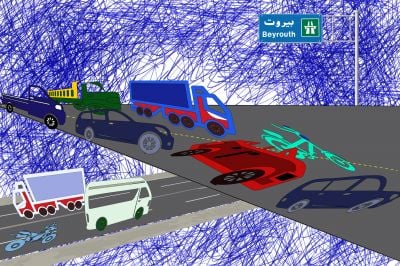
If you too want to be unbothered, moisturized, happy, focused and flourishing… you better get in your lane.
Sure, the dividing paint isn’t always at its crispest, but you weren’t born yesterday (hopefully, you were born at least 18 years ago), so you know where the lanes are, and straddling two of them at once is just pure selfishness — and technically illegal.
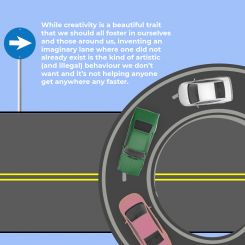
While creativity is a beautiful trait that we should all foster in ourselves and in those around us, inventing an imaginary lane where one did not already exist is the kind of artistic behavior we don’t want, and it’s not helping anyone get anywhere any faster.
In general, the right lane is where you’re meant to be. If anything has gone — or risks going — amok, the right lane, since it’s the closest to the side of the road, is safest. The left lane is for when your tires and gears are singing sweet harmonies and the road ahead is clear, literally and metaphorically.
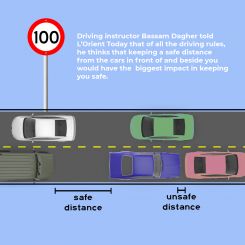
Driving instructor Bassam Dagher told L’Orient Today that of all the driving rules, he thinks that keeping a safe distance from the cars in front of and beside you would have the biggest impact in keeping you safe. Think of it like this: the magic number is three. Leave at least a three-second gap between you and the car ahead.
Turning tricks, the legal kind
When you’re turning right onto a different road, make your move from the right lane. The same applies to the other way: turn left from the left lane and into the left lane. Where there’s a two-lane road, you risk turning that cool, smooth arc into a rather crunchy endeavor if you decide to join the new road in a lane other than the one you left from. No mixing and matching... Left meets with left, right meets with right.
Welcome to the circle of trust
Roundabouts! If you’re already in it, you have the right of way, so don’t mess up everyone else's flow by getting nervous on your way out. Vehicles wishing to enter your orbit must slow down and wait for a good time to merge.
On your way in, if you’re taking the first exit, stick right. If you’re taking the second or third, go into the inner lane. Signal just ahead of the exit you want to take. Don’t even think about overtaking someone in a roundabout, stay in line and stay calm — you’ll be out in a second.
Speed limits, not speed thrills
The thing about speeding is that it’s annoying for literally everyone else, and also, it's dangerous. If speeding really makes you feel alive, take your passions seriously and become a Formula One driver — Lebanon currently doesn’t have anyone to cheer for on the world stage of racecar driving (other than our dear Lewis Hamilton, who seems to have a crush on Lebanon). Wusses speed through Achrafieh, champs speed on the circuit.
Where there are no signs indicating otherwise, these are the general speed limits, according to the Lebanese road law: 110 km/h on highways, 70 km/h in rural areas, 50 km/h in urban areas. If you can’t see farther than 50 meters ahead, you shouldn’t be driving any faster than 50 km/h.
Slow down for slopes, curves, animals, people, bus stops, intersections, near schools, construction sites and pedestrian crossings. Remember, you are driving the fastest machine available to you, and you’ll get where you need to go in fine time if you drive smart. If you want to go faster, go to space, or move to Japan and take a bullet train.
If only there were trains
Did you know, there’s a section in the Lebanese driving law about railway crossings? Sigh… maybe one day.
Who yields to whom? Let's sort it out
Other rights of way. Pedestrians — as should be obvious — have the utmost right of way. That’s just how it is!
You’re required to get out of the way as safely and as soon as possible whenever military, Civil Defense or ambulance vehicles that have their sirens or emergency lights on come your way.
Public buses, those glorious purple creatures that have started to go into circulation this year, have the right of way when pulling in or out of their designated stops.
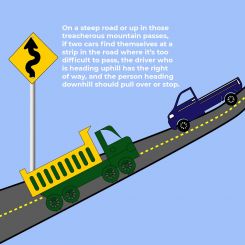
On a steep stretch or up in those treacherous mountain passes, if two cars find themselves at a strip in the road where it’s too difficult to pass, the driver who is heading uphill has the right of way; and the person heading downhill should pull over or stop.
If you’ve already gotten yourselves in a tight spot and can only resolve the impasse by having the car(s) coming from one direction reverse back out to give way to the car(s) coming toward them, the hierarchy is as follows: a single vehicle gives way to several, a light vehicle to a heavy one, a truck to a bus. And if you’re completely equal in all other ways, whoever is descending does the chivalrous move of backing it up.
Blink, flash, wave: Signals are your friends
There are many ways to let people know what you’re up to. Assuming no one has angrily punched out one of your car lights yet, you can signal with those. They’re a handy form of communication. Hazard lights can alert the drivers behind you of a speedy brake, and flashing your headlights can get the attention of someone in front of you.
On rural roads, if you see something to be wary of, you can warn drivers coming in the opposite direction by flashing your headlights at them.
At night, in order to aid oncoming traffic in their bid not to crash right into you, turn down your high beams as you pass them. If someone behind you has blinding high beams, flip the lever at the bottom of your rearview mirror to dim them without losing sight.
If your lights are out of commission, use your arm. Bent up at the elbow means you're turning right, straight out means turning left, and bent down at the elbow means you’re slowing to stop (this is relatively universal).
Overtaking: Space, time and ego management
People tend to overtake other cars as if they’re Vin Diesel and everything is Hollywood. You’re not invincible. Remember Paul Walker.
When overtaking, do the math first. Space and time, man, it’s trippy! In your mind’s eye, picture how you’ll go and remember the car you’re overtaking is still moving — so leave more space than you think you’ll need.
For the love of God (who loves good drivers, by the way), do not overtake someone on a curve where you can’t see what’s around the corner; and if someone is overtaking you, that is not the time to start having an ego — don’t accelerate, keep a steady pace.
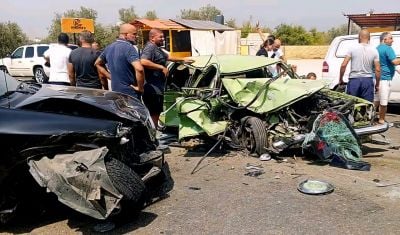
You should only overtake on the right if the car in front of you has signaled that it’s turning left. Otherwise, pass from the left — it’s the only right way to do it! That is to say, it’s the only way left to do it!
Thou shalt not overtake: in intersections, in fog, during a traffic jam, ahead of speed bumps or crossings, in tunnels, when signs say not to. Also, don’t overtake a car that’s already overtaking a car….
Strap in: Protect your mini-me
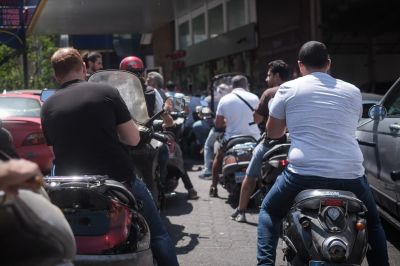
Get your baby in the back seat and in a car seat. You created a human being — protect it! It’s illegal to have a kid under 10 in the front seat, and to have a kid under five not in a car seat, let alone cradled in your lap on the back of a motorcycle…
Use a seatbelt, even if people make fun of you for it. It’s better than coming to after an accident with your head through the windshield.
One drink per hour, not per kilometer
Having a fun night out with your pals? You know what would really dampen the mood? If any one of you got into a car and drunkenly flew off a cliff, plowed into another vehicle, over a pedestrian or spun out into a pole.
If Lebanon’s police force actually had the resources to pull over drunk drivers, anyone with a blood alcohol level over 0.5 grams per liter (or Blood Alcohol Content [BAC] over 0.05 percent) would be charged. That percentage depends on several factors, like weight, age, how much you ate, and the period of time across which you’ve been drinking.
The general rule for keeping your drinking in the safe zone as a driver is one drink per hour, but there are BAC calculators that can help you guess your alcohol levels according to a few of the aforementioned factors.
Drinking is considered by many in the security and emergency services fields as one of the leading causes of deaths on the road in Lebanon.
Elie Miramo, of Miramo Driving School fame, told L’Orient Today he believes monitoring your drinking when you know you’ll be driving that night is one of the most impactful behavior changes someone could make in order to increase their safety on the road.
Courtesy isn’t in the law, but maybe it should be
Want to elevate your driving style? Collect karma? Feel good about yourself and improve humanity’s general standing? Here are some etiquette tips that aren’t in the law, but would definitely refurbish the vibe on Lebanon’s roads.
- When a line of traffic is coming in from an adjoining road, allow merging on an every-other-car basis.
- If someone gives you space to let you in, give them a wave, a nod, a wink, or a rose, to show your appreciation.
- On the street, do not double, triple, quadruple (and so on) the rows of parked cars. You're either parked by the curb or you're taking another trip around the block to look for space elsewhere.
- Whatever it is you suddenly remembered, dropped, saw, or heard, do not, under any circumstances, come to a full stop in the middle of the street, let alone a highway.
