






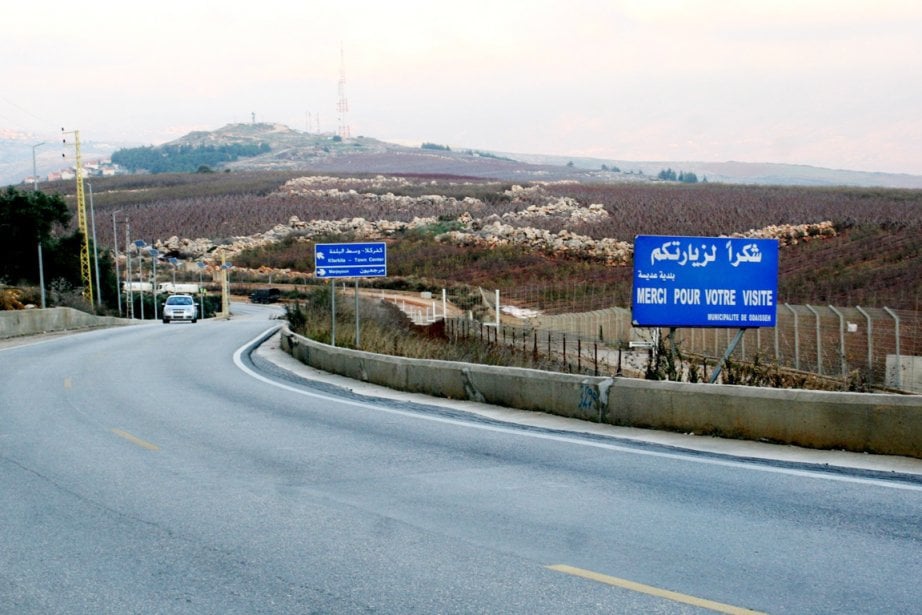
This photo, taken from the Lebanese side, shows a barrier separating southern Lebanon from northern Israel. (Credit: Ali Dia/AFP.)






BEIRUT — The office of Israeli Prime Minister Benjamin Netanyahu announced Thursday that Israeli citizen Saleh Abou Hussein, who had been held in Lebanon for about a year, has returned to Israel following negotiations conducted with the help of the Red Cross.
Netanyahu's office welcomed his return, an Arab Israeli, calling it "a positive step and an encouraging sign for the future," according to a message posted on X. The prime minister's office did not provide details on the circumstances of Hussein's detention.
However, his lawyer told the Lebanese channel LBCI that he had been detained for "more than 13 months, for illegally crossing the border by mistake." "He tried to swim back, but got lost," she said. "There is no file on him before the military court and the Lebanese justice system," she added.
'We cannot accept the excuse that he is of Arab origin'
Reacting to the announcement, Kassem Hachem, MP from the Amal movement, expressed his astonishment in a statement that "the release of an Israeli citizen occurs after a year of captivity, without any statement or announcement."
He added, "On what grounds is he released without any attempt being made to free the Lebanese prisoners held in the enemy's jails? We cannot accept the pretext that he is of Arab origin. Anyone who holds the nationality and identity card of the enemy remains the enemy, regardless of their origin," said Hachem, who called to "seize every opportunity to free our young men (detained in Israel) and bring them back" to Lebanon.
Following suit, Hezbollah MP Ibrahim Moussawi said he was “surprised, as were the Lebanese people, by the Israeli enemy’s announcement that it had received an Israeli from Lebanese authorities, in a unilateral move in which Lebanon recovered none of its own citizens detained by the enemy.” “This raises serious questions and deep doubts about the government's negligence and its inability to take advantage of the opportunity to negotiate an exchange with the opposing side,” he emphasized in a statement.
Denouncing “the [Lebanese] authorities’ failure to properly fulfill their responsibilities,” Moussawi accused the state of having “sent a message of shame and betrayal [...] to the Lebanese people” by releasing the Israeli prisoner.
“The state does not care [about its people] and does not know how to leverage the cards of strength it has, wasting them for free, while the occupying enemy continues its crimes, its aggressions, and its violations,” the Hezbollah member’s statement continued. He finally called on the Lebanese authorities to “clearly and fully explain to the Lebanese people, especially to the families of the prisoners, the truth of what happened.”
The issue of Israeli detainees in Lebanon has not been raised in recent months in the discussions surrounding the implementation of the ceasefire terms between Israel and Hezbollah — unlike the matter of Lebanese detainees who were captured during the Israeli ground offensive and who remain imprisoned in Israel. Their release is one of the measures outlined in the roadmap presented by U.S. envoy Tom Barrack for enforcing the truce.
Cross-border infiltrations of Israeli civilians into Lebanese territory are rare. However, groups of ultranationalist settlers advocating for the establishment of settlements have crossed into South Lebanon multiple times during the exchanges of fire, daily strikes, and the Israeli invasion between September and November 2024.