






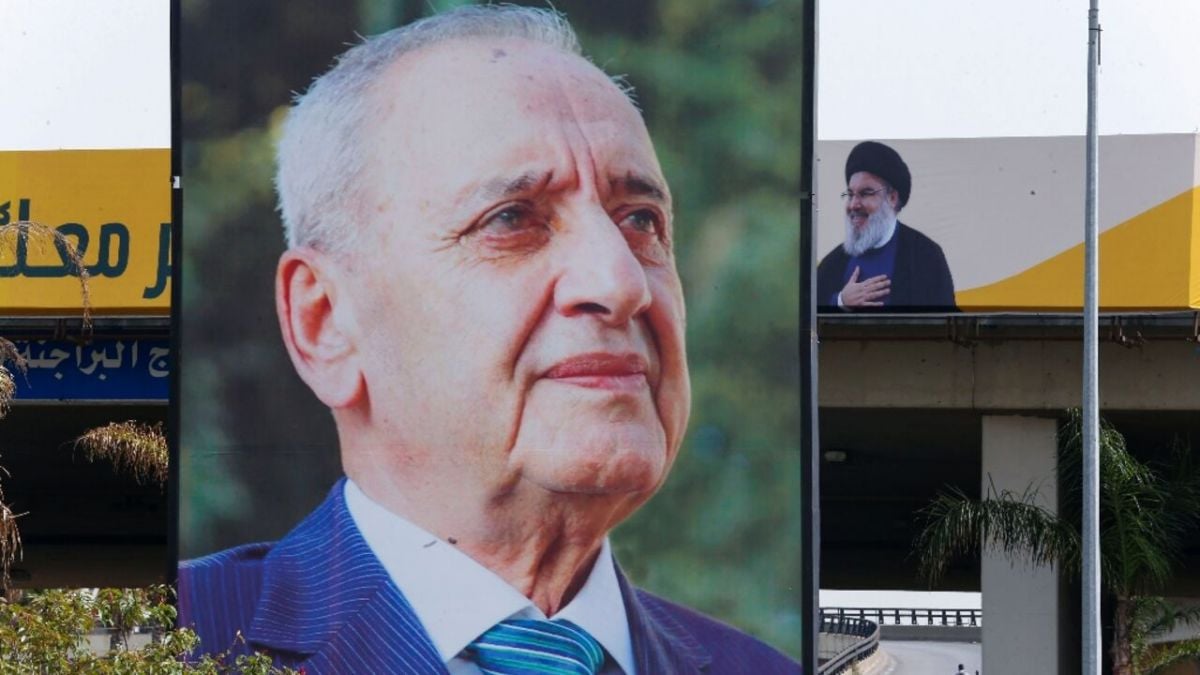
Parliament Speaker Nabih Berri on a billboard in Beirut, while another, in the background, features Hassan Nasrallah, the former Secretary-General of Hezbollah, on May 2022. (Credit: Archive photo Louai Bechara/AFP)






BEIRUT — Parliament Speaker Nabih Berri said Thursday he was open to a compromise over the crisis sparked by last week's framework agreement between Lebanon and Israel, while reaffirming his rejection of direct negotiations and warning against any internal discord.
In an interview with local daily Addiyar, Berri said the door to compromise remained open. "If there is a will to compromise, I am ready for it. No one wants the country to end up at deadlock," he said.
Asked what form such a compromise could take to resolve the crisis, Berri reiterated his opposition to direct negotiations, saying he knew where they would lead and that they had produced a "discord agreement." He contrasted that with the agreement he sponsored on Nov. 27, 2024, which he said secured Hezbollah's complete withdrawal from south of the Litani River without requiring direct negotiations.
Warning against discord
Berri said that before the framework agreement was reached, he spoke with President Joseph Aoun. At the time, he proposed that the Israeli withdrawal be carried out by districts rather than through "pilot zones," arguing that this would provide a clearer and more credible implementation mechanism. According to Berri, Baabda initially approved the proposal, but officials were later "surprised" to find that the final agreement retained the principle of "pilot zones" instead of districts. Asked what message he wished to send to the president, Berri replied that he had none at this stage.
The Parliament speaker also warned against taking to the streets and fueling internal discord. He said Israel, through its demands and pressure, was seeking to push the Lebanese Army into confronting the "Resistance," describing it as its real objective. However, he insisted this would not happen because the Lebanese understand the dangers of internal strife, and neither the army nor the "Resistance" would be drawn into serving Israeli interests
On exit strategies from the crisis, Berri reaffirmed his belief that Lebanon needed international backing to allow for compromise. According to him, this support should bring together the United States, Saudi Arabia and Iran, which he described as the main guarantors of a viable compromise.
Lebanon and Israel signed a framework agreement in Washington last Friday aimed at resolving conflict with Israel, even as the Israeli army continues to occupy more than 600 square kilometers in south Lebanon, which extends up to 10 kilometers deep into Lebanese territory. The text also provides for Hezbollah's retreat and disarmament and withdrawal of Israeli troops from two "pilot zones" in south Lebanon, without offering a timeline. According to Israel's Channel 11, the withdrawal would be postponed until Lebanon and Israel reach an arrangement on a "joint supervision mechanism" involving their respective armies. The agreement has drawn a mixed reaction in Lebanon, with officials and the public expressing rejection, criticism and support.
