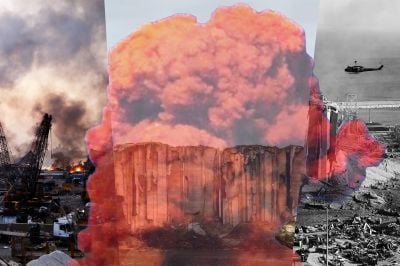
(Credit: Jaimee Lee Haddad)






On Aug. 4, 2020, at 6:08 p.m., one of the most powerful non-nuclear explosions in modern history destroyed the Lebanese capital, killing about 235 people and injuring thousands.
What happened on Aug. 4, 2020?
The first details emerge in the hours after the blast. The explosion was caused by a fire that set off the detonation of hundreds of tons of ammonium nitrate stored dangerously at the port of Beirut.
The involvement of Lebanon's political class quickly transforms the case into a state crime. From former President Michel Aoun to Prime Minister Hassan Diab, top officials had been informed of the danger.

Over the years, revelations have exposed the complex network of responsibility related to the shipment of fertilizer, which is also used as an explosive.
Behind the 2,750 tons is a vast network of businessmen and companies from around ten different countries, possibly connected to the Bashar al-Assad regime.
However, what happened specifically on Aug. 4 is a mystery.
So far, no evidence has clarified the origin of the fire that caused the explosion. Accident, attack or sabotage?

Three hypotheses — each fragile and incomplete — are possible, but none has been proven true to date.
After a two-year delay caused by legal procedures, the reopening of the local investigation in early 2025 raises hopes for answers.
Hearings are resuming, now with new political guarantees, as the government led by Nawaf Salam since February prioritizes judicial independence.
But the case remains stalled. Shielded by investigative secrecy, the inquiry proceeds behind closed doors, with no clues emerging about missing evidence or the reasons for the deadlock. “Nobody knows what is taking so long,” said Samaneh Moafi, deputy research director at the Forensic Architecture analysis center.
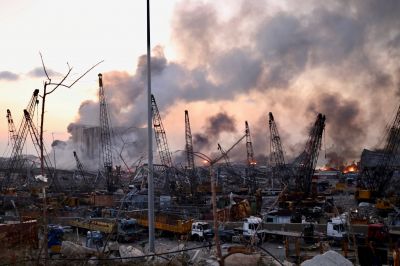
Authorities had promised to resolve the case within five days, but five years later, the mystery remains unsolved. Data, analysis, unanswered questions: Here’s what we know so far.
Attack theory
A significant number of Lebanese people still believe that the explosion at the Beirut port bears Israel’s fingerprints.
“It would have taken an unbelievable number of coincidences for what happened to be an accident. Israel had every reason at the time — the crisis, the internal climate — to try to weaken Hezbollah. A small drone or a ground agent would have sufficed,” said Firas Hatoum, former investigative journalist for the Lebanese channel Al Jadeed.
In the hours and days after the explosion, the theory of an external attack spread quickly. Residents reported hearing airplane sounds seconds before the blast, with some describing a whistling noise similar to a jet engine.
The theory is echoed at the highest level. President Michel Aoun raises the possibility of a “missile” or a “bomb.” His American counterpart, Donald Trump, suggested — before retracting — a “terrible attack.”
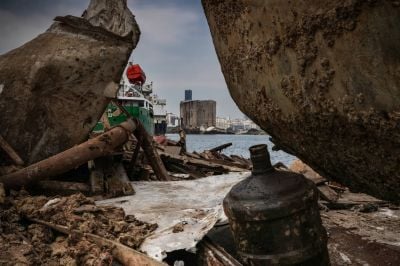
Attention quickly shifted to Tel Aviv. Since its founding in 1948, Israel has had a long history of military attacks on Lebanese territory, often with little concern for civilian casualties.
This time, Israel was accused of attempting to destroy a possible Hezbollah munitions cache. Israeli authorities have accused Hezbollah for years of using the port of Beirut to smuggle weapons from Iran.
Proponents of this theory argue that Tel Aviv wanted to get rid of the ammonium nitrate — or any other weapon in the warehouse — while also stirring up the population against the party, which is blamed for the explosives in the capital.
The party’s official response, which supports the theory, only fueled suspicions of potential mutual interests between the group and Israel to protect each other and prevent escalation.
At the time, the political climate appeared to support this theory. Tensions were running high between Israel and Hezbollah. Border clashes in the south had been threatening to escalate for several weeks.
“We will do what is necessary to defend ourselves,” declared Israeli Prime Minister Benjamin Netanyahu to the party just hours before the explosion.
The rapid expansion of the Port of Haifa, supported by a land transport network project, presents another argument: Some suggest a secret plan to make Israel’s third-largest city the region’s main commercial hub, surpassing Beirut.
Some of these arguments are based on valid observations, but they do not stand up to scrutiny when examined against the available material.
Factually, the idea of an air attack has no solid basis. “Technically, it is possible, but there is no evidence that this was the case,” said Eliot Higgins, director of Bellingcat, a Netherlands-based investigative journalism group.
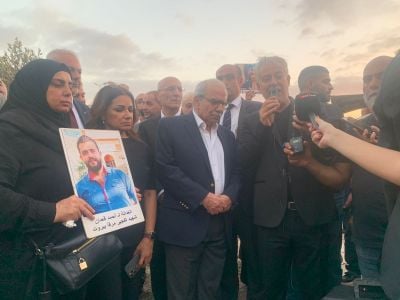
“The fact that a fire preceded the explosions allows us to rule out the hypothesis of a missile or explosive device triggering the blast ... Such means would have caused an explosion immediately, not a fire,” stated a French expert report from 2020.
Local surveillance systems did not detect any aircraft in Lebanese airspace. It is possible that “very small objects might not be detected by radar,” clarified Ritwik Gupta, a researcher at Berkeley University.
But satellite images from private companies, including some available online, indicate a ground-based detonation. “There is no visual or seismic evidence of an initial impact [before the explosion], and the photos seem to correspond to a ground-based explosion,” said Nathaniel Raymond, director of the Humanitarian Research Lab at Yale's School of Public Health.
“Such a scenario is speculative,” concluded Higgins. What about the plane noises reported by residents before the blast? They match the sounds of chemical reactions inside the warehouse: rapid pressure waves, delayed detonation, intensifying fire — several phenomena can explain these noises, creating what experts call an “acoustic illusion.”

Despite the lack of evidence, the rumor of an external attack continues, fueled by the opacity surrounding aspects of the case.
Speculation has persisted for years regarding how expert reports and satellite images from Western capitals are managed.
Local authorities received images from private companies, U.S. authorities, and, according to our sources, the French authorities.
However, Paris is suspected of withholding data in its possession, and Washington is accused of providing satellite images that are useless for the judicial investigation.
In reality, it's impossible to know which images have been captured by foreign intelligence satellites, but experts believe the probability that the Port of Beirut was photographed just minutes before the explosion is very low.
“There is no permanent coverage of anywhere on earth — a city only appears from time to time,” explained Gupta.
Even if images are captured at the right time and place, there is no guarantee they will be useful for the investigation or of sufficient quality.
“Satellite images only provide part of the answers. You can spot vehicles, black dots, but it’s hard to determine an individual’s exact identity,” said Raymond.
Although it doesn’t offer a solution, time has provided valuable perspective to reassess some hypotheses.
From Beirut to Tehran, Israel has proven it can strike ground targets with surgical precision.
The extent of infiltration by Israeli intelligence within Lebanese society also indicates that a ground operation cannot be entirely dismissed.
Recent explosions in Iran, which some Iranian sources attribute to Tel Aviv, serve as reminders that foreign sabotage operations are a key part of Israeli tactics.
Yet, years later, the Beirut Port explosion yielded no benefits for the Port of Haifa, which is far from a dominant Mediterranean super-hub. “It’s now a high-risk port for maritime transport. Bazan, Israel’s largest oil refinery, has even suspended its operations there,” noted political analyst Joe Macaron.
Accident theory
This is the theory proposed by authorities in the hours following the explosion and the one preferred by international investigators. Many experts also consider it the most likely.
The main argument focuses on analyzing the contents of warehouse no. 12 and its storage conditions.
The presence of fireworks and flammable materials, such as methanol or wood, along with the ammonium nitrate, made the warehouse a ticking time bomb.
“Ammonium nitrate is rarely used in weapons because there are more effective explosives. It is a very stable compound and difficult to detonate. However, if stored improperly — piled up in large quantities and exposed to heat or flames — it can explode,” said Jacqueline Akhavan, professor of explosives chemistry at Cranfield University.
The first internal warnings about the danger date back to 2014, and a more thorough examination of the detonation increases the likelihood of an accident.
“Normally, an ammonium nitrate explosion does not produce toxic smoke. The red smoke rising from the Port of Beirut on Aug. 4, 2020, indicates the chemical reaction was incomplete. The nitrate didn’t fully react. Otherwise, the destruction would have been significantly greater. That tells us the detonation was unintentional, or at least very poorly initiated,” explained Jimmie Oxley, professor of chemistry specializing in explosives at the University of Rhode Island.
According to an FBI report from October 2020, only 552 tons of ammonium nitrate out of the 2,750 imported in 2013 actually detonated.
What remains unclear is what sparked the fuse. “That’s the hardest part to determine. I've examined many accidents in my career, and the question always is who started the fire, who struck the match?” continued Oxley.
“No hypothesis can be favored,” began the French expert report based on samples collected in August 2020.
The visual data analysis by Forensic Architecture in November 2020, however, ruled out an accident caused by welding work for three reasons: the fire’s origin was nearly 50 meters from the work area; the work finished several hours before the fire; the workers had no access to the inside of the building, with repairs focused on an exterior door.
A simple spark, such as an electrical failure, a cigarette or a match, could have caused the fire that triggered the blast. There’s no way to know more without additional information.
“To determine intentionality, we’d need access to on-site investigative reports, surveillance camera footage or employee and worker testimonies from the day of the explosion,” said Moafi. “Yet in all these areas, there’s a total lack of transparency,” she continued.
This isn't the first time poor storage conditions have caused a major disaster.
Seventy such incidents were documented in the twentieth century. The explosion at the AZF factory in Toulouse on Sept. 21, 2001, remains one of the most notable recent examples.
Sabotage theory
However, it is hard to separate the incident from the larger sequence in which it occurred.
The explosion happened three days before the Special Tribunal for Lebanon was set to deliver its verdict on the assassination of former Prime Minister Rafik Hariri, just two months after an official document warned about the terrible storage conditions.
If the ammonium nitrate catches fire, it would trigger “a huge explosion with catastrophic consequences for the Port of Beirut,” wrote Captain Joseph Naddaf in a report dated June 1, 2020.
This was sent to the General Directorate for State Security under the Higher Defense Council, led by then-President Michel Aoun.
In response, State Prosecutor Ghassan Oueidat ordered the securing of warehouse No. 12. After years of neglect, the threat was finally beginning to be taken seriously by the authorities.
The double explosion happened in this climate of uncertainty.
Other events have also fueled doubts about the theory of an accident, including political interference in the judicial investigation and institutional obstacles maintained by the ruling class to slow the process.
The disappearances of individuals with sensitive information — such as Colonel Joseph Skaff, who died under suspicious circumstances in 2017 after raising concerns about the ammonium nitrate, retired Colonel Mounir Abou Rjeily, murdered in Karbala on Dec. 2, 2020 and Lokman Slim, an activist critical of Hezbollah, found shot in his car on Feb. 4, 2021 — cannot be ignored in the analysis.
Together, these elements form a web of suspicion. However, they do not offer any clear answers.
Did Hezbollah or another group have an interest in making the ammonium nitrate disappear? Was it possible to transport the cargo without attracting suspicion? Could they ignore the deadly risks of a fire for civilians?
Further uncertainty surrounds whether surveillance cameras at the port: Were they working? Who accessed the footage?
Various unverified accusations circulate that the footage was stolen or deleted to conceal information. No one appears able to answer this today.
Five years later, the Lebanese still face the same unanswered questions.
The memory of the port remains unresolved, awaiting new evidence — a photo, a testimony, a report — something to uncover the whole story and restore meaning where it has been lost.
This article was translated from L'Orient-Le Jour and edited by Yara Malka.