


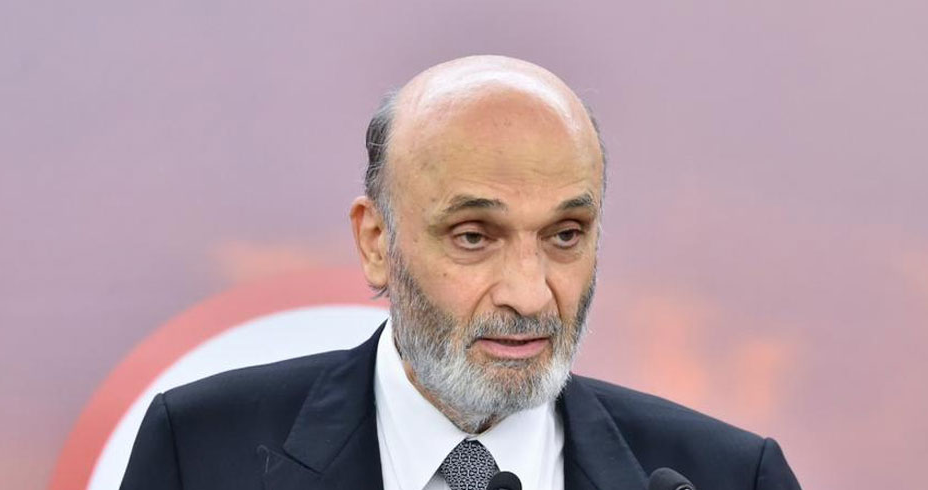
The leader of the Lebanese Forces, Samir Geagea. (Credit: NNA.)






The leader of the Lebanese Forces (LF), Samir Geagea, on Tuesday criticized Lebanon's official response to U.S. envoy Tom Barrack regarding the state's monopoly on weapons, deeming that it matches Hezbollah's demands.
In this context, he stated that the dissolution of armed organizations in Lebanon "has become a demand of the majority of the population," as the country recovers from a devastating 13-month war between the Shiite party and Israel.
It was a conflict in which Hezbollah emerged greatly weakened, now under local and international pressure to give up its arsenal.
"After all the suffering we have endured, the Lebanese response to certain American proposals matches completely — except for a few cosmetic phrases — the demands of Hezbollah. By what logic and justification do Lebanese authorities respond in this way to American proposals?" the LF leader said in a statement.
Geagea also accused the authorities of giving a response to the American envoy "without consulting the government, which, according to the Constitution, is responsible for administering the country's public policies, and without consulting Parliament, which is primarily responsible for managing the country's policy and supervising government work."
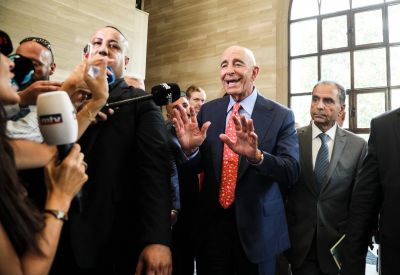
Arriving in Beirut on Sunday night, the U.S. envoy was received by President Joseph Aoun.
During their meeting, Aoun handed him a "draft protocol of agreement" outlining Lebanon's commitments since the Nov. 27, 2024 cease-fire. These include the terms of the truce, the president’s inauguration speech, and the ministerial statement of Salam's cabinet.
Among these commitments, the presidency cited "the urgent need to save Lebanon by extending the authority of the state over its entire territory with its own forces, maintaining a monopoly on weapons held solely by the Lebanese armed forces, and affirming the authority of Lebanese constitutional institutions over decisions of war and peace."
These factors must be guaranteed "simultaneously and in parallel with the maintenance of Lebanese sovereignty over all its international borders, reconstruction, and the launch of the economic recovery process." But according to our information, Washington now expects a concrete implementation mechanism and the start of its execution.
In an interview with "Sawt Kel Lebnan" (the voice of all Lebanon) radio, Agriculture Minister Nizar Hani said Tuesday that Lebanon's final response to the U.S. proposal will be presented to the Council of Ministers at an upcoming meeting.
Barrack, for his part, visited Parliament Speaker Nabih Berri on Tuesday, who, according to media reports, is himself expected to submit a proposal based on the idea that Israel make a first gesture toward Lebanon by suspending its attacks for 15 days, after which Lebanon would begin a process of disarmament.
Disarmament, a 'demand' of the Lebanese
"Illegal weapons in Lebanon after the 2024 war are not an American problem and are no longer an Israeli problem. It is essentially a Lebanese problem. The presence of illegal armed organizations in Lebanon, Hezbollah at the forefront, has destroyed the Lebanese state," Geagea also said, in response to a statement by the U.S. envoy.
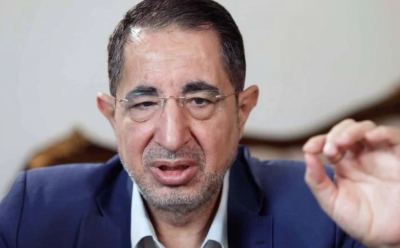
Asked Monday night by Télé-Liban, Barrack recalled that Hezbollah constituted a "problem" for Israel and that it was necessary "for it to willingly agree" to a solution that would "restore trust" among the various belligerents. The secretary-general of Hezbollah, Naim Qassem, for his part stated over the weekend that Hezbollah would not give up its "strength" and remained ready to confront Israel.
The LF leader further stated that "the presence of [armed and illegal] organizations continues to confiscate the state's strategic decisions. Their dissolution has become a demand of the majority of the population and a clear requirement of all Lebanon's friends in the East and the West, particularly in the Gulf States.
This is to allow Lebanon's friends to renew their interest in the country and provide it with the necessary assistance, be it in expelling Israel from Lebanon and ending its military operations, confirming and consolidating our southern borders, or demarcating our eastern and northern borders," Geagea added.
"What is happening unfortunately takes us years back and exposes Lebanon to great dangers, new tragedies, and new misfortunes," he warned.
The Kataeb Party's political bureau, meeting under the leadership of party chief MP Samy Gemayel, called on “all political forces to strengthen constitutional institutions” and warned against “the dangers posed by illegal militias remaining armed, as well as the lack of state authority and sovereignty over the entirety of Lebanese territory.”
The party stressed that if this situation continues, it “could undermine national unity, fuel extremism, and obstruct the process of building state institutions.” It also urged “legitimate armed forces to show firmness in controlling the borders, maintaining security, and enforcing the law fairly across the entire country and among all communities.”
Finally, the Kataeb called on Hezbollah to “seize the current opportunity to immediately hand over its weapons — unconditionally — in order to fully reintegrate into the state and seriously engage in rebuilding state institutions in accordance with the Constitution.”