


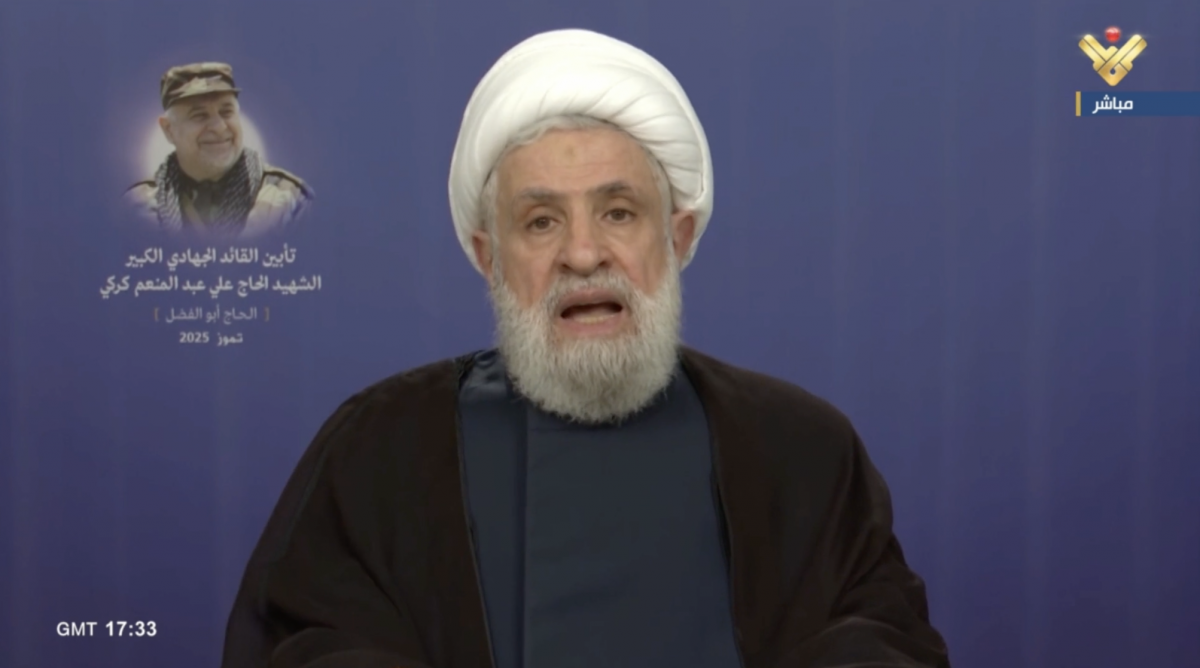
Secretary-General of Hezbollah Sheikh Naim Qassem during a televised speech on Friday, July 18, 2025. (Credit: Screenshot/Al-Manar)






The secretary-general of Hezbollah, Sheikh Naim Qassem, said Friday that his party would not give up "its strength" and was "ready to confront" Israel, while the question of disarming the pro-Iranian group remains at the heart of political debates both in Beirut and internationally.
"We will not give up our faith or our strength. We are ready to confront the enemy. There will be no surrender or capitulation to Israel, and Israel will not get our weapons," he said during a ceremony honoring a military official of the party. "We know that confrontation will be very costly, but submission would leave us with nothing," he added. "We are ready to defend ourselves in the event of Israeli aggression."
These comments come a week after the visit to Beirut by U.S. envoy Tom Barrack, who brought a "roadmap" urging Hezbollah's disarmament that Washington hopes to conclude by the end of the year. Since then, rumors have circulated about possible tensions between Parliament Speaker Nabih Berri and Hezbollah over how to respond to the American initiative. Qassem responded by stating, "Do not count on an inter-Shiite conflict. Hezbollah and the Amal movement form a strategic alliance."
He also said that Lebanese President Joseph Aoun, Prime Minister Nawaf Salam and Parliament Speaker and Head of the Amal movement Nabih Berri "are demonstrating wisdom and cooperation to get the country out of the crisis."
'3 real threats'
Hezbollah leader further stated that "all confessions in Lebanon are threatened." "Lebanon faces three real threats: Israel in the south, groups affiliated with Da'esh [the Arabic acronym for the Islamic State group] in the east, and American hegemony that seeks to control the country, place it under guardianship and prevent it from living freely," he continued. He called for "unity," asserting that "when these threats have been removed, we will be ready to discuss a national defense strategy."
Hezbollah insists that the issue of its weapons is a matter for internal dialogue with the president, as part of a national defense strategy, and refuses any timetable or engagement imposed from outside. Among its conditions are the withdrawal of Israel from occupied Lebanese territories, the release of prisoners and the end of violations.
Reflecting on the latest war that pitted Hezbollah against Israel last fall, Qassem claimed that "the resistance ... prevented Israel from reaching Beirut." "The main mission of this resistance remains liberation, the protection of Lebanon against occupation, the fight against Israeli colonization and the defense of Lebanon's right to its sovereign future," he said.
He also maintained that Hezbollah had "fully respected the cease-fire agreement south of the Litani," emphasizing that "the Lebanese Army was deployed wherever it could." He accused Israel of continuing "eight months of continuous aggression," in violation of the truce concluded on Nov. 27, 2024, after 13 months of war. Under the terms of this agreement, Hezbollah was to withdraw its fighters north of the Litani River, with only the Lebanese Army and UNIFIL remaining in the sector. Israel, for its part, was to evacuate all of southern Lebanon, but still maintains military positions in five localities.
Taif Agreement
"Today, the United States is proposing a new agreement, as if the last eight months of violations had never happened," said Qassem. "The new agreement proposed to exonerate Israel for the entire previous period of aggression." According to him, "the true objective of this aggression is the disarmament of Hezbollah ... a purely Israeli demand."
Qassem also emphasized that there is a desire to see "Syria completely disarmed, subject to the orders of Israel." "Will we accept that for Lebanon?" he asked. "The weapon of the resistance is what has allowed Lebanon to stand up and prevented the expansion of Israel."
The Hezbollah leader also declared that "Lebanon is our definitive homeland. We are all committed to the Taif Agreement and its provisions." He added, "Today, it is the very existence of the resistance, its environment, and Lebanon in all its components that is threatened."
The leader made these remarks during a ceremony honoring Ali Karaki, a Hezbollah cadre killed on Sept. 27 alongside former Secretary-General Hassan Nasrallah. "He was one of the main architects of Hezbollah's military structure," Qassem said, noting that Ali Karaki "planned and supervised several suicide attacks."
This article was translated from L'Orient-Le Jour.

 7 p.m. recap: 1 person killed near border with Lebanon; 200 kilos of explosives carried by mules; Riyadh shuts its airspace