







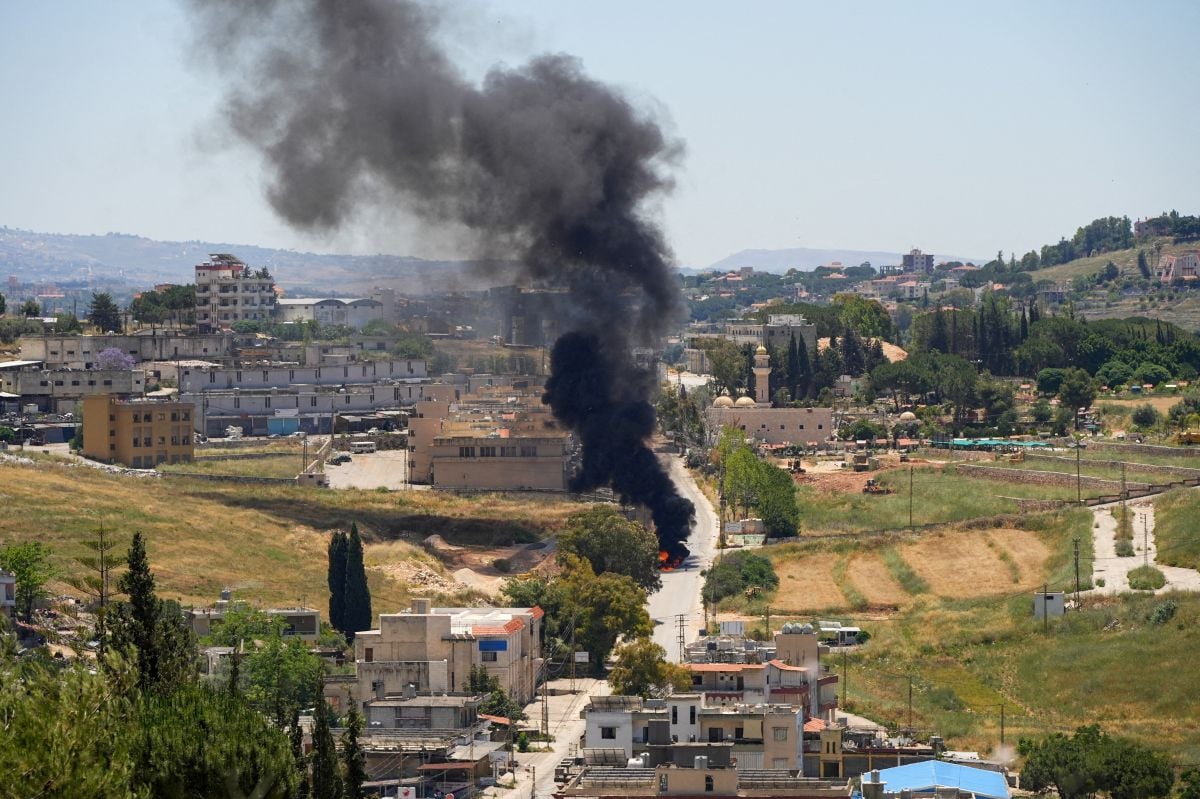
Black smoke rises at a strike scene following an Israeli strike on a car, seen from Nabatieh, Lebanon, on June 5, 2026. (Credit: Stringer/Reuters)






A day of intense drone strikes in southern Lebanon
Israel significantly escalated its deadly drone campaign in South Lebanon on Saturday, carrying out dozens of strikes across the region, according to observations by our correspondent in the region. The attacks came two days after a U.S.-Israeli-Lebanese tripartite statement condemning Iranian actions in the Middle East and expressing a desire to separate the Lebanese and Iranian files. The statement had raised hopes of a cease-fire that has yet to materialize, with Israel maintaining that no agreement has been reached with Lebanon.
Between midnight and 5 p.m., the Israeli army carried out at least 28 drone strikes on villages across southern Lebanon, primarily in the Nabatieh and Sour districts. Motorcycles, vehicles and homes were targeted without prior warning.
The Israeli army also carried out a drone strike on a military vehicle traveling on the Khardali-Nabatieh road, killing three Lebanese soldiers, including two officers. While Lebanese officials swiftly condemned the attack, Israeli army Arabic-language spokesperson Avichay Adraee said the vehicle had been moving ‘’suspiciously’’ toward Israeli forces near Kfar Tebnit, in what he described as an ‘’active combat zone under an evacuation order.’’
According to Adraee, ‘’all movement’’ in the area requires prior coordination with Israeli forces. He added that the incident remains under investigation.
Elsewhere in the Nabatieh district, drone strikes targeted a motorcycle in Deir Zahrani, killing its rider, and a car in Kfar Tebnit, killing two people. In Harouf, a strike wounded a woman, Salma Harb, as she was returning home. Two other people, including a rescuer, were also injured in the attack.
In the Sour district, several motorcycles were struck by Israeli drones. The attacks killed Ali Khalil Samadi, a medic with the al-Rissala Scouts, affiliated with the Amal Movement, in Abbassieh; another person in Jouwaya; a third in Hosh; and a fourth, Hassan Tayeh, in Baal. Two others were wounded.
Press photographer Ali Khalil, from Deir Kifa, was also killed while covering developments in South Lebanon. He had been collaborating with al-Imane television while working independently.
Three people were additionally injured when an Israeli strike hit a vehicle belonging to the Islamic Health Committee, which is affiliated with Hezbollah.
According to our correspondent, the Israeli army appears to be using drone strikes to paralyze movement along major and secondary roads linking Nabatieh to surrounding towns, including Deir Zahrani, Zefta, Habbouch, Chouqine, Zebdine, Harouf and Doueir. The aim, he said, appears to be to halt movement altogether.
Strikes in the Bekaa
At least 10 people were killed in Saturday's drone strikes, according to a preliminary toll pending official figures from the Health Ministry.
The toll does not include casualties from numerous airstrikes and artillery attacks that hit areas across South Lebanon, including Harii (Bint Jbeil district), Chouqine, Mayfadoun (Nabatieh district), Abbassieh and Srifa (Sour district), Soujoud (Jezzine district) and Shehabieh (Sour district).
In Saksakieh, in the Saida district, two women, Zahra Moustapha and her daughter Hiyam Younes, were killed in an Israeli strike.
The Israeli army also demolished homes on the outskirts of Kounine, in the Bint Jbeil district.
In West Bekaa, a drone strike killed a motorcyclist, according to our correspondent.
Since the morning, Israel has issued a single evacuation order covering the villages of Aramta, Soujoud and Kfar Houna in the Jezzine district, Machghara in West Bekaa and Ansarieh in the Saida district.
For its part, Hezbollah has in recent days concentrated its operations on Israeli positions in the Nabatieh district in an effort to prevent further advances and the establishment of new Israeli positions, our correspondent reported. The party has intensified attacks on Zawtar, Shaqif and Yohmor Shaqif in particular, and claimed to have thwarted an Israeli advance in Hadatha, in the Bint Jbeil district.