






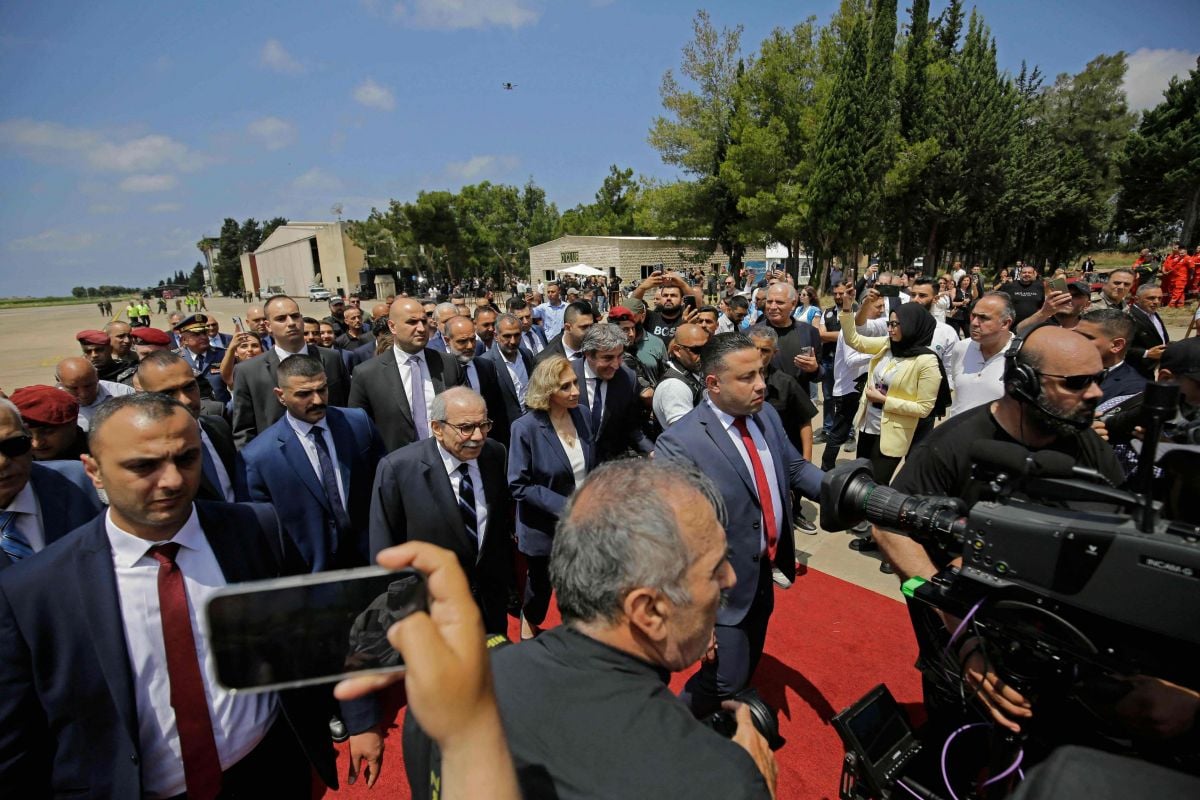
The Lebanese Prime Minister, Nawaf Salam, arrives at René Moawad Airport in Qleyaat, North Lebanon, on June 6, 2026, for the inauguration of the building. (Credit: Ibrahim Chalhoub/AFP)






Lebanese Prime Minister Nawaf Salam said Saturday, during a ceremony marking the launch of rehabilitation works at René Moawad Airport in Qleiaat, that the Taif Agreement ‘’requires the state to extend its authority over its entire territory by its own means’’ and that ‘’the decision on war and peace is exclusively its prerogative.’’
His remarks come as Hezbollah and Israel continue to exchange deadly attacks in Lebanon, while the party refuses to relinquish its arsenal as long as Israel maintains a military presence in parts of southern Lebanon.
In his speech, Salam recalled that ‘’after the meetings ended in the city of Taif and the deputies returned from Saudi Arabia, the Chamber of Deputies convened right here, at Qleiaat Airport, on Nov. 5, 1989.’’ It was there, he continued, that the National Accord Charter, now known as the Taif Agreement, was constitutionally ratified.
’’It was also here that René Moawad was elected president of the republic before being assassinated a few days later as he sought to lead Lebanon from a state of war to civil peace,’’ Salam said.
’’Bringing René Moawad Airport back to life is not only about restoring a public facility. It also means reviving the very idea of the state and the memory of Taif, not as a frozen document, but as a political project that has yet to be fully realized,’’ he added, alluding to the incomplete implementation of the agreement, particularly regarding state authority, the decision on war and peace, and balanced development.
In this context, Salam stressed that implementing the Taif Agreement ‘’requires the state to extend its authority over its entire territory by its own means.’’
’’It also requires that the decision on war and peace be exclusively in the state's hands. It calls as well for Israel's withdrawal from all Lebanese territory, the return of security and stability in the South, and reconstruction,’’ he said.
’’The Taif process is the path of a sovereign state that protects and guarantees the rights of all Lebanese. At the same time, it is the path of reform and balanced development. This is the course we have set out in our ministerial statement, and we will not stray from it,’’ the prime minister added.
Development, economic recovery and social justice
Salam also condemned the ongoing Israeli attacks on southern Lebanon.
’’We are in the north of the country, but our eyes and hearts remain turned toward the South, » he said. « Just as the state does not abandon its duty to defend Lebanon's right to its land, its sovereignty and the safety of its citizens, it also does not neglect its responsibility for development, economic recovery and social justice. »
The prime minister expressed solidarity with the residents of South Lebanon who continue to bear the brunt of the conflict. According to the United Nations, more than 1.1 million people have been displaced in Lebanon since fighting resumed on March 2, 2026.
« Your suffering is the suffering of us all. Just as there can be no stability in Lebanon as long as the South remains threatened, the country will not recover if Akkar remains marginalized and the Bekaa continues to be denied its rights, » he said.
Referring to what he described as a « political and national choice for development, » Salam highlighted decades of deprivation, marginalization and underinvestment in infrastructure, public services and employment opportunities in Akkar.
He noted that Akkar records the highest poverty rate in Lebanon, at 62 percent, compared to a national average of 33 percent.
’’Akkar also has the lowest participation rate in economic activity and the labor market, at no more than 35 percent, compared to 43 percent nationally,’’ he said, citing figures showing that around a quarter of the governorate's residents are unemployed.
Salam said the rehabilitation of Qleiaat Airport was therefore « not merely an investment project, but a key step toward balanced development, regional equity and the fulfillment of the state's responsibility toward its citizens.’’
’’The government's commitment to the Lebanese is beginning to become a reality,’’ he added.
The government approved the gradual reopening of the airport, located in Akkar governorate, in February for an initial four-year phase. Before the resumption of the war between Hezbollah and Israel on March 2, authorities had hoped the facility would welcome its first flights before the end of the year.
Salam also used the occasion to outline the government's broader vision for northern Lebanon, which includes activating the Tripoli Special Economic Zone, completing the Rashid Karami International Fair project and further developing the Port of Tripoli.