






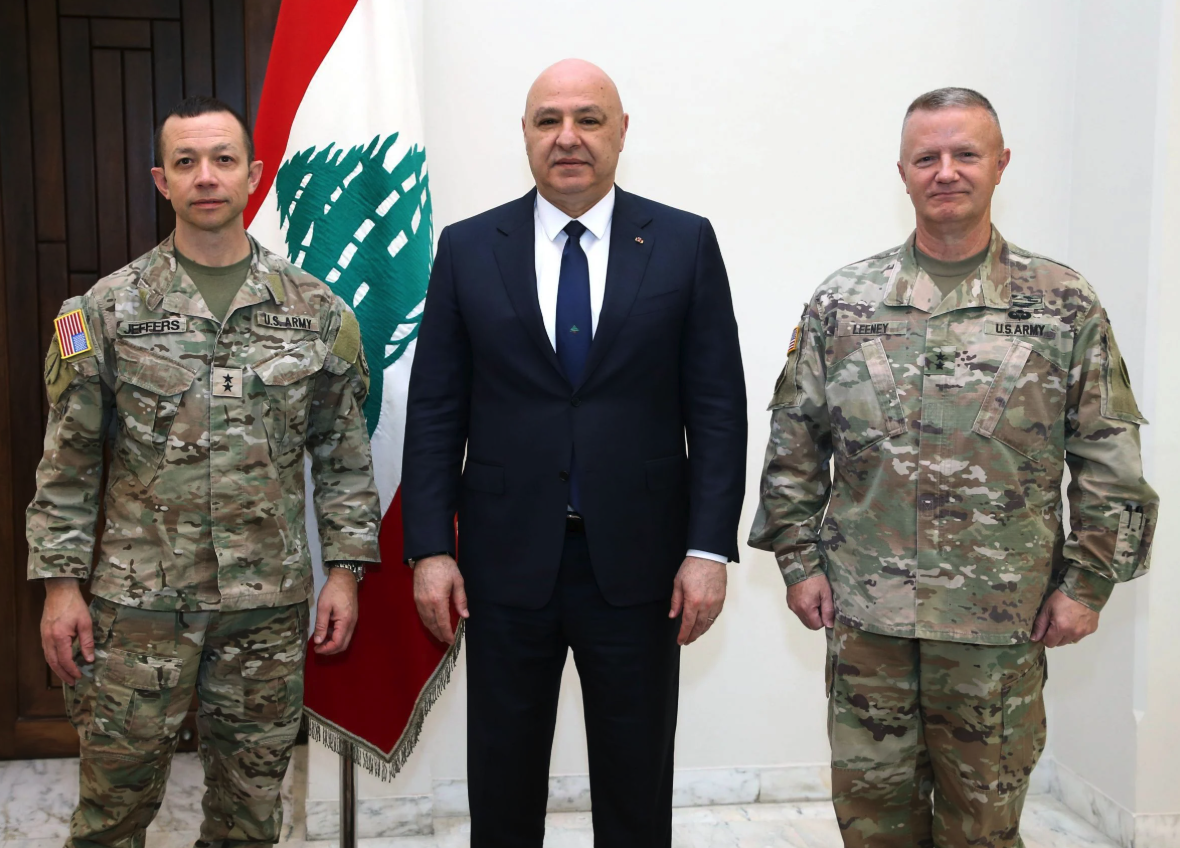
President Joseph Aoun flanked by American General Jasper Jeffers (on the left) and Major General Michael Leeney, in Baabda, on April 30, 2025. (Credit: @LBpresidency/X)






Correction: An earlier version of this article indicated Leeney was deputy commander of CENTCOM, when he was in fact deputy commander of CENTCOM's army branch (ARCENT) in South Carolina.
BEIRUT — The head of the cease-fire monitoring committee, American General Jasper Jeffers, introduced his successor to President Joseph Aoun on Wednesday, during a meeting between the three and U.S. Ambassador Lisa Johnson at Baabda Presidential Palace.
A statement from Baabda revealed that the committee, made up of French, American, Lebanese, Israeli and UNIFIL representatives, would now be chaired by Major General Michael Leeney, who, unlike Jeffers, will fulfill his role from within Lebanon, where he will reside. Jeffers, who is also involved in the States' Yemen operations, will remain involved in the committee as a supervisor and periodically visit Beirut.
“I am grateful for the opportunity to participate in such an important mission, and I am very optimistic about the future," Leeney said, as per a statement from the U.S. embassy, which described Leeney as a "full-time senior U.S. military leader in Beirut."
The statement also specifies that Leeney will "work closely with [Lebanese Armed Forces] LAF, UNIFIL, France and the Military Technical Committee for Lebanon to enable the LAF to provide security and fully safeguard Lebanese sovereignty." Israel continues to occupy five points on the Lebanese side of the borderline, claiming the need to maintain military outposts to guard against "threats."
The US responds to Lebanese calls for action
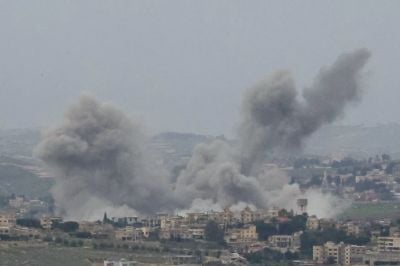
Sources within Baabda have indicated that Leeney's appointment is seen by the Lebanese heads of state as a gesture from the U.S. of its commitment to ensuring the truce is effectively implemented — at a time when Israel is escalating its attacks on Lebanon in violation of the cease-fire, launching airstrikes with apparent impunity.
On Sunday, Israel bombed Beirut's southern suburbs, prompting Lebanese authorities to double down on their insistence that the U.S. curb Israel's violations and pressure it to respect the agreement. The recent tour by U.S. officials and diplomats was intended to respond to Lebanon's calls for intervention as well as to monitor Lebanon's efforts to achieve a monopoly on arms in the country, which it is doing with U.S. support.
President Aoun, Prime Minister Nawaf Salam, and Parliament Speaker Nabih Berri coordinated their positions ahead of the visit, agreeing to collectively demand the cessation of Israeli aggression, its withdrawal from Lebanese territory, and the Lebanese Army's further deployment in the South, with the aim of dismantling Hezbollah's military infrastructure and placing its weapons under state control.
Stating their case to the U.S. representatives, Aoun, Salam and Berri insisted that Israel's ongoing occupation and continuous attacks undermine the state, even as it has made clear its intentions to acquire all of Hezbollah's weapons. Israeli strikes, particularly on Beirut's southern suburbs and areas near the airport, will have very negative consequences on all sectors in Lebanon.
The American delegation reportedly expressed an understanding of the demands and pledged to relaunch the monitoring committee's work to implement the agreement, urging Lebanon to, meanwhile, continue its efforts toward a monopoly on arms.
From California to Afghanistan to CENTCOM
Leeney was born in 1966 in Bridgeport, Connecticut, and has spent most of his career — which has involved service in the infantry ,armored division and air defense — in California.
He was an executive officer in the U.S. battalion deployed as part of the Multinational Force and Observers (MFO) in Sinai, Egypt, and in the 40th Infantry Division's agribusiness development team in Kunar, Afghanistan. In May 2018, he was deployed as chief of staff of the Train, Advise and Assist Command South (TAAC-S) in Kandahar, Afghanistan.
Returning to the States in February 2019, he was then appointed deputy general in charge of operations for the 40th division. In May 2022, he became commander of the 40th division, then was deployed as commander of Task Force Spartan at Camp Arifjan in Kuwait, from July 2023 to March 2024.
In October 2024, he assumed the role of deputy commander for U.S. Central Command's (CENTCOM) Army branch, known as ARCENT.
Leeney meets the heads of state
After the Wednesday Baabda meeting, the two generals and the U.S. ambassador went to Ain al-Tineh to meet with Berri, and then on to Yarze to visit Lebanese Army Commander Rodolphe Haykal and to the Grand Serail to speak with Salam.
“General Leeney will work closely with the Lebanese Army, UNIFIL, France, and the Lebanese Military Technical Committee to enable the Lebanese Army to fully ensure the security and protection of the country's sovereignty," the aforementioned U.S. embassy statement reads. "Conscious of the importance of ending hostilities, General Jeffers will continue to monitor the situation in Lebanon while fulfilling his duties as commander of U.S. Special Operations Forces in the Levant, the Gulf, and Central Asia.”
At Ain al-Tineh, Berri criticized “the escalation of Israeli aggressions and daily violations, while Lebanon respects all its obligations, whereas the Israeli side does not respect the cease-fire and has not withdrawn from territories it still occupies in the South.”
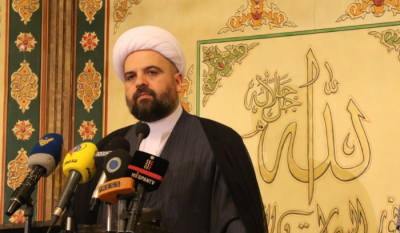
In the meeting, Berri argued, “This escalation in aggression and Israeli violations undermines the state's recovery process, stability, reforms, and sovereignty,” according to a statement, and called on the U.S. to compel Israel to immediately apply the agreement.
General Leeney confirmed that “the commission will start holding regular and permanent meetings to monitor the situation's evolution.”
At the Grand Serail, Salam delivered a similar points. “Lebanon respects the agreement, and the Lebanese Army continues its efforts to extend its deployment and fully establish its authority over the entire Lebanese territory,” he stated, before condemning Israeli violations and calling for the liberation of Lebanese prisoners.
“The Israeli withdrawal constitutes the real entry point to strengthening the state's authority and consolidating it, in parallel with Lebanon's measures to strengthen the army's capabilities in manpower and equipment,” he added.