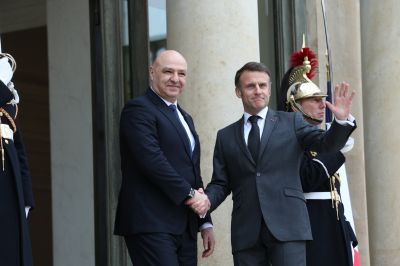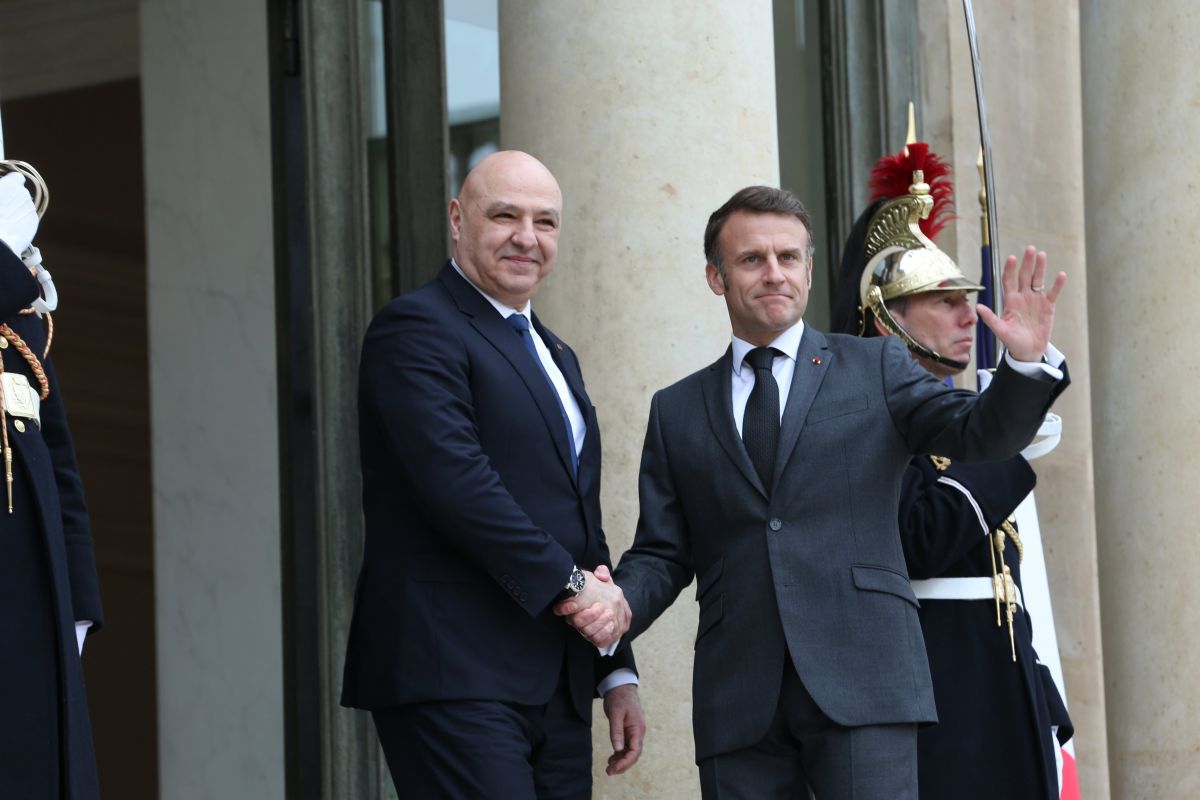
President Joseph Aoun was welcomed Friday morning at the Élysée by his French counterpart Emmanuel Macron. (Credit: Photo released by the Lebanese presidency.)






BEIRUT — In an interview with Le Figaro during his visit to Paris on Friday, Lebanese President Joseph Aoun addressed key issues impacting Lebanon, including the disarmament of Hezbollah, the Lebanese Army's efforts, the ongoing economic reforms and the country's "essential" relationship with France. Aoun also addressed Lebanon’s position on regional tensions, its stance on issues with Syria, and its commitment to sovereignty and security.
Hezbollah's disarmament and Lebanese Army role
Addressing the contentious issue of Hezbollah's disarmament, Aoun pointed to the Lebanese Army's efforts to dismantle groups with links to Hezbollah, Iran and in Palestinian refugee camps.
"The Lebanese Army has already dismantled several pro-Hezbollah or pro-Iranian Palestinian [refugee] camps: one near Beirut, two in the North near Tripoli, and three in the Bekaa Valley," he stated. Aoun added that the army had carried out more than 250 weapons seizures, including operations targeting arms caches in tunnels south of the Litani River. "Some of the seized arsenal is destroyed, but if they are usable, the recovered weapons go to the Lebanese Army," Aoun explained.
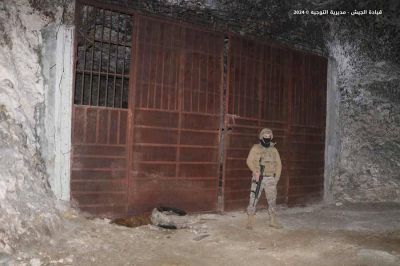
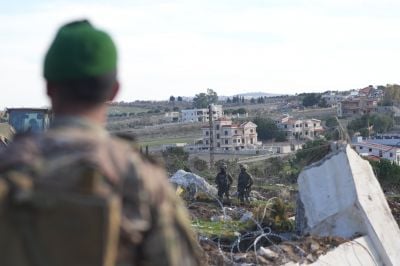
With the Lebanese Army currently numbering 77,000 personnel, Aoun underscored the need for more resources to enhance the army’s effectiveness, especially in southern Lebanon. "The Cabinet has decided to enlist 4,500 additional soldiers to intervene more effectively," he noted.
Aoun also raised concerns over the armament of Palestinian groups in Lebanon, which he said should be addressed in coordination with the Palestinian Authority. "The goal is for our army to enforce its presence in the entire territory. The state must have the exclusivity of carrying weapons," he emphasized.
Lebanon's neutrality and the Iranian axis
Aoun affirmed that France's support for Lebanon remains "essential," describing it as a cornerstone of Lebanon’s relationship with the European nation. He emphasized the deep historical ties between the two nations, noting that France is seen by many Lebanese as "their protective mother."
Aoun highlighted France’s role in Lebanon’s security, recalling the participation of French soldiers in the United Nations Interim Force in Lebanon (UNIFIL) and France's involvement in the cease-fire monitoring committee.
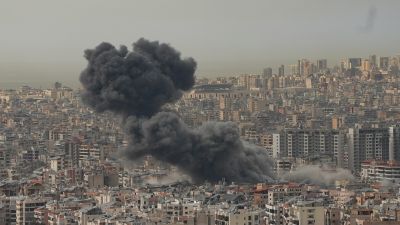
He also reaffirmed the country's commitment to United Nations Resolution 1701, which ended the 2006 war between Israel and Hezbollah. However, he accused Israel of violating the cease-fire. "Unfortunately, Israel is violating this cease-fire agreement," Aoun said, pledging to continue diplomatic efforts toward a resolution.
Asked about Lebanon’s potential exit from the Iranian-backed axis, Aoun reaffirmed the country’s stance of neutrality. "Lebanon, due to its geographical position, cannot afford to belong to any axis," he remarked. "The internal unity of the Lebanese people [is] essential" to protect the country from any danger.
On the possibility of restoring air links with Iran, which have been suspended since February, Aoun was cautious. "For now, no. One day, perhaps," he replied.
Economic reforms and relations with Syria
Turning to Lebanon's economic challenges, Aoun assured that negotiations with the International Monetary Fund (IMF) were ongoing, with reforms to be introduced in several key areas. "These reforms, which will be endorsed by Parliament, I have no doubt, will focus on three areas: fighting corruption, lifting banking secrecy, and restructuring banks," he outlined.
"The priority of priorities today lies in restoring the financial and banking structure of our country," Aoun added. He emphasized that reforms were critical for restoring both national and international confidence in Lebanon's economy. "For this, reforms, more reforms, and always reforms are needed. They are the means to restore national and international confidence. For the rest, we are trying to exercise full sovereignty, with our army and services, ensuring the nation's security in the face of terrorism, drug trafficking, and all external aggressions," he said.
Regarding Lebanon’s ongoing issues with Syria, Aoun expressed hope for progress on critical border and refugee matters. "We are going to start solving, I hope, the difficulties related to the definition of land and maritime borders with Syria, as well as the refugee problem," he said.
"All these issues are awaiting the formation of a Syrian government. The stability of Syria would positively reflect on Lebanon's stability," Aoun concluded. "We hope that this government will bring Syria back on its feet."