







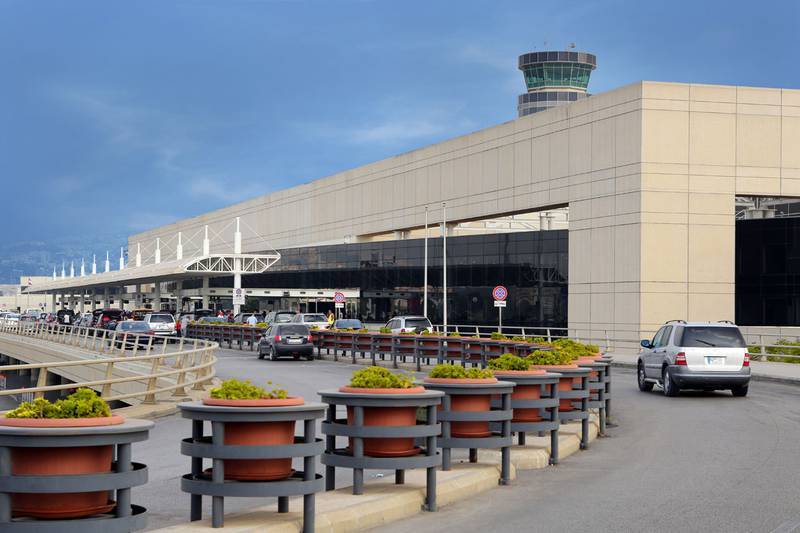
The Beirut international airport. (Credit: AFP)






The Lebanese Army yesterday announced it had arrested 850 people in the past week who were allegedly attempting to illegally cross from Syria into Lebanon. A week prior, the army said it had arrested 700 people on similar charges, claiming they intended to attempt irregular sea crossings. Numerous people- and drug-smuggling networks operate on the porous border between Lebanon and Syria, where state authority is limited. New restrictions targeting displaced Syrians in Lebanon include stripping them of “refugee status” if they cross the border back to Syria.
A Russian national arrested while attempting to leave Lebanon on suspicion of spying for Israel has been in custody for two weeks, a security source told AFP. The same source claimed the man had allegedly been recruited to spy on Hezbollah, which, the source said, tipped off security forces to his identity. The Russian Embassy in Beirut said it is working on clarifying the circumstances of the arrest and obtaining “consular access” to the detainee. Last Friday, General Security’s acting chief Elias Bayssari announced the arrest of two people with alleged connections with Israel.
After yesterday’s questioning, Financial Prosecutor Ali Ibrahim is scheduled to hold further hearings today in an investigation sparked by a forensic audit of Banque du Liban, a judicial source told L'Orient Today. The same source did not rule out the possibility of an eventual hearing with former BDL chief Riad Salameh. Lebanon’s top prosecutor ordered Ibrahim and several judicial bodies to investigate claims made by Alvarez & Marsal’s report on their central bank forensic audit. The report alleges BDL hid significant losses and spent lavish sums. Earlier this month, in comments to Reuters, Salameh denied the reports’ claims.
French President Emmanuel Macron said that a “political solution in Lebanon will involve clarifying regional interference, including that of Iran.” Macron took the opportunity to “particularly thank [French envoy for Lebanon] Jean-Yves Le Drian for the mission he is leading.” Le Drian is scheduled to return for a third visit to Lebanon in September, during which he intends to hold a dialogue between different political parties to end the presidential election impasse. In remarks published yesterday, Parliament Speaker Nabih Berri told al-Joumhouriya he would not call for a presidential election session until a consensus on a candidate is reached. Berri said he wants to avoid repeating “the failure of the 12 previous sessions.” The presidential vacuum in effect since Oct. 31 has repeatedly interfered with Parliament’s ability to legislate and caused controversy concerning cabinet’s capacity to convene.
Days ahead of the scheduled vote to renew the UN peacekeeping mission UNIFIL’s mandate in Lebanon, Hassan Nasrallah reiterated his opposition to Article 16 of the mandate as it stands. “The Lebanese government is working on ‘fixing last year's mistake’ of giving UNIFIL the right to move across Lebanon freely,” the Hezbollah leader said in a speech delivered last night. UNIFIL’s mandate is due for renewal this Thursday, after a year marked by tensions between the UN force and residents of southern Lebanon. Last year, the renewal resolution’s Article 16 granted permission to the UN force to carry out its mission “without prior authorization'” and ”independently” of the Lebanese Army. Alongside Hezbollah, the Lebanese authorities opposed the amendment but were unable to remove it. “A foreign armed force moving around Lebanon without agreement with the army is an attack on our sovereignty. … The people of the South will not allow a decision to be implemented in spite of the Lebanese government,” Nasrallah said.
Several parliamentary groups and the Lebanese Political Detainees in Syria association petitioned the United Nations to include “missing Lebanese” in their investigation of Syrian prisons. Signatories included MPs from the Lebanese Forces, the Kataeb Party, the Democratic Gathering, the Renewal Movement and several independent MPs. In June, the UN General Assembly created an independent institution to “clarify” the fate of the thousands of people who have gone missing in Syria since the start of the war in 2011. The resolution was adopted by the General Assembly with 83 votes in favor, 11 against and 62 abstentions, including from Lebanon.
In case you missed it, here’s our must-read story from yesterday: “For Washington, now is not the time to upset Riyadh”
Compiled by Abbas Mahfouz