






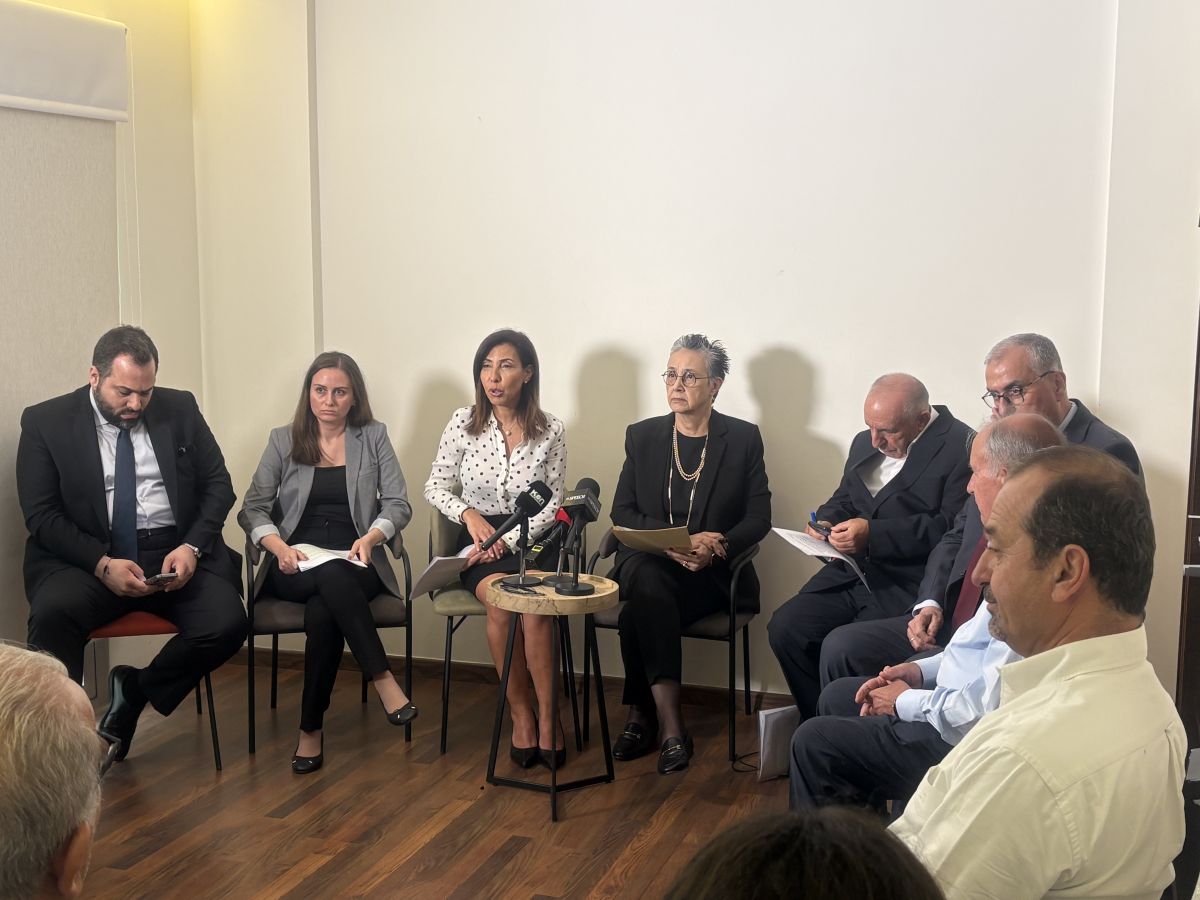
MPs Halima Kaakour and Najat Aoun Saliba (center) during the press conference to announce the filing of an appeal against the decision to reopen cement plant quarries, on April 28, 2026. (Credit: S.B/L'Orient-Le Jour)






Civil society has organized opposition to the government of Prime Minister Nawaf Salam’s decision allowing the reopening of cement quarries, particularly those in Koura (Chekka), in sites mainly located in the two villages of Kfar Hazir and Badbahoun.
MPs Najat Aoun Saliba and Halima Kaakour, in cooperation with Legal Agenda and local Koura associations, held a press conference Tuesday to voice their rejection of the resumption of activity at these quarries and to announce their submission of a petition for annulment before the State Council.
The decision to grant a one-year permit, renewable for up to 10 years, for the operation of cement quarries was first adopted on April 9, on the proposal of Industry Minister Joe Issa al-Khoury, giving regional municipalities two weeks to grant or refuse their approval.
With the refusal of this timeframe by the municipalities, especially that of Kfar Hazir, the decision was reaffirmed at the last Cabinet meeting. The initial decision had sparked disagreement between the industry minister and Environment Minister Tamara El Zein, but at the last government meeting, Zein submitted a revised version of the decision with stricter environmental criteria.
For the civil society groups gathered Tuesday, the result is unchanged: Even if the quarries are reopened under a legal framework, the measure remains “unacceptable.”
In a statement, the MPs and environmentalists denounced the “illegal” nature of the decisions of April 9 and 23, arguing that the quarry sites “do not comply with the only master plan in force in Lebanon, dating to 2002 [amended in 2009], which restricts quarrying zones to the Anti-Lebanon” mountain range in the Bekaa, while Koura is in Mount Lebanon.
The text, read by Kaakour, emphasized that the rejection expressed by local authorities was ignored. It also denounced “a waste of public funds because these permits are not conditioned on payment of arrears demanded from quarry owners [across Lebanon] for environmental damage caused by their operations.”
In general, the statement accused the government of “favoring the interests of companies over the public interest.”
For her part, Saliba criticized the justifications made for the decision, particularly those relating to the need to supply the market with cement, stressing that this did not warrant the disappearance of mountains. “The solution is simple: reduce import taxes on raw materials and break the local production monopoly, which would lower prices and reduce pressure on Lebanon’s environment,” she said.
Environmentalists from Koura highlighted the impacts of the quarries on local populations. Georges Inati, coordinator of the Kfar Hazir Environment Committee, insisted that “cases of cancer and respiratory diseases are widespread in households in [his] village due to emissions rich in sulfur and pollutants.”
Fares Nassif, president of the Raseef al-Ard association, said that Koura residents “have clearly expressed their refusal of the quarries’ reopening, contrary to what the companies and the government claim.”
Bassam al-Kantar, a member of the National Human Rights Committee, emphasized that the right to a healthy environment is a human right. He stressed the need to grant the High Council of Quarries the necessary authority to make decisions independently of the political establishment, to stop ignoring local authorities, and to avoid in the future the issuing of temporary quarry operation permits.

 8 p.m. recap: Israel again threatens Beirut’s south suburbs; 2 ships hit near Hormuz; Riyadh football matches canceled