






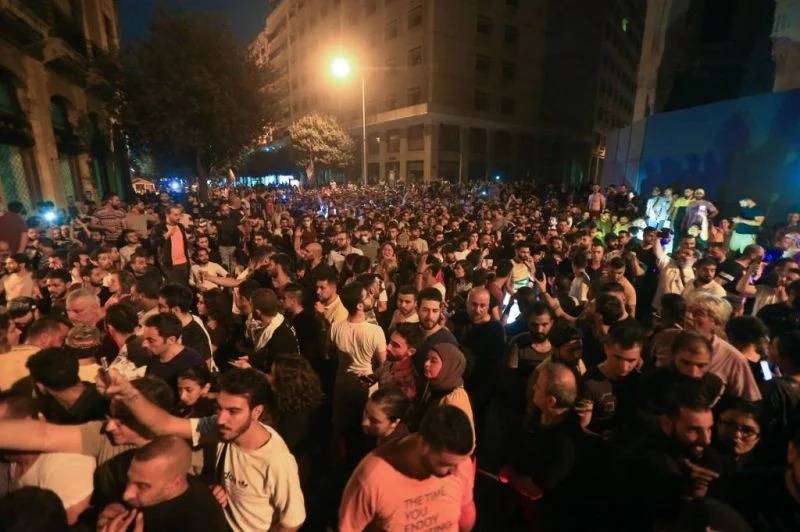
Demonstrators gather at a demonstration during the protest movement that arose following an Oct. 17, 2019 government decision to tax calls made on messaging applications. (Credit: AFP)






"A third year has passed and the authorities are still trying to revitalize themselves without any will to revitalize the nation," collectives from the Oct. 17, 2019 popular protest movement said in a statement calling for demonstrations today to mark the third anniversary of the start of the uprising. Three years ago protests erupted across Lebanon and escalated over the following weeks and months with hundreds of thousands taking to the streets to express discontent with the political class. The protests led to then-Prime Minister Saad Hariri’s resignation. Several collectives have announced demonstrations for today at 4:30 p.m. at Martyrs’ Square in Downtown Beirut. They plan to observe a minute’s silence in memory of "the martyrs of Oct. 17" and then head towards Parliament on Nejmeh Square. Over the course of the monthslong protests in 2019 and early 2020, security forces repeatedly clashed with protesters. Earlier this month, Forces of Change MP Cynthia Zarazir filed a lawsuit against parliamentary police and Lebanese Army soldiers for "repeated attacks against protesters" and "intentional hurt." Zarazir is one of 13 MPs associated with new independent movements connected to the Oct. 17 uprising.
Qatar’s intention to join the consortium licensed to explore Lebanese offshore oil and gas blocks is the latest bellwether of international support for the maritime border agreement between Lebanon and Israel, recently praised by both France and the United Nations. The US-mediated deal received approval from Lebanese and Israeli officials after drawn out negotiations, prompting a slew of congratulatory statements from international actors. French President Emmanuel Macron and UN Secretary-General António Guterres spoke of positive repercussions for the “region.” Macron added his commitment to ensuring French energy company TotalEnergies would uphold its commitments as part of the energy consortium, in which it partners with Italian energy company Eni and the Lebanese state — and, potentially, according to a Friday statement by caretaker Energy Minister Walid Fayyad, Qatar. The maritime border deal has yet to be submitted to the United Nations; however, a Friday statement from Parliament Speaker Nabih Berri casts doubt on whether MPs will have a say on it before it goes to the international organization. Berri last week ordered that MPs receive a copy of the agreement after calls from parliamentarians to be involved in the approval process, but the speaker on Friday said the US mediation bypasses the need for parliamentary approval for the deal.
Electing a new Lebanese president before the constitutional deadline “is still possible,” French Foreign Minister Catherine Colonna said Friday, while Parliament is scheduled to convene Thursday for a third attempt at electing a successor to Michel Aoun. Colonna’s statement came the day after Parliament failed to reach a quorum during its second presidential election session. The French minister on Friday met with the Lebanese president, prime minister and Parliament speaker during a one-day visit to Lebanon. According to the French Embassy in Lebanon, Colonna aimed to reiterate France’s “commitment to the proper functioning of Lebanon’s institution” in the wake of the approaching election deadline and to urge the implementation of International Monetary Fund stipulated reforms required to unlock financial assistance in the face of the worst economic crisis in Lebanon’s modern history. “The entire international community is waiting for the election of a new president,” Colonna said in a press conference prior to her departure, calling on authorities to implement reforms and “live up to their responsibilities.” Meanwhile, political groups have failed to reach consensus on designating the next head of state. Statements on Saturday and Sunday respectively from Free Patriotic Movement and Hezbollah bloc heads expressed the groups’ expectations of the next president, after the FPM MPs cast blank ballots in the first round and boycotted the second of voting on the matter. Greek Orthodox Archbishop of Beirut Elias Audi yesterday criticized perceived pickiness from politicians over presidential candidates, just 11 days before the end of Aoun’s term. Meanwhile, collectives associated with the Oct. 17, 2019 popular uprisings said in a joint statement yesterday that they “ask the Lebanese people to meet on Thursday, Oct. 20, 2022, the day of the third session devoted to the election of a president" in an effort to “force the election of a president” and described previous sessions as “sterile.”
“The expected joining of Lebanon to the oil-producing countries requires us to speed up the implementation of reform,” Economy Minister Amin Salam said Friday, assuring his commitment to implementing the International Monetary Fund’s stipulations for unlocking multibillion dollar assistance for Lebanon. Officials from the fund and international actors have repeatedly castigated Lebanon’s delay in implementing reforms set in an April preliminary agreement. Modest progress made by Lebanese authorities includes passing a budget law for the current year, progress on revising the banking secrecy law and attempts at unifying the lira to US dollar exchange rate. Salam’s statement echoed that of French Foreign Minister Catherine Colonna, who tempered praise of the maritime border agreement by highlighting that it is “not a substitute for the economic and financial reforms.”
Mass return plans for Syrian refugees set to start this week would put the displaced at “risk of suffering from heinous abuse,” Human rights watchdog Amnesty International warned Friday. “The Lebanese authorities are scaling up the so-called voluntary returns … when it is well established that Syrian refugees in Lebanon are not in a position to take a free and informed decision about their return,” Amnesty’s acting deputy director for the Middle East and North Africa, Diana Semaan, said. On Wednesday, President Michel Aoun revived plans for the mass repatriation of Syrian refugees, announcing that the return of displaced Syrians would start this week, with 1,600 passengers aboard the first return trip. The United Nations refugee agency, UNHCR, the same day denied involvement in any return plans, as it had done when the notion was first proposed in July. That month, while Lebanese authorities announced a plan aiming to return “15,000” displaced Syrians each month, UNHCR relayed refugees’ concerns over “safety and security; housing; and access to essential services and livelihoods.” The international agency also called on authorities “to ensure [Syrian refugees] continue to be safe and protected in Lebanon.” General Security head Abbas Ibrahim on Wednesday said Lebanon “will not wait for a green light from [the international community] to resume the return,” adding that international actors’ stance on return plans "could change" due to the increasing number of irregular migration attempts from Lebanese coasts. Syrian nationals comprise a large number of irregular migrants departing Lebanon toward Europe to escape increasingly deplorable living circumstances. In addition to hardships caused by Lebanon’s economic collapse, refugees reported in August intensified pressure and a tightening of restrictions, including “arrests at checkpoints of those with no legal papers, raids on camps, adoption of stricter movement rules, and tensions between host and refugee communities.”
In case you missed it, here's our must-read story from the weekend: “Tayyouneh clashes: One year later, questions remain unanswered”
Compiled by Abbas Mahfouz

 7 p.m. recap: Iran warns Egypt, Israeli soldiers vote in south Lebanon, Haret Hreik responds to Kataeb