






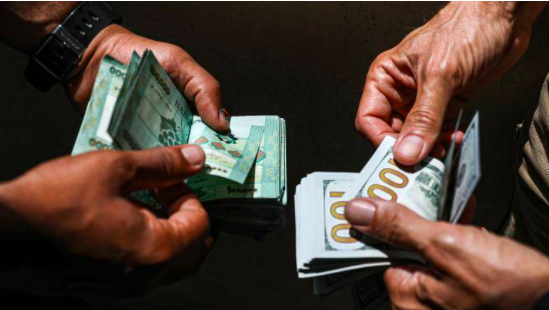
Starting today, international card holders should be able to make ATM withdrawals at the Sayrafa exchange rate. (Credit: AFP)






Want to get the Morning Brief by email? Click here to sign up.
Starting today, international card holders should be able to make ATM withdrawals at the Sayrafa exchange rate. In the latest move by Banque Du Liban towards making the Sayrafa rate the de facto local and international benchmark for the US dollar to lira exchange rate, the Sayrafa rate will now be used for all fresh and all international card payments, including point-of-sale and e-commerce transactions, as well as ATM withdrawals. The central bank platform’s rate will be published daily on the BDL website. Banking sector sources told L’Orient Today that ATMs should start dispensing Lebanese lira at the Syarafa rate today for holders of international and local fresh cards. However, local fresh cards are currently not being recognized yet by the merchants’ point-of-sale terminals as fresh US dollar cards, a supposedly temporary glitch in the latest scheme concocted by the central bank to flex its muscles. Some believe these quick fixes in lieu of a solid long-term financial recovery plan are a mere establishment ploy to ease tensions and appease voters in the runup to parliamentary elections in May. Meanwhile, according to a financial ‘recovery’ proposal seen by Reuters, Lebanon’s ruling class plans to make depositors bear the brunt of the spectacular losses needed to close a $69 billion gap, a scenario widely understood to have been engineered by those same leaders.
“Flagrant violations in pricing” were discovered at supermarkets following the recent sizable drop in the lira to US dollar exchange rate. Following an inspection of pricing at Beirut stores by the Economy Ministry yesterday, the ministry’s director-general, Mohamad Abou Haidar, noted that the lowered lira to US dollar exchange rate, which went “from LL30,000 to around LL20,000,” should be “met with a proportional decrease in prices.” Abou Haidar warned that supermarkets that failed to comply with price adjustments might face “greater fines.” The lira-to-dollar exchange rate climbed to around LL20,800 after it reached a high of LL33,700 in mid-January. Economy Minister Amin Salam had, in response to the lira’s recent appreciation, requested import and supermarket syndicates to lower their prices accordingly. Hani Bohsali, head of the food importers’ syndicate, said in a Jan. 17 statement that food importing companies had begun to “introduce new prices in line with the lira-to-dollar exchange rate.”
Lebanon registered a record 10,760 new COVID-19 cases yesterday. Despite this worrying increase of nearly 50 percent compared to the previous 24 hours, Health Minister Firass Abiad maintained at a press conference that there remains no need for a countrywide lockdown, although he warned against easing measures “like other countries,” without elaborating. While case numbers spiked yesterday, the number of hospitalizations and ICU admissions connected to the coronavirus remained relatively steady, with occupancy rates at 65 percent and 73 percent respectively.
Roadblocks caused disruptions across Lebanon yesterday during a day filled with strikes and protests. Owners of public vans and vehicles closed the international road at the Aley roundabout by placing vehicles in the middle of the road, as others blocked the Tripoli-Beirut and Sur highways. Port workers in Tripoli carried out a sit-in in front of the Union of Port Workers headquarters in solidarity with the land transport unions, on the first day a planned three-day strike by the latter. However, land transport unions head Bassam Tleis announced yesterday evening that he asked his union to cancel today’s strike, saying he “will give [the government] a one day chance” to address the challenges faces his sector as a result of the country’s ongoing economic crisis, alluding to the outcome of the 9 a.m. cabinet meeting scheduled for today. EDL workers, meanwhile, went on strike yesterday to protest dire circumstances at the state electricity provider, while the residents of Khiam in the Nabatieh area carried out a sit-in in front of the municipality building to object to the high unjustified cost of generator subscription bills. They also called on the Economy Ministry to “move urgently and control hiking prices in shops and supermarkets.” Education Minister Abbas Halabi announced that today will be a “regular teaching day,” calling for schools and universities to reopen after they were instructed to close yesterday due to potential road blockages.
Separately, a protest in Zahle highlighted one of the country’s many overlooked issues: an increase in random acts of brutal violence. Members of the Lebanese Dental Association in the Bekaa protested the murder of their colleague the day before by holding a sit-in at the Zahle Justice Palace. Elie Jasser was stabbed to death in his clinic over a dispute concerning the dentist’s supposed treatment of the alleged assailant’s fiance.
In case you missed it, here’s our must-read story from yesterday: “Activists ‘cautiously optimistic’ after formation of anti-corruption commission”