At the same time, beat the eggs with the sugar and the corn flour (cornstarch).
Pour everything over the boiling lemon juice. Stir constantly until the mixture thickens.
Remove from the heat and chill until it reaches room temperature.
Add the cold butter in small pieces and blend with an electric mixer.
Keep in the refrigerator overnight.
Assembly:
Line a tart tin with the shortcrust pastry and bake for 20 minutes at 180 degrees.
When the tart base is done baking and has cooled, add the lemon cream.
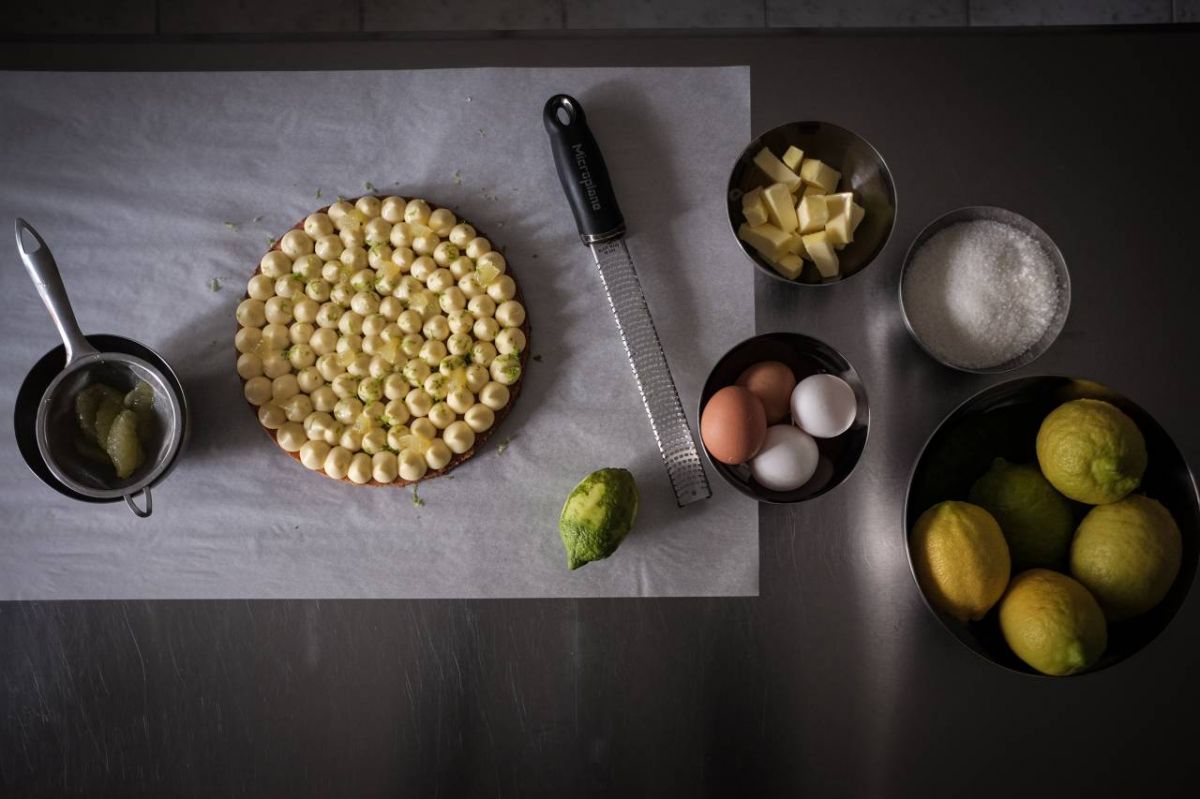
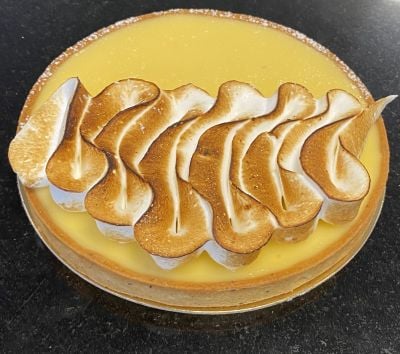
For the daring ready to take on the challenge and perfect the tart’s decoration, use a piping bag and fill it with the lemon cream.
Pipe it onto the tart in the shape of drops, moving in a circular motion from the outside toward the center.
Refrigerate for at least 1 hour before serving.
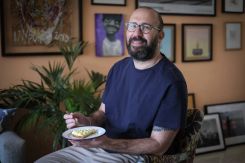
Raja Farah and his lemon tart, which remains one of his bestsellers. (Credit: João Sousa)
The story of Raja Farah and his two grandmothers
"I have always been amazed to see that the best chefs in the world are men, while cooking is a women's affair," says Raja Farah, before adding: "All my life, I have been surrounded and inspired by the women in my family, my mother and especially my two grandmothers: Samira, on my father's side, and Marie Daher, on my mother's. I learned by watching them prepare our family meals, which regularly brought together about forty people and filled the house with life. I learned the method, but also the importance of the moment: bringing people together, reconnecting around a meal."
From the height of his five years, he also confides, "I loved the kitchen, pastry exclusively, eating and observing. The transformation of an ingredient into something fantastic fascinated me."
It was at five years old, too, that he received from his mother Fadia — who noticed this emerging and almost natural passion — a book, his first cookbook, entitled Pâtisserie et cuisine.
"I still have it…" Little by little, "it was wartime, in the middle of the '80s," he tried out cake recipes with more or less success—or failure. "I remember the day when, during a cease-fire that usually lasted two hours, I just had time to make a cake I wanted to be vanilla. My mother was out, I was stressed while waiting for her, impatient to put it in the oven before the fighting resumed."
Mission accomplished and then a dash to the shelter a few minutes later, where the kind neighbors and family tasted this dessert, congratulating the very young self-made pastry chef, "but actually, it was awful, and they didn’t want to hurt my feelings! I had put salt instead of sugar…"
These clumsy beginnings did not stop Raja from eventually following his heart. Even though he would pursue literary studies to please his family and not cook a single dish during his studies in the United States, "much later," while working as a copywriter in advertising, this first love, as if obvious, caught up with him.
At 33, he set off for France, earned a diploma as a pastry chef from Ferrandi, the French school of gastronomy and hospitality management, multiplied internships in prestigious places including the Plaza Athénée, then came back to Lebanon where he created his "little custom cake business," which he named Les Mauvais Garçons.
Happy to create, to compose, to please, Raja Farah spent five joyful years before the thawra, COVID-19 and then the economic crisis forced him to put this project away — temporarily, one hopes.
How do you price a cake? How do you make sure you find the (right) ingredients? At what price? How do you work under these conditions, with unreliable electricity and dependence on mafias? "It’s too much stress," he says to himself.
"Pastry is therapy, a moment of relaxation that I no longer have and which can no longer happen under these living conditions. For now, I prefer to make a few pastries for pleasure, while waiting…"
While also waiting for a return to a sweeter world, Raja Farah writes. On social networks and under the pseudonym Oh My Happiness, he has gathered the best of his emotional vignettes — which he has shared since Oct. 17, 2019, between anger, nostalgia and sadness — in a book titled 291 Days, Chronicles from Thawra to the Beirut Blast.
"Samira died when I was only 12, Marie when I was 40. But as an adult, their presence and their culinary influence are very strong."
In partnership with
Recipe tips : Add lemon zest or slices of candied lemon to give it an extra touch of acidity.
In 2014, Raja Farah changed careers to pursue pastry making. After spending a year in France to obtain a pastry chef diploma from the French gastronomy school Ferrandi, and after completing internships at the Plaza Athénée and with chef Jean-François Piège, he returned to Lebanon and opened a small custom cake business called « Les Mauvais Garçons ».
In 2014, Raja Farah changed careers to pursue pastry making. After spending a year in France to obtain a pastry chef diploma from the French gastronomy school Ferrandi, and after completing internships at the Plaza Athénée and with chef Jean-François Piège, he returned to Lebanon and opened a small custom cake business called « Les Mauvais Garçons ».
Offer sent. We hope to welcome you among our subscribers.
Would you like to support L’Orient Today?
Lebanon is in danger of collapse. We need you more than ever. By supporting us, you will allow us to continue to fulfill our mission and provide you with continuous, independent, quality information.
Offer sent. We hope to welcome you among our subscribers.
Would you like to support L’Orient Today?
Lebanon is in danger of collapse. We need you more than ever. By supporting us, you will allow us to continue to fulfill our mission and provide you with continuous, independent, quality information.