





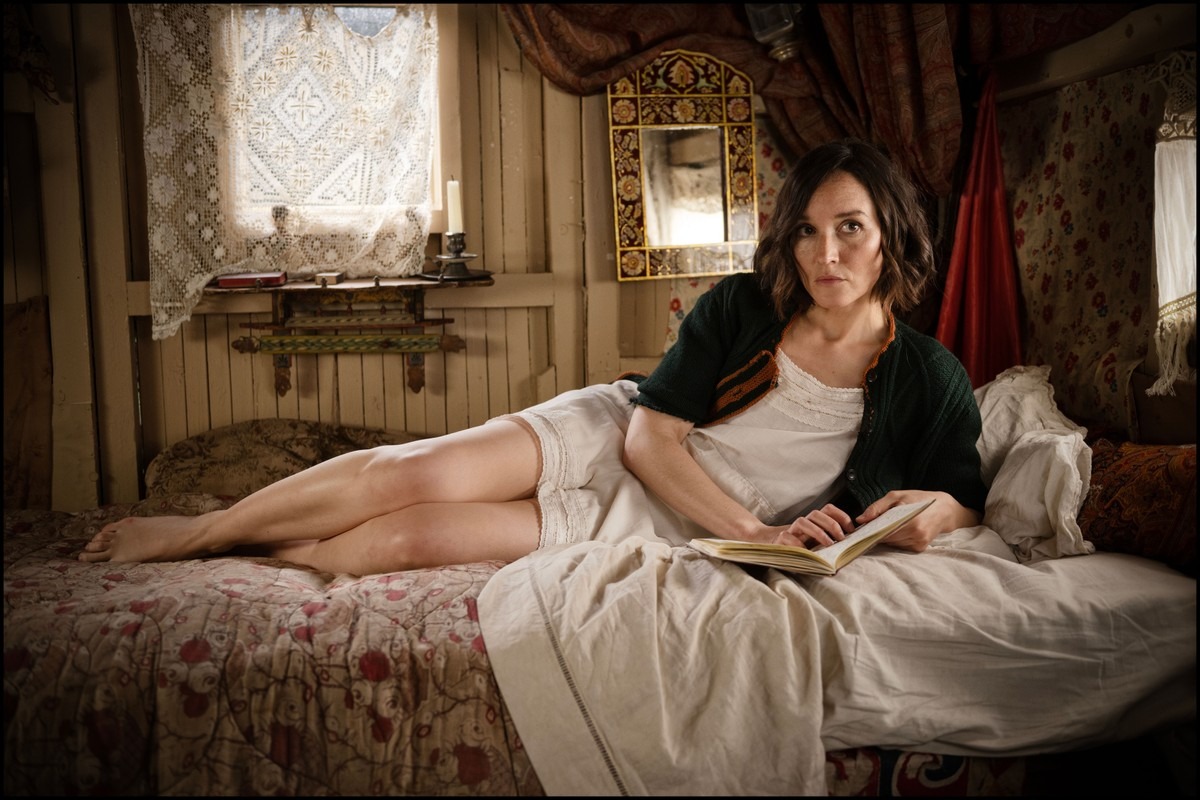
Anaïs Demoustier in the role of Suzanne in the film "La Vénus électrique" by Pierre Salvadori. (Credit: Guy Ferrandis/Frenetic films)






An inconsolable painter, a fairground worker posing as a fortune teller, and a gallerist willing to maintain the deception: The European Film Festival in Lebanon will open its 30th edition under the banner of emotion and imposture.
"The Electric Venus," by Pierre Salvadori, will be screened Thursday, Oct. 8, at 7 p.m. at Metropolis cinema in Beirut. This French-Belgian co-production, also selected to open the 2026 Cannes Film Festival, brings together Pio Marmaï, Anaïs Demoustier, Gilles Lellouche, and Vimala Pons.
Set in Paris in 1928, the film follows Antoine Balestro, a fashionable painter who has lost all interest in working since his wife’s death. One drunken evening, he believes he has found a way to communicate with his late wife through a fortune teller. But Suzanne, his interlocutor, is a modest fairground worker who entered the caravan to steal something to eat. She seizes the opportunity and plays along.
Armand, Antoine’s gallerist, soon helps her organize fake séances, hoping to get his protégé back to work. Inspiration returns, but feelings complicate the arrangement when Suzanne falls in love with the man she is deceiving. Shown in French with English subtitles, the film will be screened again Oct. 17 at 5 p.m.
Organized by the Delegation of the European Union to Lebanon, under the patronage of the Ministry of Culture, in partnership with the Metropolis Association and in cooperation with EU member states, the festival will run through Oct. 17. The program currently includes 25 titles, several of which will have a second screening.
On Oct. 9 at 6:30 p.m., "Young Mothers," by Jean-Pierre and Luc Dardenne, will follow five teenage girls living in a mother-and-child home as they seek to build a better life for themselves and their children. The film won the Best Screenplay award at Cannes in 2025. That same evening, at 8:30 p.m., "Late Shift," by Petra Volpe, starring Leonie Benesch, will take audiences into a Swiss hospital alongside a nurse coping with the demands of an understaffed service.
The lives of artists also feature in the selection. "Chopin, Chopin!" by Michał Kwieciński, screening Oct. 9 at 8:45 p.m., focuses on the composer in Parisian circles as illness makes creation more urgent. The next day at 6 p.m., "Franz," by Agnieszka Holland, follows Kafka’s journey between his desire for an ordinary life and his need to write. With "Romería," by Carla Simón, screening Oct. 11 and 15, the search is a family one: A young woman joins relatives she does not know and discovers the silences surrounding her parents.
On Oct. 12 at 6 p.m., "A Simple Accident," by Jafar Panahi, winner of the 2025 Palme d’Or and a French-Iranian-Luxembourg co-production, will be among the selection’s highlights. Two days later, at 7 p.m., "Nouvelle Vague," by Richard Linklater, will revisit the filming of "Breathless." Jean-Michel Frodon will introduce the screening.
Cinema history also runs through this edition. "The Maids of Wilko," by Andrzej Wajda, will be screened Oct. 9 at 6 p.m., marking the centenary of the director’s birth. On Oct. 12 at 7 p.m., a restored print of "La Ragazza di Bube," by Luigi Comencini, will be shown in tribute to Claudia Cardinale. "The Turin Horse," by Béla Tarr and Ágnes Hranitzky, will follow Oct. 13 at 6 p.m., in homage to Tarr. Jean-Michel Frodon will introduce the latter two screenings.
Animation will also feature, with "Les Contes du pommier" on Oct. 12 at noon and "Arco," by Ugo Bienvenu, the same day at 4 p.m.
Finally, Lebanese cinema will be represented by "Dead Dog," by Sarah Francis, on Oct. 15 at 7 p.m., with the film’s team in attendance. Set in a mountain house, the film follows a couple separated by years of living abroad as they confront what remains of their life together.
See the full program on the Metropolis website.

 7 p.m. recap: Iran warns Egypt, Israeli soldiers vote in south Lebanon, Haret Hreik responds to Kataeb