





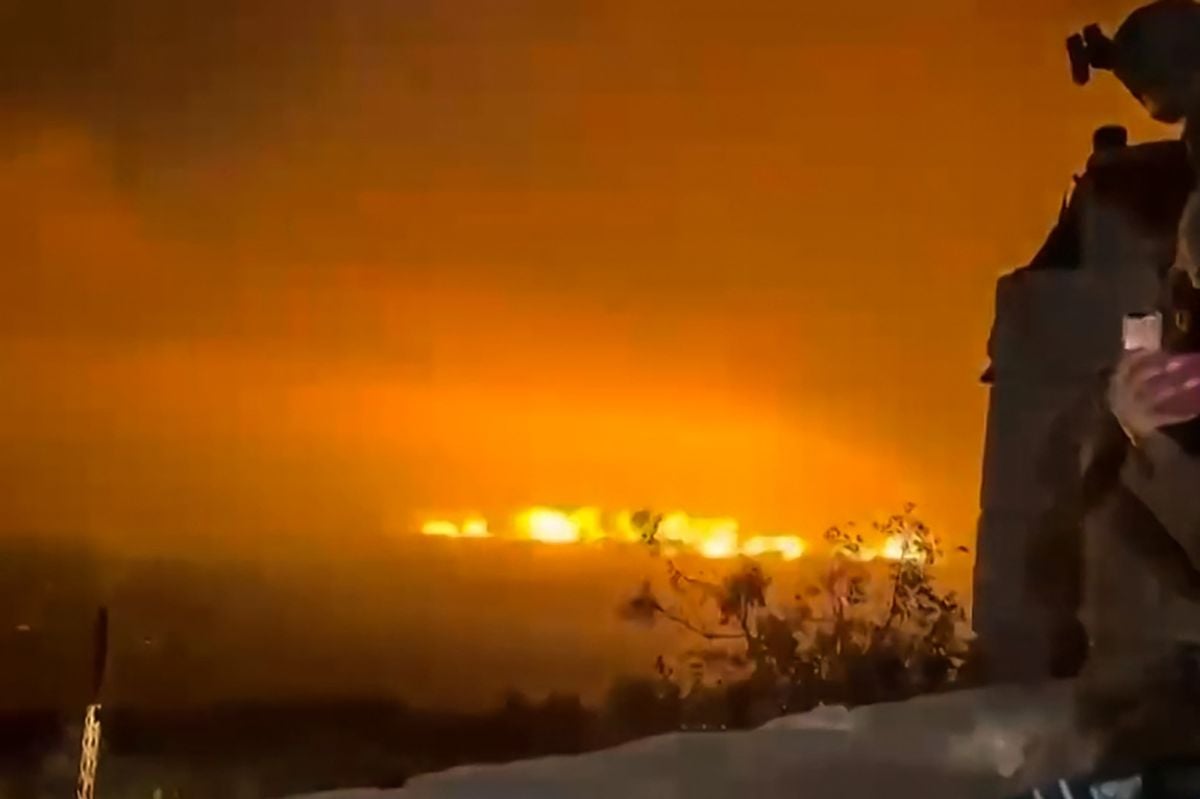
This screenshot, taken from a video shared on X by Israeli Defense Minister Israel Katz on Sept. 10, 2026, shows the moment Israel dropped massive explosives on Ali Taher, southern Lebanon. (Photo X / @ISRAEL_KATZ/AFP)






SOUTH LEBANON — Thursday night Israel began executing its previously threatened operation on the Ali Taher hill, a strategic point south of Nabatieh, with massive explosions sending shockwaves that were felt across southern Lebanon.
According to the Israeli website Ynet, Israel is reported to have blown up "tunnel infrastructure" on the Ali Taher hill using more than 1,100 tonnes of explosives, following threats from Israeli Prime Minister Benjamin Netanyahu. Our correspondent in the region said the first site they blew up is believed to be a Hezbollah tunnel near Kfar Tibnit, with three explosions reported on the area.
Israeli Defense Minister Israel Katz stated on Thursday that the Israeli army had “destroyed Hezbollah’s underground infrastructure” on the Ali Taher hill in southern Lebanon, thereby, he claimed, completing the establishment of the Israeli “security zone” in the south of the country.
Israeli Prime Minister Benjamin Netanyahu had also stated that Israel was in the process of "dealing with" the Ali Taher ridge, over which he claimed Israeli forces gained "operational control" a week ago.
Magnitude 4.1 tremor
A week ago, Israel announced it had "taken operational control" of the Ali Taher hill, on the heights of Nabatieh. This announcement coincided with Israel's release of five detainees, Lebanese and Syrian. Since then, the prospect of a new operation against Nabatieh seemed to be taking shape. But in recent days, the deployment of the Lebanese Army in the city — greeted in particular in Washington — helped to cool tensions in this major city of Jabal Amel. On Thursday evening, as the Israeli prime minister threatened to "deal with" Ali Taher, the ground began to shake under the feet of residents in southern Lebanon.
The massive explosions sent shockwaves across southern Lebanon that could be felt as far as Saida, situated some 40 kilometers from Ali Taher. Lebanon's Seismological Center reported that the explosions on Ali Taher caused a shockwave measuring 4.1 on the Richter scale, recorded at 9.08 p.m. local time in southern Lebanon, 13 km west-south-west of Nabatieh Tahta, according to the U.S. Geological Survey (USGS). Its epicenter was at a depth of 10 kilometers.
Explosions of this magnitude cause a tremor due to the violence of the detonation. It is therefore not an earthquake caused by fault movement. However, the danger of this explosion at Ali Taher lies in its proximity to the Roum fault, one of Lebanon's main fault lines, and the risk, even if minimal, of a triggered earthquake on this fault. The same risk was discussed at the end of July, when a massive explosion was caused by the Israeli army to destroy a network of tunnels attributed to Hezbollah under the hill of Shqif, near Beaufort Castle. The Israelis then used some 700 tons of TNT and generated seismic waves equivalent to a tremor of 3.8 on the Richter scale, according to the National Council for Scientific Research (CNRS). The areas of Shqif and Ali Taher are both close to this same major fault.
Following the explosions, Israel raised its alert level amid fears of an Iranian retaliation, according to the Israeli website Ynet.
A week ago, Iran had warned the United States that it would respond forcefully to any Israeli offensive against Ali Taher Hill, three officials familiar with the content of the message told Reuters on condition of anonymity.
Upcoming negotiations
Just moments before the major Israeli explosions at Ali Taher, Israel's public broadcaster Kan reported that an eighth round of negotiations between Israel and Lebanon is due to take place on Sept. 15 and 16 in Rome. The aim of this round is reportedly to establish a “force tasked with ensuring that the pilot areas have been completely cleared of any Hezbollah presence,” according to the Israeli public broadcaster Kan. So far, only three "pilot zones" were identified by Washington at the end of July.
In accordance with the framework agreement between Beirut and Tel Aviv, brokered by the U.S., the Israeli army is to withdraw from these areas, whilst the Lebanese Army is to deploy there to dismantle infrastructure and confiscate Hezbollah’s arsenal. On Wednesday, the Lebanese Army presented a detailed report on its activities in the "pilot zones."
The last round of talks took place last month, from August 4-6, also in Rome. It was marked by an Israeli escalation in southern Lebanon.
No date had subsequently been officially set for the next round of negotiations between Lebanon and Israel. On Wednesday, a spokesperson for the U.S. State Department told the Iraqi channel Shams TV that a round of talks would take place in Rome "soon."
Israel has killed at least 4,383 people and injured 12,406 others in Lebanon since March 2, according to the latest figures released by the Health Ministry.
The Ministry has recorded two further deaths and four additional injuries since its previous update on Monday. Notably, one person who was injured in an Israeli drone strike on Zibdin (Nabatieh) on Wednesday later succumbed to his wounds and was pronounced dead.
In total, Israel has killed at least 8,948 and injured 30,638 others since the start of its ongoing onslaught against Lebanon in October 2023.
Reporting contributed by our correspondent in southern Lebanon, Muntasser Abdallah.

 7 p.m. recap: Iran warns Egypt, Israeli soldiers vote in south Lebanon, Haret Hreik responds to Kataeb